Monday, 7 January 2013

Eight Christmas Parties...{sigh}

I can remember back when I had only had Christmas at home (or with Mom) and a party at work.  

Britain's most elegant WI committee.


Just those two events.  No wonder I was skinnier in my youth!


Yes, I'm nearly blonde again (that's me in black & purple).


Turns out that any work or social group of people here in Britain will have their own Christmas do.  


Charlotte is teething and not v. happy about it.


I'm surprised I didn't end up having a party with the people gathered at the pedestrian crossing, waiting for the light to change.  


Uncle Simon is good with babies!

I had (1) Christmas-y snacks with the ladies in the craft group.  (2) A three course pub lunch with the sewing ladies (parsnip soup, roast beef and gravy with mixed vegetables, chocolate cake with white chocolate icing - which I couldn't finish.  (3) A champagne pot luck with the WI.


Vivien won the big prize again this year, a bottle of champers.  I've no idea who she pays or how much, but with her luck she really ought to buy a lottery ticket.  


We had a quiz where, as usual, I didn't even understand the question never mind know the answer. 


Good job she couldn't see his slippers.


I did have enough Latin to know that the city with the name that means 3 cities was Tripoli, and I did know that Ringo was the oldest Beatle, so I had a good night after all.


Then Grandpa took over.

Bill had a walking club gathering / party at a pub somewhere in there, but of course I wasn't involved in that one.


Auntie Sarah's not very maternal (yet).


Bill and I both attended (4) the running club Christmas party.  


She seemed to want to chew on my fingers...(I'd just washed them).


As out-going chairman, it was my job to MC the traditional festivities, including various awards / trophies.  Bill ran the raffle.

We also (5) met up with Vivien and Steve for a Christmas meal at a local pub.  It was excellent food and great company.  This is one tradition I'd like to keep!


Chris always goes all out. That's a ham & turkey pie.
We started with smoked salmon.
Bill and I opened our presents to one another on Christmas Day and had a (6) very special steak dinner that night, with all the trimmings.  


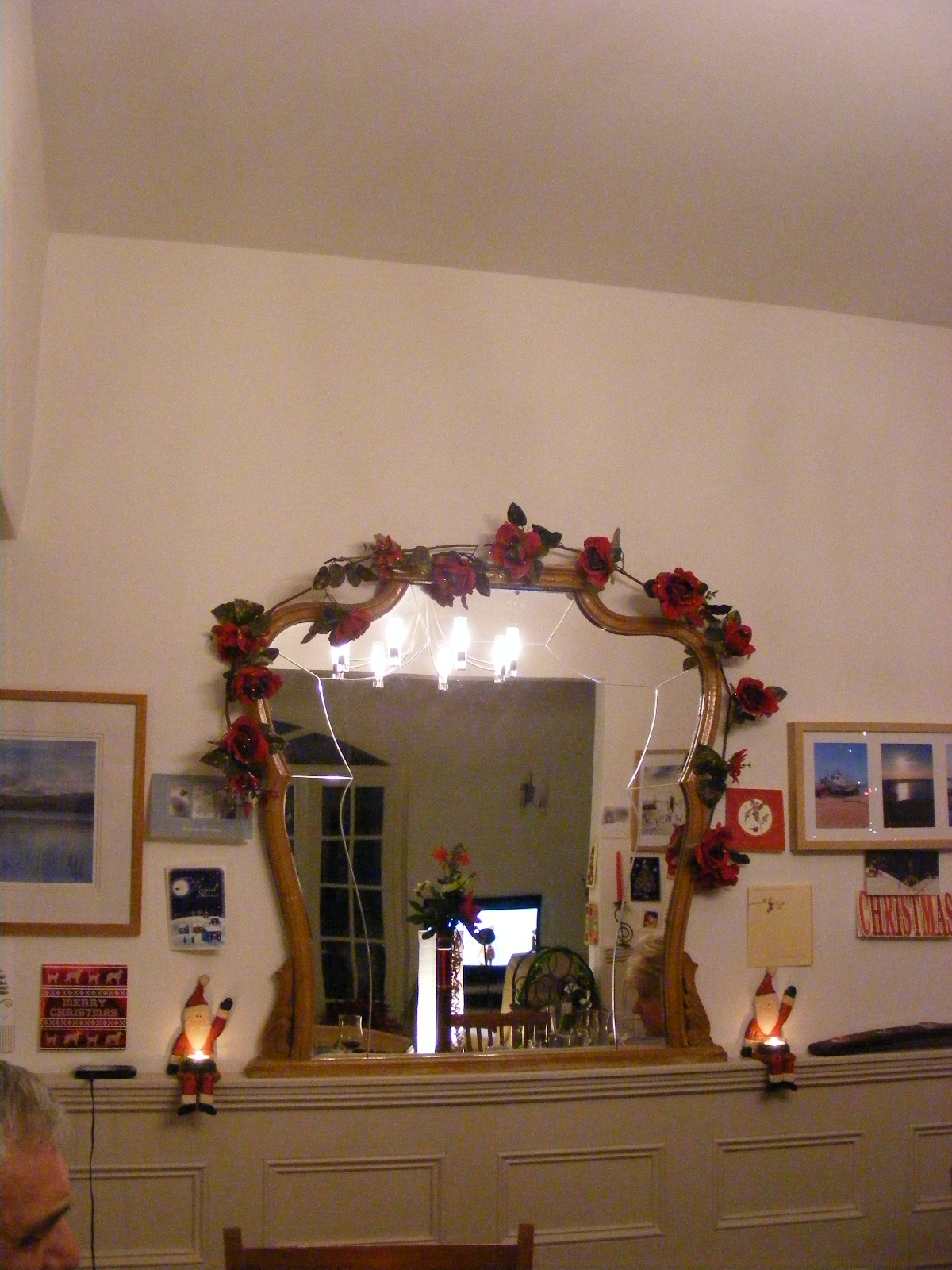
The dining room mirror.


Bill's children and Princess Charlotte (the first grandbaby) joined us on Boxing Day for the (7) traditional British Christmas luncheon, only with ham instead of turkey.   I remarked that I wondered what we had talked about B.C. (Before Charlotte).


I never met Trifle til' coming to Britain....heaven.


The day-after-Boxing-Day we went to the newlyweds (Bill's cousin Mike and wife Chris) for (8) yet another sumptuous meal.


The conservatory


I was less than excited about this, I must admit.  


Some of the tree ornaments.


Already tired and bloated, I dreaded it, but as usual I enjoyed myself once we were there.  


The  !second! tree.


Mike & Chris were still getting over dreadful colds / flu.  


Christmas cake... I just couldn't...  We finished with
a cheese board.


I was surprised they carried on with the entertaining, but Chris had obviously put in a lot of effort.  


The back garden even.


Mike showed us his new toy, a 3D TV.


The Queen in 3D ... a little startling.


I joined a gym the next day.

Friday, 4 January 2013

Part XXI - Aping the Upper Class

This is part of a series discussing The Theory of the Leisure Class, by Thorstein Veblen.  Chapter Five is titled The Pecuniary Standard of Living.  


After obtaining what is needed for basic comforts, Veblen admits that most people don’t consciously spend money on the luxuries in order to make others envious.  He thinks this habit is more a desire to live up to the conventional standard of ‘decency’ in the amount and quality of goods consumed.   Of course, this is not a rigid standard, but rather an ‘indefinitely extensible’ one.  He goes on to point out that it is only a matter of time before an increase in means is followed by an increase in expenditure; also that it is much harder to ‘recede from a scale of expenditure once adopted than it is to extend the accustomed scale in response to an accession of wealth.’  In fact, he thinks that these wasteful expenditures that ‘confer spiritual well-being’ become more necessary than those that meet the lower wants of sustenance or physical well-being.   A failure to increase consumption with increased capacity may result in being accused of ‘miserliness’.  (The British call it being mean.)

The generally expected standard for spending seems to be not the average, ordinary level already achieved, but an ideal which is just out of reach or requires some strain (I’d call it debt).   This, he says, is motivated by a wish to outdo others in our social circle. 
“… each class envies and emulates the class next above it in the social scale, while it rarely compares itself with those below or with those who are considerably in advance. That is to say, in other words, our standard of decency in expenditure, as in other ends of emulation, is set by the usage of those next above us in reputability; until, in this way, especially in any community where class distinctions are somewhat vague, all canons of reputability and decency, and all standards of consumption, are traced back by insensible gradations to the usages and habits of thought of the highest social and pecuniary class — the wealthy leisure class.”

While it is for the wealthy upper class to generally set the ideal, ‘governing form and method of reputability’, they can’t do a sudden about face with respect to popular habits; change must take time, if only to let the new habits percolate down through the lower classes.  On the other side of it, once the lesser classes have the means to emulate the wealthy, the latter must find a new, more exclusive means of establishing their superiority.  The lesser the pecuniary distance between the classes, the faster change is required. 

This change is driven by the canon of conspicuous waste, tempered by the instinct of workmanship (to do something useful, not futile).  In addition, it is driven by ‘the predatory animus’, but we haven’t got to that bit yet.  Veblen also accepts that in the ‘trickle down’ of ideal lifestyles the circumstances, traditions and ‘degree of spiritual maturity’ of the class 'being regulated' must be taken into account.  (I wonder what he’d think about the level of maturity exemplified on today’s reality TV). 

He goes on at length about habits of spending, once formed, are extra-ordinarily difficult to break and that the control exerted by the accepted standard of living is always aimed at preventing a recession from conspicuous expenditure.    

Anyone disagree with any of this?


Wednesday, 2 January 2013

A Winery

Simon took us to see his favourite (so far) winery.  The two sales people were already engaged with other customers and so we had time to explore a bit.  The man spoke very rapid English with his French accent and I had to listen carefully to follow him, though as I recall his grammar was perfect.


As it turned out, it was the lady who served us.  Although she also spoke English, she understood Simon's and Bill's wish to practise French.  


She listened patiently and replied slowly.  I'm sure she won over many customers in this way.  Bill and I tasted a few wines; Simon abstained as he was driving.  In any case, he knew what he wanted.   Grangeneuve (New Barn) specialised in red wines that I'm not fond of, but Bill bought a few bottles he liked and a white one I thought was nice.  


It was an amazing cave of a place that reminded me of probably my favourite ever hotel, La Terrasse, on the Dordogne.  We stayed there years ago as part of a bicycling holiday; the cycles provided were pretty bad, but the food was incredible.  I confess to having enjoyed foie gras.  Walnuts were the local speciality and they made everything you could think of from every part of a walnut or walnut tree.  But that was then... (before we had digital technology).


On this trip, the theme seemed to be very much lavender and wine vineyards, though salads and cheese also played a big role; also balloons, but we haven't got to that part yet.


I found myself more interested in the odd details of the place, like the wooden carrier that reminded me of the one I liked in Sydney earlier this year and their lovely courtyard.   


I probably missed the main point (or failed to appreciate it), but I enjoyed the visit anyhow.  It does my heart good to look back at the warm sunshine of those days, now that we are now in the dark and wet.


Tuesday, 1 January 2013

Monday, 31 December 2012

Wordsworth Way


We left Near Sawrey, the village of Beatrix Potter's Hill Top, and went to Hawkshead (also pertaining to B. Potter, but I won't say how in case you want to see the film).  


Wordsworth went to school here in the 1700s.


It is a typical Lake District village, full of quaint little shops and tea shops.  


Hawkshead streets


I tried to find something I really wanted, but failed.  It was more fleece than wool and I prefer the latter for keeping warm.  I was vaguely tempted by some chocolate wellies to give as gifts, but didn't figure they'd last until Christmas in our house.


View form the churchyard


We strolled past The Old Grammar School, attended by poet William Wordsworth.  


Flowers brighten the grayest day in the grayest street.


This was on our way to the old church, St. Michael's and All Angels, with a history going back to the 12th Century.  Most of my interior photos were naff, but the link shows a bit of the inside.


Church Wardens for the year 1711...


I loved the Celtic design of their war memorial.  


War Memorial

The casualties of WWI covered one side, top to bottom; those of WWII were only a few names on the other side.  


Chocolate Wellies, in white or brown...


It was, as you can see, a very wet day, but we still enjoyed our stroll followed by a nice hot cup of tea.  

So, do you reckon I should have bought the boots?

Saturday, 29 December 2012

The Perfectly Imperfect Home

As part of painting the front room, another project I had in mind was from The Perfectly Imperfect Home.    This book was recommended to me by Gretchen Rubin of The Happiness Project.   (I should go leave a comment with a link to thank her!)  


Practicing, on the kitchen floor!


This is a great decorating book for us ordinary folk who wouldn't dream of hiring a decorator, who don't have thousands or tens of thousands to spend to re-do the whole house.  And maybe it would be good even for those who do.


 One of the ideas I particularly liked was the 'gallery wall'.   Between us, Bill and I have been given, bought, inherited or made quite a few things meant to be on a wall.  Instead, our attic has been really full.    I thought that should finally change.


I dreaded the idea of poking loads of holes into a newly painted wall but there was nothing for it.  Bill was prepared to do the measuring and nailing to my satisfaction so long as he didn't have to decide what went where.    

I read a bunch of websites (see list below) for tips and ideas and came away with a few general principles I thought I could use:  space frames a uniform two inches apart; do trial arrangements before deciding; group like items together; have some logic to your choices. The latter was sort of my idea after reading other's ideas.  

One thing I did not do was to have all matching frames; neither did I have all the same type of subject in the pictures. However, I did exclude photographs from the mix and a couple of pieces that seemed to clash horribly with the new colour scheme were left out.  

I started by defining the area I wanted to fill, which was between the picture rail and the top of the couch, stopping short of bureau so there would be room for it to open.  I cut a piece of dressmaking paper, marked off in inches, to size and put it on the only empty floor space in the house large enough, the kitchen floor.  I tried putting the larger pictures in the upper left and lower right corners; I tried putting the largest picture in the centre but decided it was just too large for any arrangement.


The outcome


Bill declined to have his favourite pieces on the wall as it gets western sun in the evening.  At the last minute, however, he threw in a few pieces from his mother's house that I quite liked and I started again from scratch.  By then, I had enough practice that it didn't seem too hard.  I'd already learned that I seemed to think in columns:  start with a width-definer and centre things above and below it; I liked the green frames reasonably near the mainly green paintings; I liked small groupings beneath larger pictures and if possible I wanted some oval shapes.  I don't think I ended up with everything I wanted, but there is another vast empty wall on the upstairs landing and loads more pictures to hang!  


I can see that lamp has been moved to accommodate cards...

I only bought one piece, a silhouette series from John Speight in Kirkharle.  Most of the pieces hung on the walls in my Mom's house, she painted or she or I did the needlework.  Some were from art festivals or souvenir sketches on holidays.  A few were frames I bought at yard sales 20 years ago which have never been hung and which need something better in them, so it will be a work in progress as I find new things to put in the frames.  Mark, at the Tynemouth Fleamarket, is my go-to resource for framing anything we don't feel we can manage.  

However, the hard part, the measuring and nailing up, I shall live with for a while - probably another 12-15 years...


http://www.laurenconrad.com/post/picture-perfect-how-to-hang-a-wall-collage-gallery

http://coreasotropa.wordpress.com/2010/02/05/how-to-hang-a-picture-gallery/

http://www.curbly.com/users/mollymc/posts/13814-how-to-curate-a-gallery-wall

http://thenestinggame.com/2011/11/21/how-to-hang-a-gallery-wall/

http://www.apartmenttherapy.com/9-gallery-walls-done-right-173044

http://www.brooklynlimestone.com/2010/01/gallery-wall-tutorial.html

http://tatertotsandjello.com/2012/03/family-picture-gallery-wall-reveal.html

Friday, 28 December 2012

Part XX – Conspicuous Waste vs. Workmanship

This is part of a series discussing The Theory of the Leisure Class, by Thorstein Veblen.  His fourth chapter is Conspicuous Consumption.  


In the last post we talked about rural vs city pressures for conspicuous consumption as a means of maintaining reputability.  Because of greater mobility of populations, conspicuous consumption is beginning to outweigh conspicuous leisure as the preferred method of displaying wealth.

Veblen says the element common to both conspicuous leisure and conspicuous consumption is that of waste:  of time, of effort or of goods.  He maintains that the pressure to display wealth through conspicuous consumption could not only lead to dissipation.  It could lead to utter poverty, a complete waste of resources, in most cases (and in many it has) were it not checked by another aspect of human nature, that of workmanship.

He finally acknowledges that there are other standards of repute, other canons of conduct besides wealth and its manifestations.  He describes workmanship as
“...another force, alien, and in some degree antagonistic, to the usage of conspicuous waste… Other circumstances permitting, that instinct disposes men to look with favor upon productive efficiency and on whatever is of human use. It disposes them to deprecate waste of substance or effort. The instinct of workmanship is present in all men, and asserts itself even under very adverse circumstances… In so far as it comes into conflict with the law of conspicuous waste, the instinct of workmanship expresses itself not so much in insistence on substantial usefulness as in an abiding sense of the odiousness and aesthetic impossibility of what is obviously futile.”
Veblen notes the passage of society into yet another stage, something else that enhances the merits of workmanship.  
“…when the quasi-peaceable stage (with slavery and status) passes into the peaceable stage of industry (with waged labour and cash payment) the instinct comes more effectively into play. [Workmanship] then begins aggressively to shape men’s views of what is meritorious, and asserts itself at least as an auxiliary canon of self-complacency.”

Most people have an inclination to accomplish an end, to shape some object, fact or relation for human use.  Because of the still strong pull of reputable leisure, workmanship sometimes is, as Veblen puts it, ‘in make believe only’.  He puts forward social ‘duties’; quasi -artistic or -scholarly accomplishments; care and decoration of the house; sewing circle activities; proficiency at dress, cards; yachting, golf, and other various sports; etc. as examples of pretend workmanship. 

In the quasi-peaceable stage, the pressure to be purposeful might be relieved by ‘forcible aggression or repression directed against hostile groups' (would that be going to war?) or against the subject classes within the group’ (class warfare?) or by hunting.  With the growing peaceable and industrial society, the ignominy attached to useful effort becomes less acute and workmanship asserts itself with more persistence.

So, there have been changes in the form by which the leisure class practices conspicuous leisure. 
“Many and intricate polite observances and social duties of a ceremonial nature are developed; many organizations are founded, with some specious object of amelioration embodied in their official style and title; there is much coming and going, and a deal of talk, to the end that the talkers may not have occasion to reflect on what is the effectual economic value of their traffic. And along with the make-believe of purposeful employment…there is…a more or less appreciable element of purposeful effort directed to some serious end.” 

This reminds me a lot of what when on at my last workplace, all this talk!  And I have never really understood why it is considered productive for one or other of the royal family here to show up when a new hospital , library or shopping centre opens.  I realise they are ‘being seen to be’ busy, but it all seems a bit silly to me.  But then I’m a foreigner.

As well as with conspicuous leisure, a similar change has occurred with respect to vicarious leisure. 


“Instead of simply passing her time in visible idleness, as in the best days of the patriarchal regime, the housewife of the advanced peaceable stage applies herself assiduously to household cares”.

So, workmanship sounds like it is just about wanting to achieve something and hopefully that something might even be useful.   Wealth and leisure might be wonderful things to enjoy, but without a sense of being useful or purposeful, I'm thinking it could be quite boring as well.  What do you think?