Wednesday, 23 May 2012

Love and Devotion


Another thing we did in Melbourne was to visit an exhibition at the Victoria State library, which was free of charge.  I am probably not going to do it justice because I have to admit a lot of it was over my head.  I did my best to plow through the vast number of displays; there were many things to read and beautiful detailed drawings to admire.  The subject was Persian poetry, which traditionally was accompanied by amazing illustrations.   Much of the exhibit was on loan from the Bodleian Library of Oxford University.

I'm not very familiar with Persian culture and so it was a bit difficult to take in.  I did sit down and make notes after we left, and here's what I took away, for what it's worth.

We were introduced to a Persian poet named Hafez, who wrote in the 14th Century.  His writing is still commonly found in libraries and in homes in India, Iran, Pakistan and Afghanistan.  He wrote about the feats of Iskander, whom the Western world calls Alexander the Great.   He influenced Western writers including Shelley, Byron, Thoreau and Emerson. 

Gog and Magog in the Royal Arcade

Another piece was about Gog and Magog.  I'd vaguely heard these names.  They are mentioned in the Bible, though apparently it is unclear whether these names refer to people or to places in Christian, Jewish and Muslim writings.  Somehow mythology has decided these are names of giants and it is in this way the names are used in Britain.  As giants they are depicted in Melbourne's Royal Arcade, an incredibly beautiful shopping mall. 

I'm guessing this is Magog, but I didn't know north or south
when standing beneath, so I could be wrong.  He is however
the one who bangs the heck out of the bell when the clock
strikes the hour.


The writing underneath the giants says:

These two 7-feet giants have been striking the time on Gaunt's clock since 1892.  They were carved from clear pine and modelled on the figures erected in Guildhall, London, in 1708 to symbolise the conflict between the ancient Britons and the Trojan invaders.  Mythology tells of the giants Gog and Magog (also known as Corineus and Gogmagog) having been captured in battle by the Trojans and made to serve as porters at the gateway of an ancient palace on a site later occupied by the Guildhall.  It is traditional for Gog to stand to the north and Magog to the south.
I scribbled down the name of Darius.  Turns out he was king of an Middle Eastern empire in 550 BC - or I guess one is supposed to say CE or BCE these days.   I need to work on my imaginative powers to even think about what his life might have been like in that place, that time and in his position. 

"Rose and Nightingale" also appears in my notes.  I recall a slide show quoting a story that was quite captivating, but I don't find any reference to it on Google.  Oscar Wilde wrote a story with this name.  Nightingales and their affection for roses is a common theme in Persian poetry.  In fact, the city of Shiraz, where Hafez was born and lived, is known as the city of roses and nightingales.

Who hasn't heard of 1,001 Arabian Nights?  Compiled of writings from the Islamic Golden Age (750 - 1257 BCE - I wonder what happened in 1257/8?), the first English edition was published in 1706 and gave us wonderful stories about Aladdin, Ali Baba and Sinbad.  

I was really pleased to find a display about my old friends Omar Khayyam and Edward FitzGerald.  In this display I learned that the original Rubaiyat, said to have been bound in gold and set with precious gems, was lost on the Titanic. 

I learned the term 'orientalist' and read about several men who left their homes in Europe and lived for years - usually decades - in the Middle and Far East, learning foreign languages, culture, geography, only to have to return to home to share their knowledge.  I didn't retain any specific names, but I was awed by the courage they must have had to have immersed themselves in such a different world.  I took away the feeling that they came to love their eastern homes as much or more than their country of birth.  However, I gather that the term 'orientalist' is felt by some to describe a 'prejudiced outsider interpretations of the East' influenced by 'imperialist attitudes.'   Oh well...

This display about early orientalists was in the midst of some lovely old maps, owned by the Victoria library, including charts drawn up by Abel Tasman (as in Tasmania) and James Cook.   Somewhere in this display I read that the 'Myth of the Flat Earth Theory' was supported by scientists of the "modern period" - around the turn of the last century - in order to make their own discoveries seem more impressive.   It's a bit confusing, but apparently scientists and travellers have understood that Earth was spherical since several hundred years BCE (I seem to have lots of use for that term today!).  The idea that in the days of Columbus people believed that the Earth was flat is simply not true.

As far as my impression about the Persian idea of love goes, I wasn't that impressed.  I took away a story about a woman servant, supposedly the beloved of her master, who when she displeased him got dumped off the back of and trampled by his camel and left to die in the desert.  Another story portrayed a quite aggressive woman, one who sought out a young man in his bed chamber and demanded that the man father a child.  The man of course was pure of heart and all that.  I didn't see these these stories as having much to do with love or devotion.

In writing this and trying to find the the story about the camel I found instead this amazing lecture by Susan Scollay about this upcoming exhibit in the library.  It's quite an academic presentation and one doesn't see as many of the illustrations as might have been hoped, but her talk is well worth sitting through as it gives a wonderful over view of the background for the exhibit, some insight into another world and time and a chance to hear some of the classic stories with references to Shakespeare, Mark Twain and Eric Clapton.   In some way, listening to her talk I perceived the world as a little cozier and more comprehensible.

I clearly didn't get the whole story that was there in the exhibit.   Then again, I didn't see any mention of Twain or Clapton on the day either...

Monday, 21 May 2012

Immigration Museum

Another place we visited was the Immigration Museum.  It was a pretty interesting place; I'd never thought of how many ways one could look at immigration issues, in spite of the fact that I've always been fascinated about the reasons behind my ancestors immigrating from Ireland to Scotland to Oklahoma (or Australia); or from Germany to Minnesota for that matter.   One of the main themes I took away was that Australia has struggled with deciding on a consistent immigration policy; it has been quite 'only white Brits need apply' off and on over the relatively short history of the country.  One could stand up and shout 'racist!' but I think every developed country fears being over run by immigrants willing to work for a lot less money, people bringing strange cultural and religious views and perhaps a different set of values.  As with Native Americans and the dominant white culture in the US (well, it still was when I last lived there; not sure how things stand nowadays), Australia has had to face up to Aboriginal people's issues.  

Much like the US - and come to think of it, Britain - Australia has become a haven for people fleeing war and disasters, religious or political persecution, all the usual reasons people leave their homes.   There was a really moving video, called Leaving Home, at the entrance to the museum that recounted the many incidents around the world that precipitated the mass migration of peoples.  Those of us who have had the luxury of remaining in our homeland - or of immigrating for the sheer pleasure of it - are extremely fortunate.

One exhibit showed a wide range of skills that immigrants brought with them, from complex knitting machine designs to shoe making to photography and journalism and many more.  Each display introduced visitors to an individual and told a bit about their life in their home country and how they employed their skills - with samples included on display -  in their new home. 

Another exhibit was quite upsetting.  Britain had a policy of shipping unwanted children to the four corners of the earth even as late as 1967.  These children may or may not have been orphaned; many were in care because their family couldn't afford to raise them or because of abuse or neglect.  Some were sent abroad to situations as bad or worse than the ones from which they came.  Many were told they were orphaned or alone when in fact they had living parents or siblings still in Britain.  One exhibit allowed various men and women now middled aged or older to tell their stories.  Some of the 'Home Children' were emotionally scarred by their experiences, others were grateful for a new start in a land of opportunities.  It seemed to depend in part on how tough-minded a child was as well as whether or not they landed in a good or tolerable situation.   I found the whole thing terribly depressing, particularly because the authorities felt that telling lies was appropriate policy.  I'm unbelievably naive, I know.

Detective-Inspector John M. Christie

One of the more fun exhibits was about the Old Customs House.  You know about Customs:  they look for recreational drugs, expensive paintings on which one must pay duty, unlicensed herbal medicines and the like?  I nearly got fined on my first trip to Australia when a customs officer found two plums in my bag - I honestly thought I'd thrown them away on the plane.  I got a long lecture and it was not a pleasant experience.  Anyhow, at this exhibit I read about numerous tricks people used in the past to smuggle things in:  false-bottomed boxes, jackets with hidden pockets and for a while ladies carried items buried in the fur muffs they carried to keep their hands warm (I remember having one of those when I was a child).  I enjoyed reading about John Christie, called Australia's Sherlock Holmes.   He was apparently good at disguises and though the police force didn't seem to appreciate them (they thought his means too devious), his talents were well used by the Customs Department.  One story told that his disguise as a tinker was so good that the owners of an illicit distillery enlisted his help to repair their still...bad move.  You can read his reminiscences for free here.  I've added it to my list of e-books to download!

Do you like visiting museums when you're on holiday?

Saturday, 19 May 2012

My Wife's Bitter

Right.  This is another one of those 'real life' posts.  

You may or may not recall the neighbour I mentioned, the one who gathered our post and even cut the grass while we were away.  Just before we left we got an invitation to Dave's 60th birthday party.  It was at a lovely venue in Newcastle's city centre, with food, live music and all.  We went and had a great time catching up with a lot of the neighbours.


The invitation said that if we were feeling generous we could buy him beer, particularly beers we didn't think he would have tried before.  Otherwise, we could consider making a contribution to his favourite charity.  We did both.


My usual gift wrap - an old road map + several lengths of yarn & cloth ribbbon
from my Aunt Rita's stash. No idea what Dave thought, but this sort of thing
makes me happy...


As we were going to Australia, it seemed the obvious thing to bring back some Australian beer and this is what Bill did, wrapping several bottles in bubble wrap and ziplock bags and packing them in the centre of his suitcase.   We also found a perfect birthday card in an Australia mall:  the man on the front had golf balls for eyes (Dave's an avid golfer) and said 'Few women admit their age, few men act theirs.'   I think after reading this you'll agree it was appropriate.


One of the beers Bill and Chris selected was called  My Wife's Bitter.  The label said:  "Some marriages drive people to drink. Some drinks drive people to marriage."  It helps to know that 'bitter' is a term for 'pale ale', so the manufacturer may or may not be referring to his wife's attitude.  I must admit that I didn't write down the names of the other beers they bought; I didn't think they could top this one.

Now comes the serious part.  I visited the website listed for contributing to his favourite charity.  Dave works for our local water provider and so it seems natural that WaterAid would be of interest to him.  He's always climbing, hiking, trekking somewhere - or riding a toilet bike - to help raise money for them. 


The famous toilet bike.


When I logged onto his web page for accepting donations - he's chairing some group feat that involves climbing another mountain, apparently - I looked around the website to learn more about WaterAid. 
What I found interesting was the point that the lack of safe water is a women's issue, because guess who gets to tote water for the family if it's not immediately to hand.   Lack of safe water and sanitation is a major cause of infant and child mortality due to diarrheal disease.   It's been a while since I made any charitable contributions, so I had no trouble opening my pocketbook and donating to Dave's fundraising project for WaterAid.


Whether or not you are interested in contributing, I invite you to take a moment to appreciate your effortless supply of safe water with choice of temperature, force of flow, even fineness and firmness of shower spray.    

I think this was another fund-raising effort...or he just likes to get
his kit off...


Though a lot of people my age in Britain remember having outhouses instead of indoor toilets, think about the luxury of the sanitary convenience, the privacy and the ease of good hygiene we are privileged to enjoy.  Anyone who has travelled to a developing country and coped with or even just seen the insect-infested holes in the ground called toilets surely has a greater affection for their ceramic and metal fixture at home.  

Though much credit is given to advancing medical services in the lengthening of life in the developed world, most folks in public health recognise that progress towards good health began with safe water and sanitation.  I can't really imagine living without either.  Can you?


Friday, 18 May 2012

Miss Phryne Fisher


If you've read here for very long, you know that I drool over Kerry Greenwood's books about female detective Phryne Fisher.  The stories are set in the interwar period and if anything Bill drools even more; he's certainly read and re-read them more than I have...yet.   

Phryne wears velvet and fur...


Would you believe Phryne is the reason we went to Melbourne?  Well, one has to have some sort of curiosity about a place, some reason to go. 
Phyrne's friend Dr. MacMillan is far too young and too chic,
but the trousers are correct.


Having established that the street names really did exist and wanting to explore further afield than Sydney, Bill made a list of Phryne places - which of course he forgot to bring.  Still, he remembered a good many).


Imagine our delight when Jane told us there was a television series of Phryne adventures! 

Can't remember this character; Madame Breda perhaps.  But isn't she exotic!?


Bill complained that they added characters not in the book and fairly well butchered all the original stories. 

Essie Davis is a perfect Phryne, I think.


I don't care; I love the clothes, the architecture and even Bill agrees that some of the casting is spot on, if not all of it.


Miriam Margolyes must just have been in town when they were filming;
her character is nowhere in the books.


We were able to watch four of the six programmes, one on the internet which is where I snatched these photos. 

Off to a party; great clothes AND great architecture.


I've checked the ABC website to see if the programmes are out on DVD and I think they may be, but our DVD player can't manage Australian DVDs, so I need these programmes to air in the US or Britain....must figure out how to lobby the BBC or ITV here.


Dot the maid is spot on, except she's not that terrified of phones in the book.


Any whiff of Miss Fisher's shows turning up in the States? 


Sasha, Phryne's Russian lover.


I think you'll agree from these photos that it would certainly be worth watching!

{Heavens, this is my 1,000th post...and I'm nowhere near out of what to say!}

Wednesday, 16 May 2012

Como House

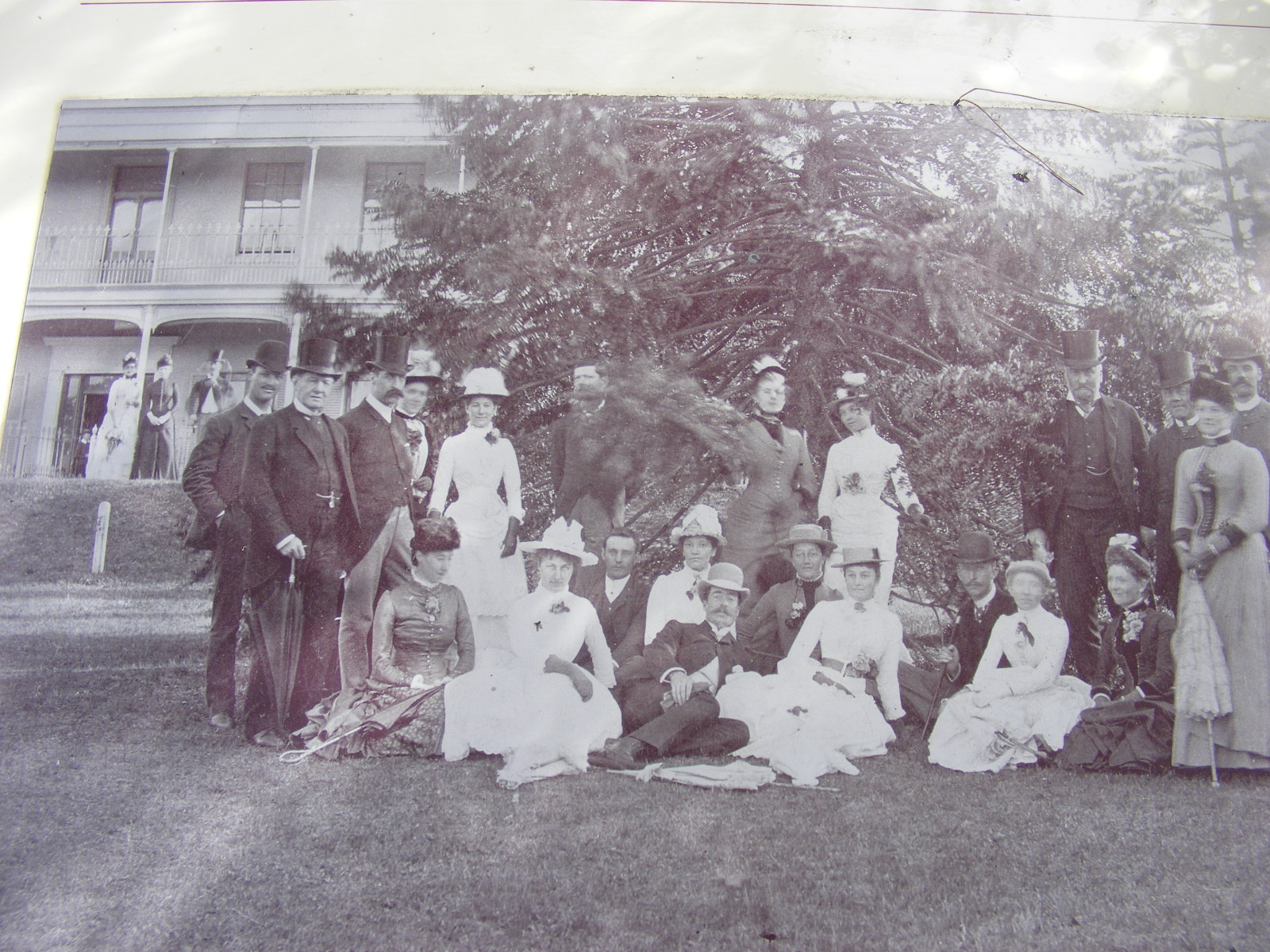
Como House was built in 1847 for the barrister Edward Eyre Williams and his family.  It is named after Lake Como in Italy, where it is said he proposed to his wife Jessie.  It originally had only a single storey, but stood on 54 acres of land extending down to the Yarra River.  Barrister Williams grew 'sick of travelling into town' and sold the property in 1853 to John Brown,  a wealthy wine and spirit merchant.


Brown added the second storey and had the garden landscaped, which was then surrounded by orchards and farmland.  Our tour guide told us that Brown entertained extravagantly, inviting all the 'best' people from Melbourne who graciously accepted his hospitality and gave him the moniker 'Como Brown' (any relation, I wonder, to The Unsinkable Molly?).  However, because he was 'in trade', he was never admitted to the prestigious Melbourne Club.  Not only did he fail to enter this exclusive level of society, his extravagance eventually led him to bankruptcy.  During the family's tenancy one of the daughters, Susan, scratched her name on a window with a diamond ring. ( Have you noticed it's always a diamond ring?  What a popular form of graffiti - the Mitford girls did it, Southern belles did it, I've encountered this quite a few times.)  In this case Susan's brother followed her signature with '...is a fool.'  (I wonder if he, too, had a diamond ring?)


In 1864, Como House was purchased by Charles and Caroline Armytage, wealthy pastoralists, to be used as their their Melbourne town house.  Now, I've always thought of 'pastoral' in religious terms, but of course there is the link between Christianity and sheep in the Bible, isn't there?   Charles Armytage was a 'gentleman squatter' - also a member of the Melbourne Club.  With 700 square miles of land and the wool his sheep produced he was part of the early aristocracy ('squattocracy') of Victoria.  Many squatters were city gents who ran their vast pastoral properties from the town houses, leaving managers to oversee the country estates. 


The Armytage's had ten children, five of each gender, with four of each reaching adulthood, though only two sons and one daughter would marry, which seems rather strange to me.  Charles Armytage died in 1875 leaving Caroline a widow at the age of 44 with nine children, the youngest of which was nine months old.  Our tour guide said that she sent her eldest sons out to manage various pastoral estates, but that she held the reins of power at Como House.  This website describes what a remarkable woman she was and gives a glimpse of the amazing lifestyle she and her family enjoyed.  The women seemed to spend large amounts of time in England.  The tour guide said that the last two Armytage daughters who lived at Como House, Constance and Leila, were spinsters.  In fact, Constance had been married, a bit late for the time at 36, to a Captain Arthur Fitzgerald who was aide-de-camp to the then Governor of Victoria.  One website I found wittily remarked that soon after moving to England he decamped with her £70,000 dowry, and thus ended the marriage.  She lived as though single from then on, remaining in England for several more years until the death of one of her brothers.


In 1959, after 95 years of Armytage family ownership, the last survivors of the Armytage family, Constance and Leila, sold the Como estate to the newly formed National Trust of Australia (Victoria).  Como House was the first property acquired by the National Trust of Australia, in fact the organisation was formed for this very purpose.  The Armytage ladies had heard of properties like theirs being demolished or re-developed into nursing homes and the like.  Their aim was to have Como House preserved as their family home. 


I couldn't help but feel that the National Trust was surprisingly lacking in entrepreneurial skill:  the gift shop sold no picture books of Como House, no specific memorial trinkets, no postcards...not that I likely would have bought them, but without being able to take photos inside, I found this frustrating.  Internet to the rescue!  This website has two posts showing the interior, though not entirely as I would wish.  Never mind.  See the photo of the servants' bells and tell me you don't think of Downton Abbey! 


My notes captured quite a few images for me:  the exquisite crocheted curtain in the Nanny's room, a knitted bedspread, the friendship quilt on the guest bed where guests' initials were embroidered on a square by a servant after the visit, the chaperone's chair at the end of the sitting room that provided a window into the ballroom, the art deco furnishings of the two daughter's rooms used after the rest of the house was closed including a beautiful pink depression glass candelabra.


Como House is often used for vintage clothing sales and - what took us there - was the setting for one of the Phryne Fisher television shows.  We saw a camera crew in the outside kitchen and wondered if another episode was to be filmed there.  More on that later!

Monday, 14 May 2012

St. Kilda and Toorak

Have I mentioned before that this was a Phryne Fisher trip?  You'll have to accept that we dip in and out of reality pretty regularly at our house and Phryne's world is a popular escape.  I believe I made introductions here.


St. Kilda and Toorak are two Melbourne suburbs often mentioned in Greenwood's books. 


Bill had made a list of places to visit, and left it at home of course, but fortunately he could remember quite a bit as he reviewed maps of Melbourne and the free tram circled the city.


Lest you make the same error I did and say TOO-rack, I can tell you since Chris told me that it's actually something like 'Track'.  Given my struggles to pronounce 'chook' (chicken) properly - or perhaps Chris was playing with me, he does that sometimes - it's probably somewhere between Toorak and Track; Teh-RACK.   Whatever.


I noticed in hearing the place names on the train journey that Australian's muffle their vowels more than I do, but almost anyone swallows their vowels more than those of us with a Southern drawl.


I loved St. Kilda:  gorgeous houses with verandas, flats with balconies, all trimmed with lacy ironwork that reminds me so of New Orleans.  


Bill was continually astonished at the use of corrugated tin for roofing, even on quite substantial structures. 


St. Kilda was a Victoria seaside playground, perhaps similar to Whitley Bay near us.  If I were to live in Melbourne, I think I'd want to be located in St. Kilda, not necessarily overlooking the sea, but within a few blocks. 


As if.  The median house price there is $940K and $823K for a 'unit' (flat).

One thing that struck me was that on our way down to the seaside from the tram, we passed a man wearing a t-shirt with the slogan 'Eat the Rich'.  I was thinking this was a more violent take on Occupy Wall Street, but it turns out this is the name of a band, also of an Aerosmith album.  Who knew?


Toorak was another story.  The houses looked more like museums or office buildings than homes. 


I kept looking for the brass plaque identifying which country's embassy I was seeing, all surrounded by six to eight foot walls.  The houses were completely out of scale, being built to within a few feet of the lot boundary.  They made me imagine a life lived in air conditioned rooms, mincing across miles of marble.  Not my cup of tea. 


Wikepedia says that the name Toorak is synonymous with wealth and privilege, one of Australia's most expensive and prestigious suburbs.   If one walks through Nichols Hills in Oklahoma City the police come along and inquire about your business (I had a girlfriend who lived there); I kept waiting for the cops to come talk to us!   The internet gives a median house price of $2.6 million, but in the recent recession housing prices were tumbling.  Not at all surprising; one pays dearly for prestige.

However, there was one house in that area that we paid to enter, because we'd had a glimpse of it on TV the previous Friday night.  More about that next time...

Friday, 11 May 2012

Gosh, Melbourne!

Where to start?  Melbourne is an amazing mix of old and new architecture.  It's frantically busy with people and there seems to always be something to do.  We stayed pretty close to the CBD (Central Business District) and the toughest thing was to figure out how to prioritise to get the most of our days. 


Tram passing Federation Square


I must admit I was pretty tuckered out by about 4pm, walking and standing most of the day.  It's not a matter of just striding out to get to a destination, but of dodging people and prams, waiting for lights to change, watching for the very high curbs, for cars, trams and buses, keeping one eye on Bill while trying to stop and snap a photo. 


St Paul's Cathedral


The hotel was a slight disappointment.  The rooftop pool was out of order and I could have shown the cleaning person a thing or two, which is worrying. 


The Forum Theatre


The first thing I did was to trip over the tiles that raised the threshold of the bathroom, bruising the ball of my foot.  This meant wearing my trainers for added cushioning, not very stylish with my skirts, but there was nothing for it but to get on and see the sights.  Each night I pulled the bathmat over that threshold to remind me to lift my feet during any night time excursions.


Three Melbourne businessmen


It rained a bit while we were there, but mostly it was sunny and in the 80s or lower 90s, so I generally happy with the weather.  We went to a proper restaurant in Chinatown one evening, but the rest of the time we had room picnics with grocery bought foods.  Not very low calorie food, sadly, but the walking took care of most of it.


Public Art; public purse?


Melbourne has had to battle to save her older buildings from the wrecking ball (or is it all just dynamite these days?).  In one exhibit relating the rescue stories of various buildings, it was interesting to note that even the demolition workers had a view about some of them and went on strike rather than to participate in their 'downfall'.   We saw one instance where a facade was being supported while a modern building was being constructed behind and observed a few examples where this had been done elsewhere.  Not ideal if the interior is still original, but many buildings not historically protected have been trashed anyhow and the facade is perhaps better than nothing.


Mitchell House, at Elizabeth St and Lonsdale, built 1936


There was a surprising amount of things to do for free:  a tram that circled the city centre, the galleries at Federation Square, an exhibit at the library, the Victorian Women's Centre.  We chased down all things Phryne Fisher and pretty much walked all the cross streets of central Melbourne, laid out on a lovely grid.  The street names echoed out of Kerry Greenwood's books and Bill was in seventh heaven. 


The Flinders Street Station


has to be seen to be believed.  It's so....yellow.


I would happily go back to Melbourne, to spend more time exploring the coast and further afield. 


I'm certain we've only scratched the surface, as has this post...more to come!