Friday, 14 July 2017

Finding Common Ancestors on Ancestry

This is a tutorial for cousins on Ancestry to make sure they can find our common ancestors. 

I've borrowed screen shots and made them anonymous, just to show the screens one sees when signing on to Ancestry.

1. This is what your first page looks like, signing on to Ancestry. You may or may not see the 'member connect activity', but you will see your family tree under this (in the next picture)


2. Click on DNA at the top of the page to go to your matches instead of your family tree. 


3. I have outlined in the previous picture (see "11 Shared Ancestor Hints") in red the next place to click.  This takes you to a list of shared matches that doesn't look much different to the general list, except that every match has one of those waving green leaves by it. A shortcut to this page is to click on the Filter for [green leaf] HINTS. 


4.  Click on the shared match (View Match) you're interested in (Which is this example is Shelley BXXXXX (managed by billxxxxxxxxx) (in his dreams). 

5.  This takes you to a big screen and I've shown it here in three parts. The top is like all your other matches:


Then, it shows a chart with the name/names of the people who are in both your tree and your DNA match's tree with the lineage from each of your trees back to that person. Pretty magic, huh? (Except we both had to do all the work to get those names and dates into each of our trees.)


6. Make a note of the name or names at the top of the chart, our common ancestor(s). And, if you don't mind, the name of that person's child at the top of your column. This example shows that my Bernard had a brother named John and their parents were Patrick J and Sarah. 


7. Note the relationship by my name which will be on the right hand side opposite yours. It might be something like 6th cousin (once removed); and if so of course the list of names would be much longer than pictured above, which is a closer relationship. 


8. Please send me a message on Ancestry (or comment here it is easier) to tell me who is our common ancestor!

Monday, 10 July 2017

Dragon Mountain


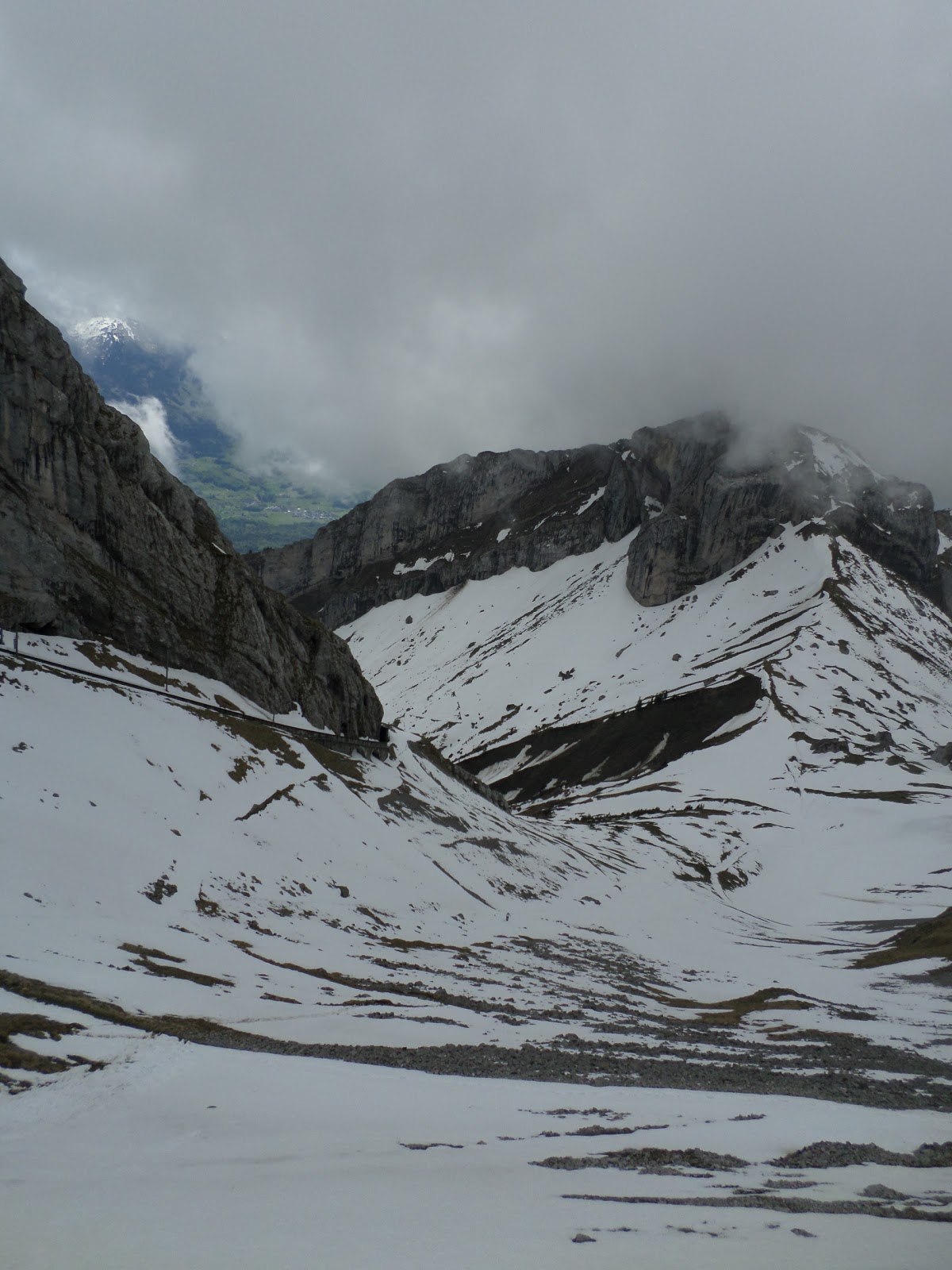
Another day we got the train to Lucerne and then, on another railway, up the side of a mountain. So we could walk around in the clouds in a place called Pilatus. 


Apparently the Pilatus Railway is the world's steepest cogwheel railway. I'm not that big on engineering stuff, I was just hoping whoever built the thing knew his stuff.


There wasn't a lot to do up there other than find a seat and have our (packed) lunch. I heard an older American man complaining to his younger Asian wife, "They want 10 bucks for a sandwich up here? I can get a perfectly good sandwich at home for $3". I think "home" was somewhere in the mid-west and I dearly wished he'd stayed there. 


His wife attempted to explain that he was looking at the majesty of the world-famous Alps, but I don't think he got the message. 


I was thinking of the stereotypical idea of age and money vs youth and sex; I suspect neither thought they got a great bargain. I hope I'm wrong.


Jane and I were taken with the black birds zooming around. One young Asian woman was wearing a white veil, I guess to signify she was on her honeymoon (and why exactly one would wish to do this is beyond me). 


Her new (young, Asian) husband took photos of her with this black birds perched on her shoulder and arms, feeding from her hands. I don't think I like any wild birds well enough to do this sort of thing, but obviously she did. 


Bill was able to tell us these birds were choughs, related to other black birds, ie crows, ravens, jackdaws, etc. Their red beaks were distinctive, but I mainly liked how they sailed through the clouds.


I thought at first that the tiled outline (and the stuffed animals in the shop) were more basilisks, but then I read that we were visiting the Dragon Mountain, so these were definitely dragons, not basilisks.


After we had climbed to the highest point to look down at clouds, walked through a cliff-edge tunnel to look at clouds, taken our photos next to the snow and eaten our lunch, we queued to get on the railway car back down. 


It turns out our tickets were actually to get a cable car down the other side, but Jane didn't figure she could cope with that so we settled for the front railway car instead. 


Add caption


I was happy with that decision (but just imagine the photos I might have taken!)


Obsessed with dragons.


At one point the driver (far too young for this job, I felt!) spoke to me in German. When I looked blank he asked if I spoke German and I said no. 


He apologised, saying he thought I did. I took this as a complement for some reason. I never did know what he was saying, as he then addressed his comments to the woman sitting next to me, who did speak a German.


I got a crick in my neck trying to look over my shoulder at the front window of the car. 


I sat with my back to it, thinking if I sat on the other side I would have photos full of people instead of scenery. 


I worked out that actually, the only ideal place to sit in the front rail car is the driver's seat.


Having survived the journey up and down Dragon Mountain, we had a coffee and some apple torte. It wasn't particularly nice I'm sad to say, but the coffee was excellent and it's hard to mess up ice cream.


After that treat we headed off for our next adventure (hint: water).


"Edward Locher (1840-1910) created a special cograil system for the 48% gradient of the steepest cog wheel railway in the world, the Pilatus Railway, opened in 1889. His system was based on a horizontal grip: the so called 'herring bone' cograil, gripped on both sides by two horizontal cogwheels. Guideplates mounted below the cogwheels prevent dislodgement and at the same time regulate the movement of the vehicle on the track."

Wednesday, 5 July 2017

More Questions

After our walk on the Rheingasse, I had more questions.

Why are there carvings of salmon on buildings?


So far as I could tell, this was someone's house...
with a salmon over the front door. I saw another in a
different part of town.


Salmon were once so plentiful in the Rhine that they were a symbol of the city. Sadly, as in many other places, including our own River Tyne, salmon disappeared because of industrial pollution. This fish had not been seen in the Rhine since 1958 and were absent for 50 years. Fortunately efforts at improving the water quality were successful and the first salmon was seen again in 2008. This is very similar to the story of the Tyne, once the best salmon fishing in England (so much so that some silly Georgian gentlemen duelled over riparian rights). They are definitely back after a lot of work on the part of the Environment Agency; I've seen them jumping myself!


Why is Swiss money abbreviated as CHF and their internet URLs end in CH, when "Switzerland" doesn't have any of these letters?


The F is for Francs and the CH is for Confoederatio Helvetica, or Helvetic Confederation, basically the Latin name for Switzerland (sort of like Hibernia for Ireland and Caledonia for Scotland). This post is typed in the font called Helvetica, in honour of this discovery.


Why is Switzerland so expensive?

I accidentally found this very interesting blog post when searching for answers to other whys in this post. The author is an American living in Switzerland. She explains that salaries are high and taxes relatively low there, but they have no universal health care, as do surrounding EU countries, and the cost of living is high. Also, tourists are prepared to pay over the top and so it is "what the market will bear" which is what I'd assumed from the start. One thing she describes is that Switzerland is an 'island' surrounded by EU members and that many companies will not ship goods into Switzerland. Scary thought for another 'island' about to leave the EU, eh?

Are snails important in Basel? 


I thought this was just a house, but given they have a 
dancing couple by their front door, perhaps it is a dinner club...
that serves snails. I didn't think to look at their menu.


Loads of folks have snapped photos of this painting but, other than being an obvious tourist thing (attraction seems too important a label), I've no idea about what red snails mean to ?Baselians? They are however featured in an art exhibit, so there must be something about them...


Zum rothen Schneck: to the Red Snail


And finally,

Isn't 'fledermäuse' just the cutest name ever for a bat?

Saturday, 1 July 2017

Green Walk on the Rhine

On the other side of the river we found a bench where we sat and ate our packed lunches, some of which we shared with the masses of sparrows that gathered. 


As we walked that section of the city - I think it was called the Rheingasse (Rhine Alley?) we found one of the really posh residential areas. 


One side seemed predominantly single dwellings, some terraced and some detached with gardens. 


The other side looked to be mostly apartments in very old higgledy-piggledy buildings. 


Our brochure described it as a 'well-kept residential quarter'. 


Past the terraced houses a few restaurants appeared and this one seems to
 feature dancing, given the entwined couple.


I couldn't agree more and we returned a couple of times to enjoy this area, always discovering something new.


Couldn't find all the basilisk fountains the other day; but
there really were loads everywhere.


Americans seem to need loads of space and land around their homes, but part of Europe's charm is clusters of flats with complex roof lines showing endless additions. 


A Yank would want to build on top of the mountain that looks over the valley. 


In Basel the homes are the mountain, overlooking the Rhine. 


We spent ages admiring different arrangements of gabled windows, precarious balconies and houses we thought no wider than a stairwell.


Amongst the houses we also found a group of striking modern apartments, all in black. We noticed how fab the brightly coloured balcony (green with envy) furniture looked against the black background. Bill was ready to move in.


Then there were the terraced houses with seemingly no garden but covered with climbing plants. 


I loved the balcony with the thoughtfully painted ceiling, seemingly for the benefit of those gazing upwards. 


Funny little details raised all sorts of questions for me to research. 


A Braille version of the skyline with names of buildings f
or sighted readers as well.


I have to say this was one of my favourite days and parts of Basel. 


It's always great fun to imagine how it might feel to live in these various forms of accommodation. 


Thursday, 29 June 2017

Boat on a Rope


And then there was the Rhine. My childhood memories of the Canadian River in downtown Oklahoma City is of looking down at a wide muddy place with a few puddles. 


That's all changed now, with a canal and some great restaurants, into a thriving commercial district but the point is, big rivers with lots of water really impress me.

The Rhine meets my definition of 'big' and then some.


So having found the loo we found ourselves beside the Rhine where we discovered a couple of small boat docks and what I call a Boat-on-a-Rope. 


This told us just how strong the current on the Rhine was. Basically there was a very large cable was strung across the river and another cable or rope connected a boat to the cable. Simply by directing with the rudder the boat could cross back and forth between the docks on each side, using only the current for power.


The docks themselves were simple little places, but they generally seemed to have been made quite home-like in ways that always appealed to me. 


Very clever stuff. And it cost something like 50-60 cents. Not everything in Switzerland is terribly expensive!