Showing posts with label History of Jewellery. Show all posts

Tuesday, 4 August 2015

History of Jewellery - Part XX

Susan talked to us about Branding in the Jewellery Business, which got Bigger in the late 20th Century, though Tiffany's Blue Book Catalogue was first published back in 1845.

By the 1970s and 80s, Paloma, daughter of painter Picasso, was designing jewellery for Tiffany, some of which is rather similar to the famous silver hearts that were all the rage, by Elsa Peretti. Even I had some earrings with a copy of that motif (but not from Tiffany, of course). Paloma's silver kiss was also comparably affordable. 


Another company, "Bvlgari", she said was perhaps the Main Brander (so much so that they have the nickname "Vulgari"). And of course there is the famous quote from Eliabeth Taylor's husband, Richard Burton, who said "Bulgari is the only Italian word Liz knows." Bulgari designs fitted well with the lavish clothing styles of the 1980s and the power suits that women wore in the work place.


Liz's emerald suite by Bulgari


Versace's clothes also suited big jewellery pieces. Bulgari produced silk cord necklaces that came in sections.  Which may have inspired some of the designs of Pandora, a Danish company.

And this, my friend, brings us to the end of this series. Thank you for your interest!

Tuesday, 28 July 2015

History of Jewellery - Part XIX

In this, the penultimate (I've always wanted a chance to use that word) post based on the lecture we got from Susan Rumfitt back in March, I'm going to talk about three things.

One


I mentioned before that she told us Art Deco was the last true style of jewellery. She said it suits all ages and lifestyles, if not price brackets. In the 1960s there was an art deco revival - and the name 'art deco' was coined. Back in the interwar period it was called something like 'art moderne'.  In addition to the revival in the 60s, she told us Cartier had re-invented itself in the 21st century with its art deco jewellery. However at present I only find art deco writing implements for women, price from £300-770. (No presents, please).

Oh yes, and the tiara worn by Kate Middleton when she married Prince William was made by Cartier in 1936 for the Queen Mother.


Two

One of many hallowed institutions here in Britain that is associated with jewellery making is The Worshipful Company of Goldsmiths. I remember visiting a jeweller in some small Northumbrian village on a day out with Vivien and he explained about the hallmarks on gold jewellery that signify not just the standard, but much more. I suspect it would be difficult to sell my American jewellery - not that I want to at this point - because of the lack of hallmarks. If the phrase 'Worshipful Company' amuses you as it does me, you can read about the 12 livery companies of London. They are called livery companies because back in the day of their original guilds, craftsmen wore special clothes to signify membership.

Anyhow, Susan told us about a fabulous exhibition at Goldsmith's Hall, designed by Alan Irvine. You can read about that here.  She pointed out that whilst we're quite blase about seeing jewellery in glass boxes sparkle madly because of special lighting, back in 1961 this was a new idea.

Three

In Vienna, one very rainy day back in May, we spent the day at The Dorotheum, an auction house, browsing room after room and floor after floor of beautiful things for sale. To my amusement I learned that the German word for jewellery is 'schmuck'. Of course, in English it has a different definition: a foolish or contemptible person. The term come from the Yiddish word 'schmok', which means ... something else.


Tuesday, 21 July 2015

History of Jewellery - Part XVIII

If you're confused about the timeline of the subject matter in these posts, it's probably because I'm a bit muddled as well. Just because I'm determined to finish what I started doesn't mean it will be done in a sensible, orderly fashion, OK? I might go back one day and re-jig these posts, but for now you'll just have to bear with me.

For a while it seemed I couldn't get away from mentioning the Duchess of Windsor if I wanted to talk about jewellery. Now it seems I'm stuck on Liz Taylor - and pearls. 


Susan told us briefly about La Peregrina, a large natural pearl which Richard Burton bought for $37,000 from Sotheby's for Liz Taylor's 37th birthday in 1969. It sold in 2011 for something like $11.6 - 11.8 million.

My thoughts when I began to write about this were to re-tell the story about how Taylor famously 'lost' the pearl and found it in the mouth of one of her dogs. I was thinking she was pretty casual with a pearl that was owned by Philip II (1527-1598) of Spain. His wife, Queen Mary (1516-1558) of England, was painted wearing it, as was Margaret of Austria (1584-1611) Queen of Spain.  And of course it passed through the hands of the Bonaparte's of France.


We'll make no unkind comparisons between Liz and Mary, OK?


My other thought at the time was that Susan told us no one knows who bought the pearl from Christie's (well, I suppose they do, but it doesn't seem to be in the public domain). I was thinking that there are so many fabulous treasures that disappear into private collections and are never seen again. We need to all support our museums to enable the public access to such wonders. I think that's all I wrote on the subject.

However, upon this writing, I've come up with some other observations besides that Taylor's dog is lucky to have survived his little escapade. Last night we watched a BBC programme that had to do with establishing the provenance of a painting belonging to a certain English church and supposed to have been given by a particular aristocratic family in the area. Bill and I were taken with the way that so much likelihood, supposition and expert opinion were the basis of the given 'provenance', which is defined as the history of ownership used to help establish authenticity.

When I came to re-write about La Peregrina (which means the Pilgrim, or the Wanderer), several things occurred to me:

Cartier's listing gives the provenance of the pearl as:
Spanish Kings:
Philip II, (1582-1598)
Philip III, (1598-1621)
Philip IV, (1621-1665)
Charles II, (1665-1700)
Philip V (1700-1746)
Fernando VI (1746-1759)
Charles III (1759-1778)
Carlos IV (1778-1808)

Joseph Bonaparte, of France (1808-circa 1844)
Prince Louis Napoleon, of France (circa 1844-circa 1848)
Duke and Duchess of Abercorn (circa 1848-1914)
Elizabeth Taylor (1969-2011)


I can't help but wonder who owned the pearl between 1914 and 1969? I see from reading Wikipedia that there is another pearl, called the Pearl of Kuwait (with a different weight) that claims to be that worn by Bloody Mary, etc. Establishing provenance and keeping it with the right article must be a pretty complicated business.

I started to be really shocked that something could be worth over 50 times its previous value (if $37,000 in 1969 is $224,440 in 2011) in just 42 years because Elizabeth Taylor owned it. Then I remembered all those rubies and other pearls in the necklace, La Peregrina didn't just hang on a leather strap...not to mention that she designed it and it was by Cartier and we don't know how much they paid for the Cartier necklace. Still...

Tuesday, 14 July 2015

History of Jewellery - Part XVII

There is, you know, a dark side to jewellery, to precious gems. I've long heard the phrase 'blood diamonds' but didn't really know what that was about. I thought maybe it meant something to do with the dangerous business of mining. Susan didn't tell us about those, but rather about pearls. 

Apparently in the time before the technology of making cultured pearls ('farmed pearls') was discovered, slave boys were weighted down to help them get deeper for the larger pearls. Of course, some drowned whilst others died from the bends (internal bleeding caused by surfacing too quickly). Pearls brought up by boys who died had higher value. Sometimes, perhaps if the pearl was big enough and they survived, they might be freed. Charming story, eh?

Consulting Wikipedia, I learned that blood diamonds are AKA conflict diamonds (and their are of course other conflict resources) mined in a war zone and used to fund an insurgency or over-throw of the government. Various countries in Africa are given as examples. In 2000, the World Diamond Conference at Antwerp adopted a system of international certification to allow only import of officially sealed packages of diamonds and to impose criminal charges on traffickers in conflict diamonds. However, apparently the system isn't fool-proof as demonstrated by the Marange diamonds in Zimbabwe, where there are rumours of forced labour, etc.

In more recent years rich diamond sources have been found in Australia and Canada, but the history of diamonds is generally connected to countries in Africa. When you consider the dangers of mining, the great wealth attached to owning mines and the racial inequality that has existed, what do you think might have been the number of deaths attached to gaining that wealth? And what percentage of those deaths do you think were white people? Those ideas don't just attach to diamonds and pearls but to most gemstones, I expect. I think we should all look at our jewellery and consider what its real cost might have been.

We can't talk about the history of diamonds without mentioning De Beers. When I first moved into this house my neighbour was a lovely old lady named Dorothy. I often regret that I didn't spend more time talking with her. She was still quite beautiful in her own serene way, always friendly but never nosy. She told me briefly that she'd been in the WAAF's during WWII. She'd long been a widow when I met her and she mentioned that her husband had been older than she. Also that they had lived for a number of years in South Africa because her husband worked for De Beers; I think she said he was an engineer. I wished I'd asked her more about her life as I imagine she had some great stories to tell...well, some stories, anyhow. 

My favourite diamond ring, Grandma's engagement ring. They were married in Feb. 1913. The centre diamond isn't that large, but it flashes beautifully in the sun (which is in short supply today). I think Grandpa did pretty good, considering he was only 19 when they married!


The name De Beers belonged to the brothers who sold their farmland to Cecil Rhodes. Given that we have Rhodesia, now Zimbabwe, Rhodes University in South Africa and the Rhodes Scholarship, funded by his estate, one wonders why the diamond company was named De Beers. I'm sure he had his reasons. I'll spare you all the business details (most of which I don't understand anyhow) but some of the relevant dates are:

1888 - Founded by Rhodes and Rudd. Cecil Rhodes was chairman of the board.
1902 - Rhodes died. De Beers controlled 90% of the world's diamond production.
1927 - Ernest Oppenheimer became chairman of the board; the Oppenheimer's ran De Beers from then on.
1947 - American ad agency working for De Beers coined the phrase "Diamonds are Forever". Equating diamonds and love, the market in engagement rings was thus boosted.
2011 - The Oppenheimer family sold 40% of their De Beers holdings to Anglo-American (which an Oppenheimer started, but later sold), giving Anglo-American 85% ownership. The Oppenheimers apparently decided they wanted out of the diamond business. (Love the link above: Diamonds aren't forever.)

Over its nearly century-long diamond monopoly of the diamond industry, entries for De Beers under 'Legal' on Wikipedia include

  • Sherman Anti-Trust Act
  • South Africa's missing billions
  • Diamond prices (which De Beers controlled by withholding or flooding the market)
  • Industrial diamonds (needed for its hardness and thermal conductivity for grinding, polishing and cutting in industry and science - so not just a pretty rock)
  • European Commission
  • Conflict diamonds and the Kimberly Process
  • Forceful relocation of indigenous San people in Botswana
Sadly, vast money and power do not seem to make people nicer.

On a possible more positive note - though entirely through self-interest - Susan said that De Beers is responsible for keeping the jewellery industry thriving, through grants for new designers.


The best part of Grandma's ring isn't the diamonds, it's the sweet little hearts on each side of the setting.


If you want to know more about diamonds (and why De Beers wanted men to 'surprise' women with proposals of marriage) read on here.

Tuesday, 7 July 2015

History of Jewellery - Part XVI

Chanel Picture

I thought bib necklaces were a recent innovation, but turns out they were big in the 1950s because of Dior's New Look with its open collars. 


Yet another piece belonging to the Duchess of Windsor.


Dior was fast taking over the fashion world from Chanel, who went into semi-retirement at the Ritz Hotel.  Poor thing, eh?

I expect by now there is no one who doesn't know she had an affair with a Nazi soldier and according to our lecturer was a spy for the Germans with the code name of Westminster. This latter is new information to me, but apparently a book was published a few years ago based on some declassified archival information. I'm aware that a lot of the upper classes in both Europe and America had Nazi sympathies, ranging from simply liking those ideals better than those of communism to thinking Hitler would sweep the world clean and start a new order, putting things 'right'.

Anyhow, Chanel has been dead for over 40 years now. Our jewellery history lecturer mentioned a painting that hung in Chanel's Ritz apartment that had been 'overlooked'.  You probably know all about this already,  but this was news to me. If you missed that news story (back in 2013), the story goes that the inventory the Ritz took of Chanel's apartment when she died did not include this painting that hung on the wall. 


I can't see how it could have been overlooked, it's pretty garish - and it's about 6' tall, but that's the story. It is described as 'rustic, of Byzantine and Renaissance period' and is by Charles Le Brun, a 17th Century French painter. I'm not sure it can technically be referred to as 'lost'; no one knew it ever existed.

How it came to be in Coco Chanel's possession is unknown, but her Nazi connections are suspected to be the potential route, looted either from a museum or from a private home.

I though it was a fascinating story.

Tuesday, 23 June 2015

History of Jewellery - Part XV

Susan told us that jewellery design got a bit quirky after WWII. For one thing, during the 1950s, jewellers began rolling gold into thin layers which they could then sculpt and roll. This made pieces look larger without the added expense of using more gold.  This is a style that sounds vaguely familiar, but I'm not finding the examples I had before I deleted all my work. Maybe something like this from Van Cleef and Arpels?


The use of semi-precious stones also become more and more popular, with odd combinations like amethysts and turquoise. 


Cartier - for Duchess of Windsor (again)...


Not just 'quirky' but positively surreal elements - actually called surreal -  also crept in and to my mind it was all pretty creepy. I can't think of anything Salvador Dali did that I can enjoy, but if you like this sort of thing you can see more of his jewellery here.


We were given Elizabeth Taylor's iguana clip as another example of surrealism, but at least she wore this around the time of the film Night of the Iguana...not one of hers, but of Richard Burton's - and it looks a bit of a creepy movie as well-ick.


Clothes, she reminded us, were also fairly surreal in the 1960s and 70s: Paco Rabanne's plastic neon coat; "space clothes" (by Andre Courreges); and she mentioned Emanual Raft (who is apparently still designing) to whom she attributed the gyro bangle, versions of which are still being made - or at least the name is still used.

Another name she mentioned was Andrew Grima, responsible for modern British jewellery design according to Wikipedia. She described his early work with agate, referencing stars and planets. As you will see, his work was plenty exotic - and though he died in 2008, his work goes on (or that of his wife and daughter).

If you know about the history of clothing design, you'll be aware that for many decades fashion had strict dictates: the silhouette, the skirt length, the required accessories all had to be right in order to not look foolish. That is not presently - thank goodness - the case, at least not for most of us ordinary folk. The speed with which new fashions are presented has backfired on the industry and given us all a bit more leeway to choose our own paths. 

Susan made the point that jewellery styles have all been mixed since the time of Art Deco (in the 1920s and 30s), which she says was the last of the true styles. 

Tuesday, 16 June 2015

History of Jewellery - Part XIV

I'm thinking the last installment of this series being number 13th is no mistake. I had nearly all these posts written, lumped together in one big draft. I pulled out the last one and scheduled it when we were in Vienna last month and for some inexplicable reason, deleted the rest of the draft...with hours of work in it. So I'm reconstructing as best as I can...wish Blogger had a back up system for drafts like deleted emails.

During WWII England stopped manufacturing jewellery; France and Italy's production was sharply curtailed. Guess it's hard to make necklaces and earrings when bombs are dropping on you, eh? My notes also indicate that France and Italy both imposed a tax on the value of jewellery to help fund the war...whether this was at purchase or of one's existing collection, I'm not sure. 

In Britain, as part of the prevailing attitude during the war, we were told, it didn't do to be seen decked out; one piece of jewellery was all that was considered tasteful. Perhaps royalty were the exception to this rule?

We were told that whilst the present Queen tended to wear her art deco brooches in the traditional manner, Elizabeth, the Queen Mother, liked to wear brooches on her hat. 


On the other side of the pond, production continued as usual in the US and women wore what they pleased. 

The royal ladies weren't the only fans of aquamarines. Joan Crawford, American screen star, was known for wearing gold and aquamarine pieces in the 1940s and 50s.  Her famous parure came from Boucheron. 


Another film star with a penchant for jewellery was Paulette Goddard. We were told she had a great divorce settlement. Reading about her life, I'd say she was really good at getting great divorce settlements.  (Then again she didn't have such great luck with her maybe-father.)

Gifts to Paulette Goddard from one of her several generous husbands, Charlie Chaplin.


She's quoted as saying "I do not accept flowers. I take nothing perishable." 

Wise words.

Tuesday, 9 June 2015

History of Jewellery - Part XIII

There are few women who have collections that truly impress and of course one of them was the Duchess of Windsor. The pieces are valued not just for their outstanding beauty and exquisite craftsmanship but because of the stories attached to them. I no longer think of the relationship of Edward VIII and Mrs. Simpson as terribly romantic, but instead as quite sad. 

We were told about the diamond and sapphire 'contract bracelet' engraved "For our contract" and dated 18 May 1937. 


Another ruby and diamond bracelet was engraved 'Hold Tight' on the clasp which, when you think of it, makes sense for a clasp on such a valuable piece. It referred however to their holding tight to one another through the storm caused by Edward's abdication. 


Our lecturer mentioned Henry Channon, a politician and I duly scribbled the name. Turns out this is 'Chips' Channon, American born British politician who married Honor Guinness and was an admirer of Mrs. Simpson. I could get quite excited about this man, if only because he is distantly related to the Mitfords... Anyhow he is quoted as having said that the jewels given to Mrs. Simpson were the talk of London. I expect every thing about Wallis and Edward was the talk of London. 


In the post war period of the 1940's an into the 1950's and '60's, jewellery design focused on nature and animals.  The flamingo brooch by Cartier is one of the most copied pieces in the world.


So, enough of That Woman (must read this book one day).

Tuesday, 2 June 2015

History of Jewellery - Part XII

This is sort of another story of the one-upmanship that went on (probably goes on) in the worth of the uber-wealthy. Apparently Harry Winston had a stunning emerald necklace made in 1953 and it came to belong to the Duchess of Windsor in 1956. She wore the necklace the following year to a ball in Paris and it made quite a stir. Another person attending the ball was the Maharani of Baroda. When the Maharani was asked her opinion of the necklace she agreed that it was beautiful, adding that the emeralds were once her anklets.


The Duchess was not amused. She later traded the necklace for emeralds that had belonged to a King of Spain. Presumably he'd not worn them around his ankles. Strangely enough, either because of the incident with her anklets or because of the jewels lavished upon her by the Maharaja, or because her marriage to the Maharaja created a scandal, Sita Devi, the Marahani of Baroda was given the name the 'Indian Wallis Simpson'. 

Tuesday, 26 May 2015

History of Jewellery - Part XI

Pave stone settings that were popular in the 1930s. Pave (pah-VAY) is a French term meaning paved or cobblestoned. The stones are set directly into the metal. More recently, micro-pave has become more popular, but my impression from my reading is that perhaps the stones are not as secure. My notes seem to describe pave setting in an arch shape, perhaps exemplified by this reproduction ring?

Susan showed us something she called a 'flat, sculptured' piece and my sketch looks something like these:


VanCleef and Arpels, of course!

I love this one even more, from the Couture Collection in 2004, but inspired by the Mystery Set technique developed in the 1930s. This looks to me like the epitome of 'flat and sculptured'. 


Ruban Necklace

Which brings us to this technique she described but didn't name. Developed by Van Cleef and Arpels it produced invisible settings in a slightly different approach to 'pave'. By buffing the edges of the stones the 'cobblestone' look was enhanced  - and to my mind completely magical. 


You can enjoy more examples of this technique on the Van Cleef and Arpels website

We were reminded that the Duchess of Windsor was influential in the design of jewellery from the 1930s all the way through the 1970s. You can see a number of other pave-type designs on the portion of their website to do with her. More about Wallis and Harry Winston next time...

Tuesday, 19 May 2015

History of Jewellery - Part X

In the 1930s it was popular to re-cut stones and to create three dimensional sculptural mounts. Perhaps like this one? Or this breathtaking ring?

Brilliant cut diamonds were popular at this time, which means a round stone with 57-58 facets. This allowed light in through the top and to bounce back up through the 'table' (the flat part on the top of the diamond). The Old European style is marked by the presence of a 'culet': a small flat circle at the bottom (the 58th facet, if present). The European style prevailed up until the 1930s. The Brilliant cut wastes a lot of diamond material and only became acceptable with the discovery of the large diamond mines in South Africa.

We were told a story of the splitting of the Cullinan diamond - one of the largest mined to that time - by Joseph Asscher, one of the Asscher brothers of Amsterdam. It is said that he split the diamond with one blow and then fainted.  The name Asscher is also associated with a square or 'emerald cut' shaped diamond. 


One famous Asscher cut diamond was called the Krupp diamond before it belonged to Liz Taylor, after which it was known as the Elizabeth Taylor diamond. It was 33 carots and sold for $8.8 million in 2011. 

We were told a story that had Liz Taylor at a society lunch also attended by Princess Margaret. The latter was known to have remarked that Liz Taylor's jewellery was 'vulgar'. It may have been the even larger Taylor Burton diamond (68 carots) in question, but the story goes that Liz was always encouraging people to 'try on' her jewels and so Princess Margaret did. Apparently Liz saw that her ring was being admired by the Princess and she remarked, 'Not so vulgar now, is it dear?'  

Tuesday, 12 May 2015

History of Jewellery and Chanel - Part IX

This is continuing a series of posts about a lecture I attended on  the history of jewellery in the 20th Century.

According to our lecturer, Chanel didn't understand jewellery at all. In spite of the fact that she associated with very rich men, Chanel preferred fake jewellery. You can read about some of her lovers: Boy CapelHugh Grosvener, Duke of WestminsterPaul Iribe.

Westminster's entry mentions an emerald he gave Chanel. Susan told us a story that says Coco had an argument with the Duke on his yacht and she threw the emerald into the water. (So, she was the model for the old lady in the film Titanic as well as being a fashion designer, eh?) I figure Grosvener was an unpleasant character anyhow. In 1931, when being homosexual was still illegal, he 'outted' his brother-in-law, for personal and political gain. The story is actually known to quite a few of us, as it is supposed to be the basis for the incredible book Brideshead Revisited.

In searching for meaning in my notes I found there is a lot on the internet about De Beers diamonds and the year 1929. What I think Susan was explaining was that with the instability of the stock market after the crash of '29, interest picked up in buying diamonds. They were attractive for their high value and relative small size. People didn't trust putting money in the bank, so diamonds were in demand and their price rose. Susan explained that this same thing happened in the 1960s and is happening now. With the growing interest in diamonds, people needed teaching about value not just being about size, but also about colour and clarity. 

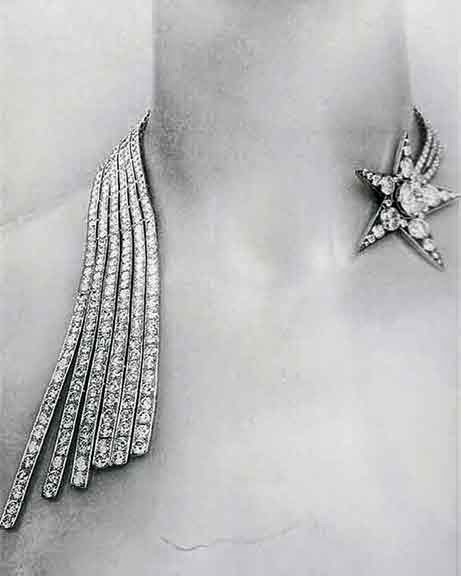
We learned about a particular necklace design by one of Chanel's lovers, Paul Iribe. I tried to sketch this necklace, it was so perfect for its time. I don't remember the star, shown in the photo below, but the lines flowing around the neck are something like I drew and my note quotes Susan as saying 'the jewellery flows along with the evening gown'. 

However my source for the photo says this Chanel necklace is by Patrick Mauries and the examples of Iribe are quite different in appearance, so I'm not sure what to think, other than this was a Chanel product.


I hadn't realised that there was something rather unlucky about being involved with Coco Chanel, even if she didn't throw your emerald gifts into the sea. I had forgotten that Boy Capel died in a car crash allegedly on his way to meet up with her. Reading about Paul Iribe, I learned that he died of a heart attack after a tennis game at Chanel's villa on Roquebrune Cap Martin, between Nice and the Italian border. They say she literally wore him out. 

Next week we'll talk about cutting stones...

Tuesday, 5 May 2015

Pearls - Part VIII

We're still in the 1920s, which brought us the Little Black Dress with Cultured Pearls. Before this there were only natural pearls and those were very rare. Our lecturer explained that cultured pearls are the same, with the same surface or nacre as natural pearls, they are just farmed rather than accidental. The farming process involves warm water and oscillation, presumably to increase the irritation experienced by the oyster and encourage the excretion of the substance that forms the pearl. She used the name Mikimoto, but according to Wikipedia even though he had a patent, he did not discover this process. You can read about that for yourself here. As usual, I found something to distract me in the story about the man who is credited with figuring this out first.

A story she told us that I have been able to verify was about the Cartier Building in New York City. Apparently the building was owned by a 61 year old man named Morton Freeman Plant who had a 31 year old 2nd wife. Divorcee Mae 'Maisie' Caldwell Manwaring (who went on to have two further husbands) liked Cartier jewellery. Pierre Cartier was looking for a new store and since the Plants were concerned about the commercialisation of their area, they sold their home to Cartier - for $100 and a double strand of natural pearls, valued at $1 million in 1917.  Development of cultured pearls greatly reduced the value of natural pearls.

This is from Wikipedia, but I found it originally on this fabulous blog that has a million incredible stories:
  Daytonian in Manhattan 

According to Two Nerdy History Girls, another blog I already know and love as well (which tells me this stuff is right up my alley!), that $1 million would be worth about $16 million today. They also managed to find a photo of Mae Caldwell Manwaring, and presumably of these pearls.


Just at a glance, a 2 bedroom 1550 square foot 'coop' - I'm guessing that might be an apartment - maybe three blocks away from Cartier in New York City (though I'm not familiar with the geography, but bear with me) is on sale as I write for $5,975,000 - nearly $6 million. Maisie died in 1957 and the next year her million dollar ($16 million) necklace was so devalued that it auctioned for only $150,000...which in today's dollars might be worth about $1,276,000. The Nerdy Girls obviously used a different calculator than I found, because mine says it should have been worth $20 million.

Whatever the details, Cartier made a brilliant deal, don't you think?

Tuesday, 28 April 2015

Brocade Grenade? - Part VII

Well, I'm most annoyed that I cannot find a photograph to show you a very gaudy piece of jewellery created by Georges Fouquet which was named (according to my notes) 'brocade grenade'; it didn't look like an explosive device but we were told that 'grenade' is actually Spanish for pomegranate. Susan admitted that it wasn't to everyone's taste, but made as it was from varying sizes of rubies closely set together, it couldn't be replicated. Maybe that's just as well. It was rather gaudy.

There is much of Fouquet's work that I could die for: he collaborated with my much loved Mucha.


More of this wonderfulness here.


Carrying on with the grenade/pomegranate theme, I'll venture that the 1920s was an 'explosion' of ideas and colours from other cultures, all with their particular styles of jewellery. The discovery of Tutankhamun's tomb in the early 1920s created almost a mania for all things Egyptian and jewellery made of gold. [For major Downton Abbey fans, you may find it interesting to know that one of the discoverers of this tomb was George Herbert, 5th Earl of Carnarvon; the Carnarvon's own Highclere Castle, where that series is filmed. Oh, and it turns out Lady Carnarvon has a blog!]

In addition to Cartier's cats, VanCleef and Arpels was commissioned to create Egyptian motifs for the Duchess of Windsor. Try as I might, I cannot find an example that ties together that jeweller, that person and that motif.  However, I can show you VanCleef & Arpels Egyptian jewellery; VanCleef and Arpels jewellery for the Duchess of Windsor; can't say I much care for what Google kicks up for the Duchess' Egyptian jewellery. Nevermind, we're still talking about the 1920s and the Prince of Wales didn't meet Wallis until 1931... Re-reading my notes, maybe I've mis-interpreted and the three don't actually overlap, only that VC&A were famous for Egyptian jewellery and they designed for that particular person.

Perhaps it was the growing nationalism in India and the fact that Gandhi took control of the Indian National Congress in 1920; or, more likely, because the Maharajas of India brought jewels to Europe on an unprecedented scale:


Alain Boucheron wrote in his biography of the house of Boucheron, The Master Jewelers: “The flamboyant Maharajah... arrived at Boucheron’s in 1927 accompanied by a retinue of 40 servants all wearing pink turbans, his 20 favourite dancing girls and, most important of all, six caskets filled with 7,571 diamonds, 1,432 emeralds, sapphires, rubies and pearls of incomparable beauty.”


With the fashionable short hair, long earrings, bandanas and bright colours were the jewellery accessories in demand. This brings us to 'tutti fruitti' jewellery, though that term didn't come about until the 1970s.  Feast your eyes on this fruit!

I've made several attempts to read A Passage to India, published in 1924; I confess that I find it rather boring. Maybe my reading list here will help me get through it should I find it again. Alain Boucheron, member of yet another French jewellery family, is mentioned in this article about the wealth of Indian maharajas.  I suspect The Master Jewelers would be a much better read, well, lighter reading anyhow.


I can't even begin to speculate what brought Oriental culture to the attention of the flappers of the interwar period. Nevertheless we were told that Jade Buddhas were immensely popular as well as Indian and Egyptian designs in the 1920s. No wonder, they are really beautiful.


Tuesday, 21 April 2015

Cartier and Worth - Part VI

I've added the topic "History of Jewellery" to the right hand column so anyone just picking this up should be able to find the other bits.


Cartier is known for the cat jewellery pieces made
for the Duchess of Windsor.


Our lecturer, Susan Rumfitt, was telling us that at the 1925 Paris Exhibition of Decorative Arts, Cartier (the jeweller) displayed his wares in the fashion section, not with other jewellery makers. She said the Cartier family had been quite smart in that they had married into the Worth family and so were able to suggest the bespoke jewellery pieces to complement the couture clothes.

This was the first I'd heard that the Cartier family and that of Charles Frederick Worth were intermarried, but it's true. I found a book on Google (Cartier by Hans Nadelhoffer) that showed a family tree.   Louis Francois Cartier began innovative jewellery making in 1847. His son Alfred (1841-1925) took over the business in the 1870s. Alfred had three sons: Louis, Pierre and Jacques. The brothers are named in a fascinating article in The Guardian, which I'll come back to in a moment. What the article doesn't mention is that there was a fourth child, a daughter named Suzanne.

Charles Frederick Worth is an Englishman who went to Paris and founded the haute couture industry. If you don't know about Worth, his Wikipedia entry is well 'worth' reading. It gives the names of his two sons: Jean-Phillipe and Gaston. 

Nadelhoffer's book indicates that The Guardian is correct that Louis Cartier married a Hungarian countess, but she was his second wife. Louis Cartier's first wife was Andree-Caroline Worth, daughter of Jean-Phillipe Worth; Susanne Cartier married Jacques Worth, son of Gaston. So the Cartier and Worth families were very much 'wedded into' one another.

The Guardian article lauds the genius of Albert in sending his sons out in the world to establish Cartier in other world centers: Louis remained in Paris, but Pierre was sent to New York and Jacques to London. This didn't amaze me that much as I had read much the same about the Rothschild family. The eldest son remained in Frankfurt whilst other sons were sent to Vienna, London, Naples and Paris. I wrote about this when sharing our visit to an incredible house near Nice a couple of years ago. 

Funny enough I have several leopard brooches - costume jewellery I'm sure - that belonged to my Aunt Rita. I had no idea this motif was originally linked to Cartier and the Windsors. I'll have to get my cats out more often. The other thing I discovered is that The Guardian  has a whole host of articles about 'Great dynasties'; you can find links at the bottom of the webpage about the Cartiers. I'm looking forward to loads of reading!

Tuesday, 14 April 2015

Car and Coat - Part V

Apparently during the Victorian era just about every dress or blouse was covered with lace on the front. Things changed a lot around the 1920s.  For one, Sonia Delauney had the idea of making her car and her coat match.


Vogue magazine approved. 


We were told that Vogue magazine in the 1920s and 1930s had huge influence on jewellery design. Vogue's idea was that women should have not just matching cars and coats, but matching jewellery for each outfit, as in bespoke. So they've always had outrageous, unaffordable ideas; nothing new there then. However, Vogue was pushing the then new idea of choosing an item because of its brand name rather than because it suited one's features or lifestyle.

The 1925 Paris Exhibition of Decorative Arts was also enormously influential, with a mini-town built of show houses. Items were displayed on glass plinths under bright lights to make them sparkle...pretty much like all jewellery shops show their wares now you might say. This was a new approach, completely different to the prevailing natural styles of art and gothic architecture as promulgated by John Ruskin. Instead people were exposed to Corbusier and Mondrian.

Cubism was a source of new design shapes and colours, particularly the geometric shapes. Also tourmaline crystal, often called watermelon crystal, became very popular.  One of my favourite Dick Francis books, Straight, is about a jewels dealer and a jewellery maker (and a jockey, of course); I read about tourmaline crystal along with a whole slew of fascinating gadgets. I recommend this book highly.

Going back briefly to Delauney's work (and her husband Roberts's), they were known for developing an art form, an offshoot of cubism called 'orphism'.  I quite liked the look of it, strangely enough. Also, I recently discovered that Bill actually hears some of the inane things I say! I read on some fashion blog or other in the last few weeks (I've looked and can't find it) that some designer has come out with dresses printed with 'fractured geometrics'. The phrase grabbed my attention for some reason and I was thinking it was the most interesting print I'd seen in quite a while.  Have a look and see if you don't agree. Anyhow, Bill and I were watching the season finale of The Voice UK and whilst I wasn't crazy about the song or the set, I did think maybe we'd been transported back to the 60s and when the stage lights played across the lines in the dancers' costumes (at about 1.10 if you want to skip to there!) that phrase (fractured geometrics) came to mind again. I mentioned this to him and he reminded me of it when I started comparing it with 'orphism'.  See what you think of the Delauney look