Showing posts with label Words. Show all posts

Wednesday, 10 June 2020

L S D

I was reading yet another Lord Peter Wimsey novel one night last week when I came across a reference to old British money: £ s d. The first symbol is of course for the Great British Pound and I vaguely remembered that the 's' stood for 'shillings' but I was thinking the next word should be 'pence' but there was a 'd', not a 'p'. I asked Bill to look it up on his phone and he came up with the fact that the £ symbol originated with the Latin word "Librae" and that this is where we get the abbreviation for a pound (weight) as lb. After that he came up with 's' is for solidi and 'd' is for denarii but that got me no closer to shillings or pence. 

So I scribbled a note to myself and looked it up. Of course it's not very simple, not simple at all. 


According to Wikipedia, while the words to referring to the coinage of course are Latin and therefore to do with the Roman Empire, the definition of the amounts and the relative value between the coins was introduced by Charlemagne. The term Libra comes from the Latin for 'balance' as in balancing scales. This makes sense as Charlemagne decided that his pound weight would be roughly 490 grams, which is what a Libra weighed. The current pound weight in Britain is about 454 grams and no longer has anything to do with the weight of a GBP coin. Charlemagne's system was prevalent throughout Europe until the decimalisations that occurred in the 1700 and 1800s. Except of course for Britain where they didn't change over until 1971. The (new-ish) United States was one of the first countries to change to a decimal system, in 1792.


Under the old system there were 12 pence in a shilling and 20 shillings (or 240 pence) in a pound. Somewhere along the line I thought someone told me there were 17 pence in a shilling and when Bill would brag about how good some member of his family was at adding columns of money in his head, I was truly in awe. Multiples of 12 are a little less daunting, but I'm sure most folks are forever grateful for decimalisation (or would be if they thought about it). 


Interestingly, or so I thought, in the middle ages, only denari were actual coins, made of silver. Librae and soldi were just used as accounting terms. Over time (and inflation) in Britain, as elsewhere, other coins began to be minted (guineas, crowns, farthings, half-pennies, etc) but the original terms were still used in accounting.


All well and good, but I still didn't understand how one got from 'soldi' to 'shillings' or 'denarii' to 'pence'. So, back to Europe, in France they called these coins livre, sous and denier. In Italy they were lira, soldo and denaro. In Germany, however, the names were pfund, schilling and pfennig, which gets us closer to the English names.

I was surprised to learn that pence is another plural for penny, in addition to pennies. So all those times I've got confused and called a pence a penny, I was right after all. Or I would have been fifty years ago, as with decimalisation Britain began to say 'one pence'. Oh well.


Since Wikipedia took me no further about these names, I turned to my old friend the etymology dictionary.  To start with, solidi / solidus means 'solid' - as in a solid metal coin. So obvious, right?


Also, the old English scilling comes from "Proto-Germanic". The German term might either come from a word for 'to resound or ring' or possibly from a word 'to cut' as perhaps one might carve a shield, which has similarity to the face of a coin. I'm rather partial to the things being named for the jingle they make in a pocket. The ending 'ing' is a Germanic term for a 'fractional part' (also in farthing), which makes sense given that a shilling was a fraction of a pound.


The word denari is Latin for "containing ten", which sounds great until you remember that there were 12 denari in a solidus. Perhaps there was an earlier decimal system that time has buried? No one else seems bothered about the difference between ten and twelve, so I've no idea.


The etymology of pence is useless so I looked up penny. Tracing the beginnings of that word takes us through middle and old English and Northumbrian p-words to our old friend Proto-Germanic - also Dutch, Danish, Swedish, not to mention Old Saxon and Old Frisian and of course Old Germanic p-words - and finishes by saying, "a word of unknown origin". But it was a fun ride.


On this particular evening when I was asking Bill to explain "£ s d" he turned around and asked where the symbol for USDs - $ - originated. Since I read books, not internet devices before sleeping, I just left him with 'I've no idea.' 


But I looked that up too.

Thursday, 7 March 2019

British Citizenship

On the 13th of February 2019 I attended my citizenship ceremony, the final step in becoming a citizen of Britain.


There were also two new citizens from Bangladesh, one from India and a married couple from Rumania. Bill and I both envied the Rumanians their EU citizenship. That relates to why, after 23 years, I finally decided to apply for British citizenship. 

Between the Brexit vote and the election of Trump as President of the US I felt the world had become a strange place that didn't feel quite so secure. As an alien with 'indefinite leave to remain' - an amusing British phrase, it began to feel too...indefinite. 


The wooden thing on the table is a holder for the Mace.

I had looked into citizenship years before but, other than the vote and right to live and work in Europe, I didn't see much gain. I already could leave Britain for up to two years and still return, but not for more than two years, and that condition remains even with naturalised citizenship. We talked about living the US at one point but health insurance costs changed our minds. It's cheaper to just visit for a month every few years. So becoming a dual citizen became more attractive, giving me that vote. 

Of course Brexit continues to stumble along towards who knows what end. I told Bill getting my citizenship at this point feels like running to catch the Titanic.

It took me about a year to complete the process, no doubt someone could do it much faster. Surprisingly it cost more than twice that of obtaining US citizenship. One of Bill's Asian friends hearing my plans, sent the name of a solicitor (lawyer) who specialises in this sort of thing. I wasn't excited about paying the legal fee in addition, given I'd be doing the work. Besides, it all seemed mostly straight-forward and do-able on my own. 

The first step was to buy a book about 'Life in the UK' to study (£11.95). It was so 'rah-rah, Britain is great' I couldn't believe if was written by an actual Brit. Nor could I believe I needed to know about the popular culture and sports heroes as well as the usual government and history questions. I did like that it spelled out my responsibility to look out for myself, my family and my environment. 

No English proficiency exam was required of me, but I did have to pass a citizenship test based on the book. I found this very helpful website for study and took the exams and tests there repeatedly. I copied any questions (with their answers) I wasn't sure of into a document that I studied in between taking the tests. When I could get at least 90% pass rate on all of these tests I booked my citizenship exam. 

This part didn't go smoothly because the private company that had the contract for administering these tests was moving offices and was appallingly bad at communicating with clients but at least efficient in refunding money. The first test was cancelled 30 minutes before it was to be held in a building with only construction workers removing rubble. They kindly directed me and an also anxious young man to another building, this one with an accessible receptionist - for an unrelated company. She informed us that people had shown up for the past few weeks for tests cancelled without notice. One poor woman came up from London for nothing. The receptionist kindly gave us a phone number from the internet, which of course was answered with a recording. I went home and drafted a letter to the Member of Parliament for our area and rescheduled the test for a couple of weeks later.

The second test was at least cancelled a few days before the exam and with that email I found a live person to check with about booking future tests. I sat the exam on the third attempt. The actual test took about ten minutes to answer 24 questions. It cost £50 (when booking, not refundable if you fail.)

Next, I had to complete a 31-page application, get two references to complete portions of the form and have a proper passport photo taken (£20). The application asked for ancient history: the names, dates and places of birth for each of my husbands and for my parents. It also required provision of documents: birth, marriage and divorce records, not to mention the pass certificate for the exam. Fortunately I already had all those. The other fun part was digging out information about where I had travelled in the past three years. Had I not been married to a British citizen that period would have been five years. As it was I used Bill's emails, my diaries and this blog to compile a list of travel locations for the required time period to show I met the residence requirements for application.

The local authority in Newcastle runs a 'National Checking Service' which allows one to submit documents and have them photocopied and certified, to send with application rather than sending off originals. This service costs £80. The application fee was £1,330. 

Soon after officialdom received the application I was sent for biometric testing (£20). That was a bit fraught as the website gave different information than the checking service about which Post Office I should attend in South Shields, across the river. Bill kindly drove me down, which resulted in a traffic ticket for using a bus lane. Not even he could figure out how to navigate in South Shields without breaking the rules. I don't count his £30 ticket as part of my citizenship expenses, though it just goes to show there are many obstacles to overcome!

I went to one place only to find it shut. A bit perplexed but not out of ideas, I asked a lady where the other Post Office was and she directed me around the corner. Sadly when I arrived their machine wasn't working. There were a number of other applicants on the same mission though they hadn't the benefit of English as their first language nor, I would guess, two decades of experience in Britain. One large man was being lectured by a stern woman in a suit that he could not threaten their staff and it wasn't their fault the machine was malfunctioning. He did seem quite agitated and I couldn't blame him, though I gather he had left things to the last minute, thus adding to his own stress. I wanted to assure him it wasn't at all personal - Britain does this malfunctioning thing to everyone including its own native born. I think it, in addition to the practice of queuing, accounts for the level of national stoicism.

The lady behind the counter said I had the choice to wait for the computer guy to come or to go down to Sunderland. I chose the latter. It was in trying to reconnect with Bill that I realised I'd never yet answered my mobile phone in the years  I've grudgingly carried it. I've only ever texted a few times so  Bill and I had several failed attempts nearly worthy of a digital age slapstick before I managed to find him and the car. 

It all went swimmingly in Sunderland: I made Bill park in a car park and walk the pedestrianised street with me to the Post Office and their machine worked fine. After a short wait I entered a booth where I had a facial scan and my fingerprints taken, a rather surreal experience. After that it was just a matter of waiting from three to six months for the official verdict. 

When I got the acceptance letter I had to phone my local authority, this time North Tyneside, to book into a citizenship ceremony - that was free. 


A drawing of the Registry Office that hangs in the lobby. I'm rather sentimental about the place.


The ceremony took place at the North Shields Register office where Bill and I got married eight years ago. I wore the same dress and shoes. It did sort of feel like getting married again, pledging allegiance to the Queen and to the laws of the the United Kingdom. The latter was second nature, I would live by those laws anyhow, but the Queen? Well, I think of her as a symbol and perhaps a wise little old lady. I've been fascinated with her family since I was twelve years old and in any case there wasn't a republican oath on offer, only the choice to 'swear by almighty God' or to 'affirm'. 

The ceremony began with a few tunes on the Northumbrian bagpipes. He didn't wear a kilt, just a shirt and trousers but with a large scarf, perhaps called a plaid, I'm not sure. I recognised the Northumbrian tartan, a black and white check. This was historically quite fitting as we were part of Northumberland until 45 years ago. I noticed piper's cuff links were buttons covered in the same tartan.


The mistress of ceremony was a deputy registrar I'd spoken with on the phone. A registrar's job is sort of a records manager: births, deaths, marriages...and citizenship.  There were also two official gentlemen who gave fairly similar speeches: the Chairman of the North Tyneside Council and a Deputy Lord Lieutenant (pronounced lef-tenant, you know) - sort of a deputy deputy as it were (as in lieu).

The Chairman of the Council, Tommy Mulvenna, was wearing his Chain of Office and was accompanied by a mace-bearer (also a casual civic driver, according to the job advert) who was...carrying a mace. We examined this interesting object later and found the emblem of the Tynemouth Borough Council, one of four and a bit councils amalgamated to form North Tyneside. According to this website about a film made by a local school in 1950:

  The Mace which is now recognised as a symbol of Royal Authority and Civic dignity, was originally a weapon of offence, capable of breaking through the strongest armour. It was carried into battle by Mediaeval Bishops instead of the sword.

The Deputy Lord Lieutenant was there as a representative of the Queen herself. I didn't catch his name but he kindly came up for a chat when the ceremony was over, explaining that we were 'nearly neighbours'. That gave me pause that he knew the name of my street but then I realised that the Queen's representative probably got to see my paperwork. 


The Queen, probably in about 1995, the year I came to Britain.

I asked the Leader of the Council what I might read to help me choose a political party and make an informed vote in May's local elections. Funny enough, he said it was 'all down to how you feel' and didn't recommend any study at all. He said he was once a Lib Dem (Liberal Democrat) but now was with the Labour party and suspected his wife of being a Conservative. I think he was serious, but I'm not positive. 

The speeches themselves were pretty interesting. They touched on the need for us to abide by the laws of the United Kingdom but mostly seemed to welcome our different contributions to the diversity of Britain. 

After the speeches and the pledges came the dirge-iest (that surely should be a word) version of a national anthem I've ever heard. I knew the words from my study. They are fairly amusing in a way. Think My Country Tis of Thee and sing along if you like: 

God save our gracious Queen, Long live our noble Queen, God save the Queen. Send her victorious, happy and glorious, Long to reign over us, God save the Queen. 

It implies that so long as the Queen is happy, it's all good, but then she is a symbol of the country, right? Like I said, the words were no problem but it was s-o  s-l-o-o-o-o-w, when I wanted something a bit more upbeat to fit the cheerful occasion. Never mind.

After all that we had our photos. Shame the Queen got cut out, the photographer doesn't seem to have planned well, though it wasn't his fault the curtains wouldn't shut and the room was set up wrong for photos. Still, I'm content - it was free!


Then we all gathered for a nice cup of tea and a biscuit or a bit of cake. I went around to each of my new fellow citizens to shake their hands and congratulate them - very American of me, I know. They were all pretty pleased with themselves just as I was, and shook my hand, smiling. Except for the Rumanian man. He bowed and kissed my hand instead. 

I do wish Britain could stay in the EU.


We had a G&T at the Grand Hotel before going home to change and attend the Tynemouth Historical Society meeting.

Wednesday, 21 November 2018

100 Years of Food - 1960s

To recognise the decade lovingly remembered as the 1960s, Sue brought up the term 'technology'. It would seem that it was in the 60s when convenience foods hit the shelves. As I recall growing up Mom wasn't using much in the way of convenience food as yet but apparently here in Britain they had just discovered kiwi fruit from the Antipodes. I just learned that this word doesn't refer to Australia/New Zealand, but is a term referring to the point on the opposite side of the planet going through the centre of the Earth. So, if you were standing in Sydney the Antipodes could mean the US (or some ocean nearby). Hmmm...

Where were we? Kiwi fruit. Sometime when I was married to H1 my in-laws gave us a Fruit of the Month club gift (from Harry and David - are they still around?). I'd never seen such lush fruit. However, the box of kiwis went to waste as I'd never encountered them before and I couldn't think of eating something so 'hairy'. My boss at work was appalled that I had let something so relative expensive rot. He brought one to work one day and peeled it for me. I was full of remorse - I still am, 30 years later.

So, back to the 1960s Britain. Apparently pavlova was also all the rage. I don't think I ever met a pavlova back home in the US. We obviously didn't keep up with the food fashions. Sue's sidekick-in-the-background, Dorothy, had a friend make the pavlova bases for us. It's not really to my taste, being whipped egg whites with sugar that's baked and crunchy. If it all goes wrong and you don't have Hersey kisses shaped mounds, crush it all up with fruit and whipped cream and call it Eton Mess. We didn't have a mess, we had pavlova with tinned peaches, kiwi and whipped cream and I quite liked the very small portion I had. On my own I would just do the fruit and cream. But I hear that was big in the 1980s, apparently, fruit and condensed milk.


I wonder if we'll look back on the 2010's and discover we followed food-fashions without realising it? 

Sunday, 31 December 2017

Black-Eyed Peas!


I have a whole raft* of ideas for traditions, old and new, in 2018. The first is to honour my Southern roots in the US by eating black-eyed peas on New Years Day to bring good luck in the coming year. I hated them as a child and negotiated with Mom down to three: she thought eating three black-eyed peas might just be enough to save me. 

I love them now. We had a large ham over Christmas and I saved the fat from it to flavour my beans. We buy dried beans -  some of every kind they have at the Asian grocery in Brighton Grove - and a large bag of polenta (corn meal) about every 2-3 years. It takes that long for us to finish them off. The beans soak for about 24 hours and cook in the crock pot for a few hours on high. I generally cook about three cups of dried beans at a time and freeze the cooked beans in smaller portions. Nothing suits beans and ham like some hot buttered cornbread. That was Mom's comfort food and it has become mine as well.


Here in Britain black-eyed peas are sometimes known as cow-peas, which is perhaps too close in my mind to 'cow patty' to sound attractive, but I can see why one might think they bear markings similar to a cow, mmm perhaps a British White?


...there is nothing so easy to create as a tradition.
                                                     Sir Walter Scott

*How is it we use the word 'raft' to refer to a large collection of things when it is clearly a flat wooden thing for floating on water? Turns out that went from the North part of Britain over to the US:


 Do you have a tradition you observe for the New Year?

Thursday, 7 September 2017

G is for Gumshoe

I've been re-enjoying the Kinsey Milhone series of late. Bill happened to spot the title of a recent read and asked me what was the meaning of 'gumshoe'. He knew how it is used, but why?


I couldn't answer off the top of my head, but the answer is that of course 'gumshoe' is a slang word for detective. In the early 20th century when 'sneakers/tennies/Plimsolls/trainers' came about, the soles were made of 'gum rubber'; this was also about the time of the 'Golden Age of Detective Fiction'. Gumshoes were silent, implying stealth, a critical skill of detectives, apparently.

If you've not discovered Sue Grafton's 'alphabet series', I can't recommend it highly enough. 

Wednesday, 14 June 2017

Basel, Basil, Basel-Stadt, Basilisk

So enough of the pretty. As I've said before I followed along on this trip with no plans or agenda, almost sleep-walking at first. However, I woke up after a few days. It wasn't the food - we never ate out, but cooked in the flat - it wasn't the spectacular landscape either. It was something between history and architecture that shook me out of my submissive haze. There were things to figure out and I love nothing more than researching puzzles. So here are some of the answers I found.


Is it just a coincidence, the similarity between basil, the herb, and Basel, the city?

No coincidence at all: think 'royal'. 

The city name was originally founded by the Romans in the year 44 as Robur (from Latin roburetum which means 'oak grove'. It was renamed Basilia (from the Greek word basilea, meaning 'royal' in 374 when it became the 'royal' fortress of Valentinian I, often considered the last great western emporer.

So that makes sense.

According to etymologyonline, the herb comes from late Middle English, from Old French basile, by way of medieval Latin, from Greek basilikon, the neuter form of basilikos 'royal' or (from Wikipedia) 'king'. 

It's less clear why basil is considered 'royal'. One theory is that it came to be associated with the Feast of the Cross celebrating when St Helena, mother of Constantine I, found the True Cross. Another is more general, that it may have been used in some royal medicine or beauty treatment.

Whatever the reason, I definitely like the name basil a lot better than its other moniker: St Joseph's Wort.


What is this funny symbol we keep seeing everywhere?


Turns out this is the symbol, the "Basel-stadt", is the blazon (a heraldic symbol), for the city (stadt in German) of Basel. It depicts the top of a staff originally carried by the Bishops of Basel and dates back to the 9th century. I learned a new term, 'crosier' but apparently this staff is not a proper crosier, I just thought the photo on the link looked cool.


Why are there so many dragons on street lights, water fountains, etc.?


Actually, they are (as you may have guessed from the title) basilisks, not dragons. A basilisk has many of the same features of a dragon but its head is more like that of a rooster, with a beak and a comb on its head. That comb, being compared to a crown, causes it to be called a 'little king', hence the name (basilisks apparently aren't that large). They are sometimes referred to as a 'worm' somehow hatched by a rooster from the egg of a serpent...doesn't really bear thinking about.

Of course many of us hear about basilisks and dragons and think of the genius of J. K. Rowling. Turns out there are other Harry Potter-isms associated with Switzerland, but I will leave that for another post.


Tuesday, 1 April 2014

Return to Delaval Hall

We had a State Visit from Princess Charlotte a couple of weekends ago (time passes too quick these days!).  Helen and Martin brought Bill his birthday present, some exotic beer from Dunham Massey, a National Trust property near them. One of the beers is labelled 'Sanctuary from the Trenches'. 


Dunham is commemorating WWI by returning the Hall to the military hospital it was during that war (you know, like they did in Downton Abbey?). Anyhow, they came up and she had the plan of going to see Belsay Hall or the like rather than our usual routine of just sitting around admiring Charlotte.


Couldn't decide which I liked best...


I suggested Seaton Delaval Hall, as none of them had been. So that is what we did, following an enormous lunch at Shiremore Farm (a pub/restaurant).  Bill joined us up to the National Trust, our plan for the motorhome adventures being to visit some of these places rather than driving over to the continent this year.  Bill has already started planning trips to those with interwar decor, but our first trip will likely be to a place with a Mitford connection.


I've already told you all I can about Delaval Hall


It was a very cold day, but fortunately the wind wasn't bad. 


Looking up in one of the octagonal rooms either side of the front door.

The ceiling of the entry hall.

Looking through the central hall to the back of the house.


Even if the views were bad (and they are brilliant), the light
from all these enormous windows is fabulous.


The central hall of this building is having some repairs and so we couldn't see all there was. I was glad that we hadn't paid an entry fee (other than joining of course) as I would have felt a bit cheated. 


Queen Helen.  Charlotte knew the word 'king'; she's going
to be a royalist rather than a republican I gather.


In one of the octagonal rooms Helen found a children's dress up box with crowns and masks. We admired the soft, thick styrofoam like material of the masks, obviously hand crafted; Helen said they were far more comfortable than the usual store-bought masks. I thought it looked like a fun craft project.


View from the front porch (obelisk in the distance).


I told Helen this obelisk marked the spot where one of the Delaval's died of a heart attack when out riding. In fact there is another obelisk on the north side of the estate which marks that spot. I've no idea what this one commemorates, if anything. Helen told me 'obelisk' was one of her favourite words as a child. I don't think I ever encountered the word until my first visit to London.


Though the rose garden was well cut back and the parterre was bare, there were plenty of daffs in the woods beyond the tall hedge that enclosed the garden.


Speaking of fun words, have you ever met a  ha-haI still remember seeing my first ha-ha, though I can't recall where we were. 


West side ha-ha

East side ha-ha.

They are common enough around stately homes that I don't have the same reaction as earned them their name, but some are quite striking in their invisibility and a fairly brilliant idea.  

Monday, 3 March 2014

Fit as a Lop

I'm still plugging away at my exercise programme. My primary aim is just to make it more of a habit. Also to survive a 10K race that's coming up next month. However, my real aim is just to make myself stronger and to stay that way.  I had noticed in the last year or so that my balance isn't what it once was. I've never been able to do more than a couple of (girl style - on the knees) push-ups and my best efforts to practice good posture ended in a slump within minutes. So while I am getting ready for a 10K, I also think of it as getting ready for my old age: I want to be healthy and independent for as long as possible.


The good news is, I can see progress; the bad news is that I'm pretty tired most of the time. It has been suggested that I'm pushing myself too hard. I remember reading in a book about running after 40 that it is best to only do one hard session a week. So I'm going to try that for a while and see if it helps.

All this is by way of mentioning a phrase that popped into my head the other day: 'Fit as a lop'. For some reason I've always associated that with lop-earred rabbits and thought it was about rabbits hopping around a lot.  Not so.  Turns out this is a Geordie phrase and that 'lop' is Middle English for a flea. I remember from my dog-owning days that fleas hop a lot, too.


Monday, 30 September 2013

Nice is Not Nice (but it's wonderful all the same)

This was originally to be a post about my feeble attempts to do a few runs in Nice before Bill arrived, when I knew my legs would be used up walking the length and breadth of the place.  I'm not unhappy with my efforts, but every where aside from the Promonade des Anglais, a rather crowded place, seems to be either straight up or straight down, so I didn't cover much distance.


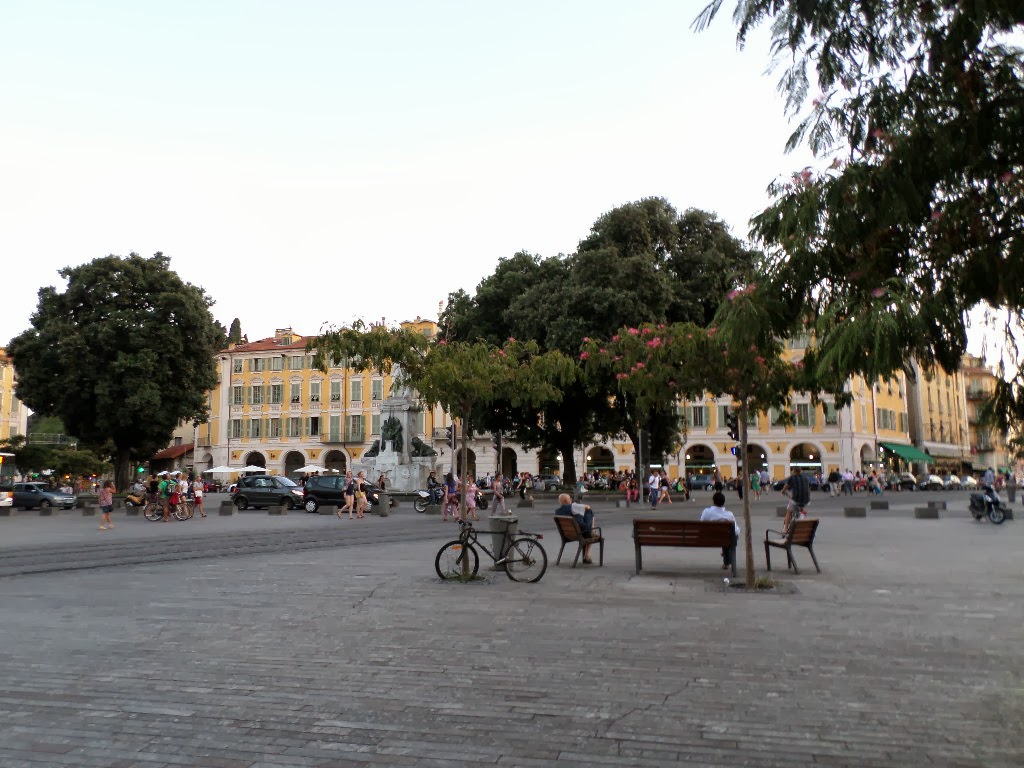
Place Garabaldi


The original draft pointed out that Nike was the name of the Greek goddess of victory.  We learned this when watching a BBC documentary about the history of the Greeks.  Of course Nike is also the name of a popular brand of running shoe and though I've had good experience of Nike's Air Pegasus, I'm currently enjoying my Sauconys.  

The city of Nice's name, relating to the same goddess, came about around 350 BC, after the Greeks successfully took the port from the neighbouring Ligurians.

Bill's sense of humour being what it is - it's probably a national trait, but his is more pronounced than most - I've found that it doesn't do to describe anything as 'nice' when in the city of 'Nice'.  

Wondering if the term might in any way relate to victory I looked it up and found that 'nice' is actually from old French, meaning 'foolish'.  I shall refrain here from anything other than relating the information I found at www.etymonline.com :

nice (adj.)
late 13c., "foolish, stupid, senseless," from Old French nice (12c.) "careless, clumsy; weak; poor, needy; simple, stupid, silly, foolish," from Latin nescius "ignorant, unaware," literally "not-knowing," from ne- "not" + stem of scire "to know".  "The sense of development has been extraordinary, even for an adj." [Weekley] -- from "timid" (pre-1300); to "fussy, fastidious" (late 14c.); to "dainty, delicate" (c.1400); to "precise, careful" (1500s, preserved in such terms as a nice distinction and nice and early); to "agreeable, delightful (1769); to "kind, thoughtful" (1830).

"In many examples from the 16th and 17th centuries it is difficult to say in what particular sense the writer intended it to be taken." [OED]

By 1926, it was pronounced "to great a favourite with the ladies, who have charmed it out of all its individuality and converted it into a mere diffuser of vague and mild agreeableness." [Fowler]


"I am sure," cried Catherine, "I did not mean to say anything wrong; but it is a nice book, and why should I not call it so?""Very true," said Henry, "and this is a very nice day, and we are taking a very nice walk; and you are two very nice young ladies.  Oh!  It is a very nice word indeed!  It does for everything." [Jane Austen, "Northanger Abbey," 1803]

Wednesday, 29 May 2013

If Walls Could Talk

Last week I talked about Amanda Vickery's book, The Gentleman's Daughter.  Today I want to share a few of the fun bits from Lucy Worsley's book, If Walls Could Talk - An Intimate History of the Home


I just wanted to share some things I learned about words, because you know how much I love words. For example, the origin of the term 'upper crust', from medieval days:


"At the bottom end of the hall an elaborately carved screen was constructed to hide the entrance to the kitchens.  It disguised the doors to the buttery (for storing drinks) and the pantry (where bread was kept).  The pantry was the workplace of the pantler, who handed out bread to the household. ... 'Trenchers' were slices of old bread which acted as throwaway plates.  They were formed from the burned and blackened bottoms of loaves. The more desireable top crust was eaten at once by the master and guests, hence the enduring term 'upper crust' for something posh." 

Ever wonder why desert and dessert were so similar in sound and appearance but nothing to do with one another?  Turns out they are in fact related terms:


"The separating out of sweet from savoury was an important development of the sixteenth century.  One step towards the breakdown of the communal household meal was the new Elizabethan practice of serving the sweets that now followed the main meat course in a different room.
Often a concert or play followed dinner in the great hall, so it was necessary to clear the tables away.  The action of removing the dirty plates from the tables was in French called the desert, the creation of an absence (the same word used for the Sahara).  This act of 'deserting' the table gave its name to the dessert or sweet course served elsewhere while the entertainers were setting up."

I always wondered about sculleries, given that this house and those of our neighbours all had one.  Most of us have modernised and joined the two kitchen-y rooms together, but I always wondered about the term 'scullery' since I associate sculling with some kind of boat.  Turns out sculleries were where the dishes were washed (also cleaning food, plucking birds, etc - the dirty stuff).  Escuelerie is the French word for 'dish room'.  

I've always wondered why Brits call 'cookies' biscuits (or why American's call them cookies). Lucy doesn't explain fully, but she does tell you about the term 'biscuit':


"Early ovens work quite differently from modern ones, where heat is provided continuously throughout the cooking process.  A stone- or brick-lined oven is heated before the food goes in, by the burning inside it of bundles of twigs called faggots.  Then the ashes are raked out, loaves are shovelled in, the door is closed and the bread is left to bake in the slowly cooling oven. 
When I used the bread oven at the Weald and Downland Museum, we stopped the oven's opening with a wooden door previously soaked in water to prevent it from catching fire. We sealed the gaps around the door with a strip of uncooked dough.  When this dough was baked, we knew that the bread inside must be finished too.  After the baking of the bread, the oven still contained just enough heat to bake a second round of cakes or biscuits.  The very word bis-cuit means 'second cooked'.
Cookie, was recognised in American English from 1703.  It comes from the Dutch word koekje,  for 'little cake', a diminutive of koek, for 'cake'.  I can only guess that Brits are more likely to take words from the French language, given the Norman invasion and all, in spite of the fact that their sovreign from 1689, was Dutch.  We could go on to talk about why the colour orange links Ireland, Holland and France, but that would be another post.

Getting back to If Walls Could Talk, it really is a good read, not least because she talks about what people actually did in bed.  You'll have to read her book to find out, but it's probably not what you're thinking.


Monday, 2 July 2012

Nelson

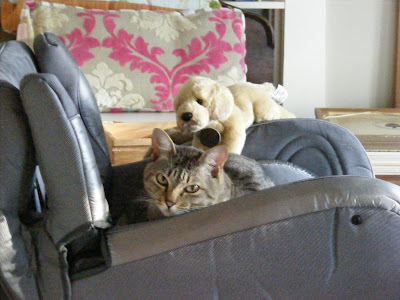
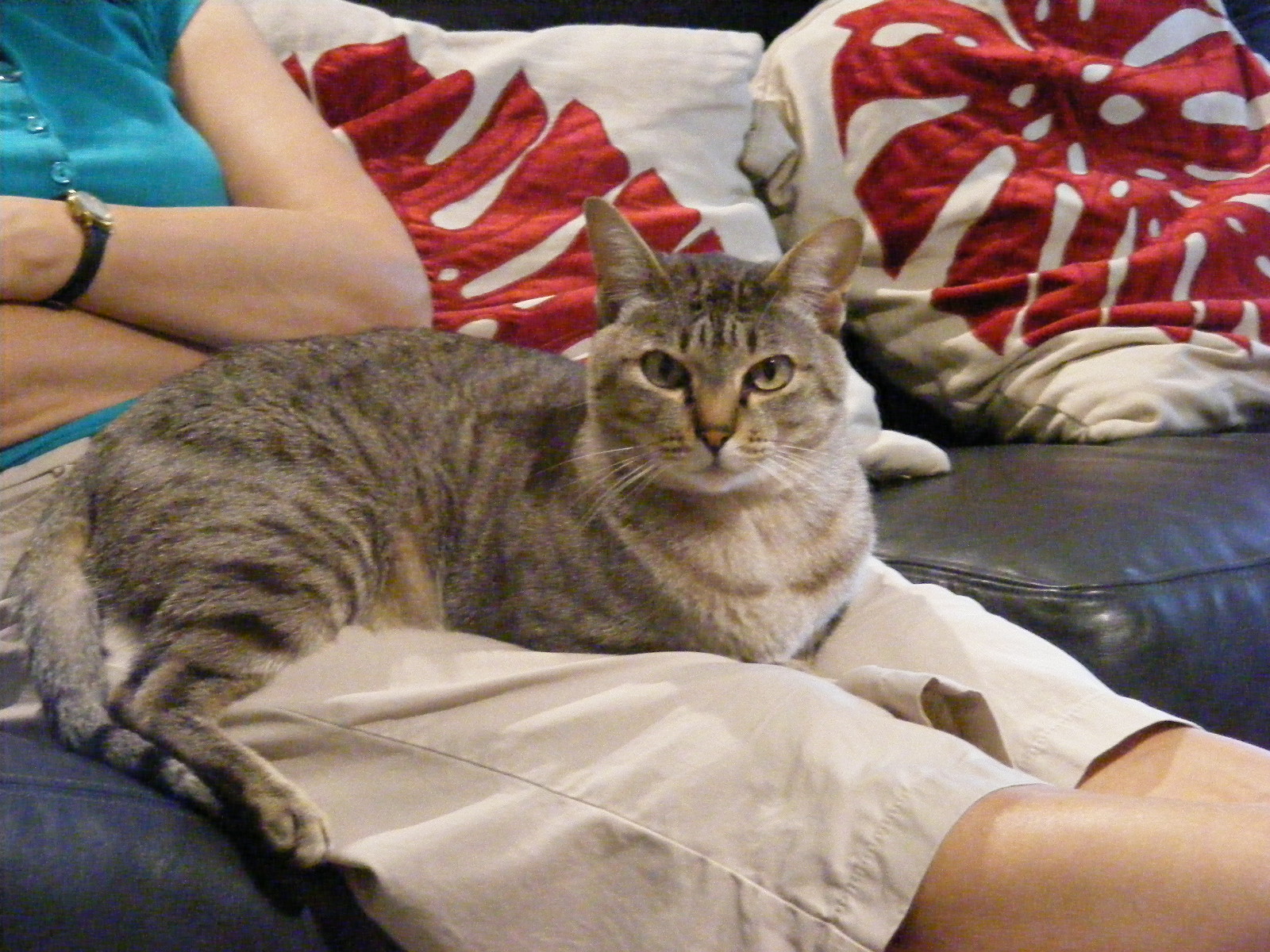
Jane's daughter, Jenni, and her husband Cedric have a cat named Nelson.   I can't find my notes - and I did make some - but I believe he is an Australian Mist;  They are bred from Burmese, Abyssinian and Australian Domestic Short-haired cats and are particularly suited to indoor life.  Being a house-only cat and thus virtually, if kindly, imprisoned, he is named after Nelson Mandela.


Jane came back early from Avoca do take up cat-sitting while Jenni and Cedric were away.    Also, to get some quiet time for herself after the stretch of busy-ness and stress of those weeks.

When Bill and I returned to Sydney a few days later, Nelson was still pining for mommy and daddy, though he did pose for photos and allow petting at times.


This will be the last post about Australia for a while. I think it's time to go home, don't you? But before we do, let me tell you about some new words I learned.

You didn't really want to do any ironing, did you?


Stickybeak: An inquisitive person; a Nosey Parker; The act or an instance of looking at or watching something, especially something which does not directly concern the one looking; to pry or to snoop. As in "Let's take a stickybeak at that house that's for sale."
Can't you see I'm busy topping up my stripes?


 Bagsy: declaring a first claim to something to which no individual has any clearly recognized right. As in, "I call bagsies." In American, one might say "I've got dibs." In fact there is a whole Wikipedia entry about the origin of the term 'dibs'. 


When is my Mommy coming to get me?


Bogan: Usually pejorative or self-deprecating, for an individual who is recognised to be from a lower-middle class background or someone whose limited education, speech, clothing, attitude and behaviour exemplifies such a background. I picked this up from Corinne Grant's book and she seemed to mainly refer to people's nerdy clothing style, basically meaning anyone British or Dutch. (She's a comedian). The Geordie word would be 'charver'. I've lost my American term.


Someone get this idiot dog off my back!


 Daggy / daggies: Uncool, unfashionable, but comfortably so. This is the term used to refer to shabby underwear in an advert for a feminine hygiene product. I remember the term from The Thornbirds, it being the result of diarrhea in sheep. Apparently short for daglock (I'm never going to look at dreadlocks the same again) and not to be confused with bogan.


Daddy plays rough, but I love it.
Budgie-smugglers: Bill dropped this one on me one day at the beach when he was making observations about age and choice of swimwear. He concluded that the youngsters preferred board shorts and the oldies liked budgie-smugglers. He tends to wear the loosed, lined swimming shorts.

 
You're not really taking a photo of my rabbit feet are you?
Isn't English an amazing language?