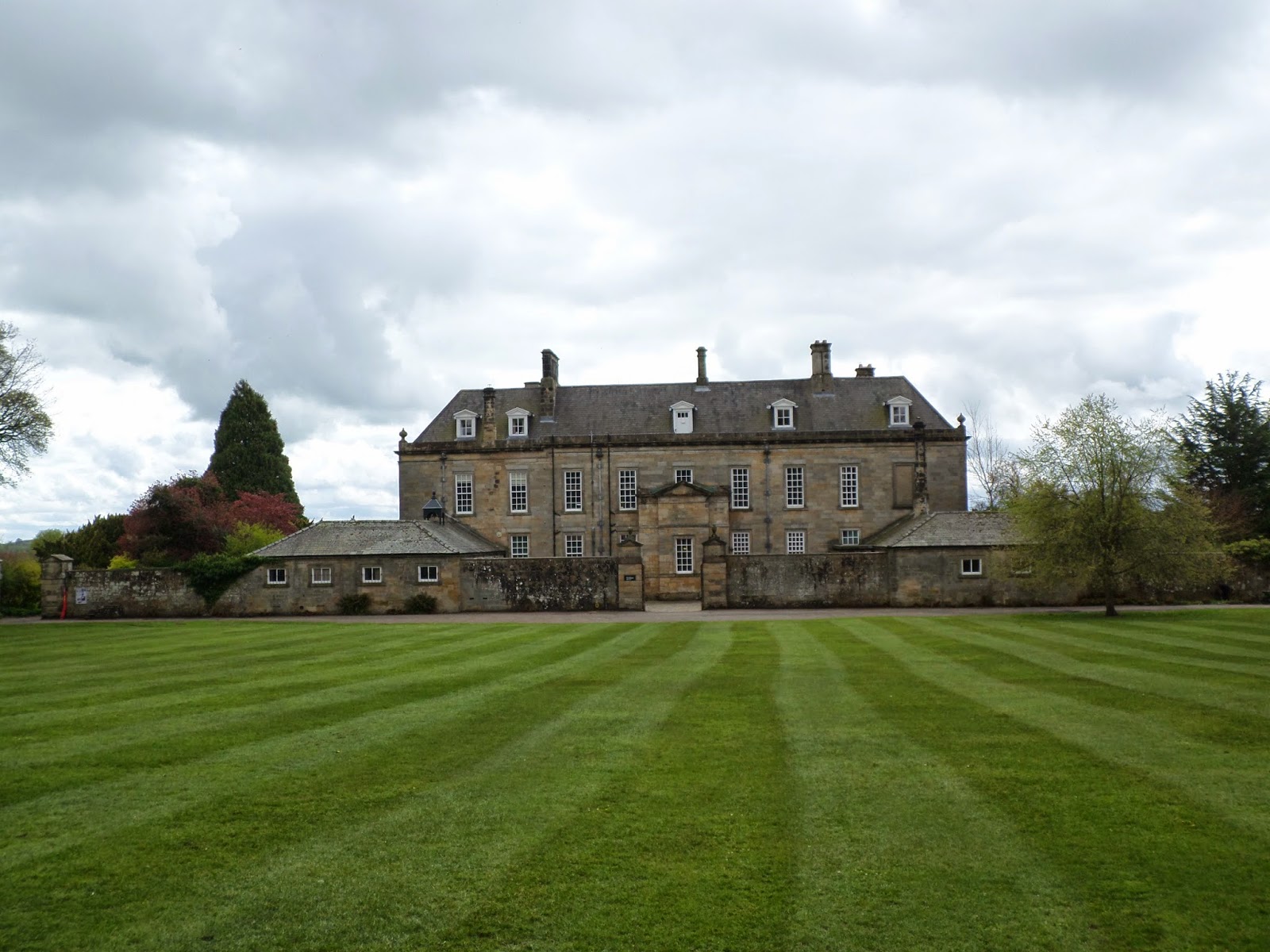
Time to catch up, talk, notice details, snap photos, enjoy the mild spring weather. Nothing better than a day like this.
Monday, 19 May 2014
A WalkThrough a Wood
Through a wood, past a bridge and some sheep, over some stepping stones...
Time to catch up, talk, notice details, snap photos, enjoy the mild spring weather. Nothing better than a day like this.
Labels:
Friends,
Local stuff,
National Trust,
Northumberland,
Out and About
Sunday, 18 May 2014
Manhunt
I love to play with my post titles. They are often silly private jokes. I chose this one mainly because how often will I get to talk about a 'manhunt'? No, it doesn't refer to a police chase. Nor is it about that song from the movie Flashdance. Is that telling my age? Well, no matter.
I believe this is related to a 'hash'. (No, it's not food either, but does involve drink). The first time Bill and I encountered a 'hash' was on our first visit to Sydney. Jane knew we were into running and so she looked for an event we could join in. The Sydney Hash House Harriers was celebrating St. Patrick's Day with a hash involving Baileys and Guinness, if I remember right. It sounded really daft but we went along for the fun.
As they did it, a course was planned in advance and marked with symbols indicating which way to turn. The hash course has loads of false trails which you don't know are false until you find the symbol telling you to turn around. The faster runners of course found and deduced the false trails first, often catching the slower runners about to enter and able to warn them off taking that turn. The result is that slower runners should follow more or less the true course, letting faster runners do the work of travelling the extra distance of the false trail. It is a way of letting runners of all abilities run together, after a fashion. People shouted 'on-on' a lot and I think there was some guy running around tooting a bugle (an allusion to a Fox Hunt - the kind done on horseback - no doubt). Halfway through the run there was a bandstand with tots of alcohol on offer. Can't say I've ever run under the influence before then or since. It doesn't help much.
When we finished running there was a 'barbie' (cook out) and a meeting in a pub where new people were required to 'down-down' as in chug a half pint of beer. Other people seemed to get beer poured on their (new) trainers. It was all a bit mad. Bill says it's all very 'public school' (upper class), ex-pat stuff. Which according to the HHH history, is true. Jane & Chris joined for a while, though they were more of the walking persuasion and Jane was 'Hon Sec' (honourable secretary) for a while. She sent us HHH t-shirts for Christmas that year.
Wikipedia dates Hash runs back to 1938 in Malaysia, but they apparently based their runs on what Brits called a 'paper chase' that dates back to 1880s, which is in turn based on the Elizabethan game of 'Hunt the Hare' or 'Hunt the Fox'. The Paper Chase involves a lead runner dropping bits of paper for his chasers to find. The 'hare' or the 'fox' are usually the faster runners in a group.
What has all this to do with Wallington Hall? Well, it seems that George M. Trevelyan, whilst in his undergraduate days at Trinity College, Cambridge, was a co-founder of a race in the Lake District, sometimes called the Lake Hunt and sometimes referred to as the 'Trevelyan Manhunt', beginning in 1898. G.M.'s (disinherited) nephew was involved in this race for forty-two years and so far as I can tell, it is still run, but by two separate groups. There is the Trevelyan Manhunt and there is possibly a manhunt run by Trinity College, Cambridge.
Though, given the 'health and safety' considerations raised by this author, it may have fallen by the wayside for Cambridge students. In any case it is clearly considered an historical and hallowed tradition by some, even important enough to mention in their obituary.
| Somewhere I have a photo of people running up and down Cheviot, but for now, Wallington Hall will have to suffice as illustraion. |
I believe this is related to a 'hash'. (No, it's not food either, but does involve drink). The first time Bill and I encountered a 'hash' was on our first visit to Sydney. Jane knew we were into running and so she looked for an event we could join in. The Sydney Hash House Harriers was celebrating St. Patrick's Day with a hash involving Baileys and Guinness, if I remember right. It sounded really daft but we went along for the fun.
As they did it, a course was planned in advance and marked with symbols indicating which way to turn. The hash course has loads of false trails which you don't know are false until you find the symbol telling you to turn around. The faster runners of course found and deduced the false trails first, often catching the slower runners about to enter and able to warn them off taking that turn. The result is that slower runners should follow more or less the true course, letting faster runners do the work of travelling the extra distance of the false trail. It is a way of letting runners of all abilities run together, after a fashion. People shouted 'on-on' a lot and I think there was some guy running around tooting a bugle (an allusion to a Fox Hunt - the kind done on horseback - no doubt). Halfway through the run there was a bandstand with tots of alcohol on offer. Can't say I've ever run under the influence before then or since. It doesn't help much.
When we finished running there was a 'barbie' (cook out) and a meeting in a pub where new people were required to 'down-down' as in chug a half pint of beer. Other people seemed to get beer poured on their (new) trainers. It was all a bit mad. Bill says it's all very 'public school' (upper class), ex-pat stuff. Which according to the HHH history, is true. Jane & Chris joined for a while, though they were more of the walking persuasion and Jane was 'Hon Sec' (honourable secretary) for a while. She sent us HHH t-shirts for Christmas that year.
Wikipedia dates Hash runs back to 1938 in Malaysia, but they apparently based their runs on what Brits called a 'paper chase' that dates back to 1880s, which is in turn based on the Elizabethan game of 'Hunt the Hare' or 'Hunt the Fox'. The Paper Chase involves a lead runner dropping bits of paper for his chasers to find. The 'hare' or the 'fox' are usually the faster runners in a group.
What has all this to do with Wallington Hall? Well, it seems that George M. Trevelyan, whilst in his undergraduate days at Trinity College, Cambridge, was a co-founder of a race in the Lake District, sometimes called the Lake Hunt and sometimes referred to as the 'Trevelyan Manhunt', beginning in 1898. G.M.'s (disinherited) nephew was involved in this race for forty-two years and so far as I can tell, it is still run, but by two separate groups. There is the Trevelyan Manhunt and there is possibly a manhunt run by Trinity College, Cambridge.
Though, given the 'health and safety' considerations raised by this author, it may have fallen by the wayside for Cambridge students. In any case it is clearly considered an historical and hallowed tradition by some, even important enough to mention in their obituary.
Saturday, 17 May 2014
The Disinherited Son
The son that was effectively disinherited by the donation of Wallington Hall to the National Trust, George L. Trevelyan, sounds like an early day hippie to me (he's even got long hair). He imagined his family was descended from a knight of King Arthur's round table; granted, Sir Trevillian sounds like Trevelyan. He is called a founding father of the New Age philosophy, you know metaphysics, spritualism and self-help psychology stuff.
I guess when your worldly goods have been given away before they become legally yours, it's just as well to get a more spiritual outlook on life.
In addition to being one of the first trained teachers of the Alexander Technique, he was associated with the Findhorn Foundation near Moray, Scotland, a large 'intentional community' (commune). I've never visited an 'ecovillage' but it sounds interesting.
In addition to all the spiritual and educational ideas, Trevelyan was involved with another activity, a tradition begun by his uncle, my favourite George M. Trevelyan. I'll tell you about that in my next post.
I guess when your worldly goods have been given away before they become legally yours, it's just as well to get a more spiritual outlook on life.
In addition to being one of the first trained teachers of the Alexander Technique, he was associated with the Findhorn Foundation near Moray, Scotland, a large 'intentional community' (commune). I've never visited an 'ecovillage' but it sounds interesting.
In addition to all the spiritual and educational ideas, Trevelyan was involved with another activity, a tradition begun by his uncle, my favourite George M. Trevelyan. I'll tell you about that in my next post.
Labels:
Biographical,
History,
National Trust,
Northumberland
Friday, 16 May 2014
Trevelyan's Friend and Family
If you didn't read all about Sir Charles Philips Trevelyan the other day - and I'd be dead amazed if you did - you won't have read what his friend, Beatrice, said about him. But first, a bit about her.
Beatrice Webb (nee Potter) 1858-1943) co-founded the London School of Economics and Political Science, or LSE, which suggests she was more than a pretty face with a well-endowed purse. Through her interest and work in the area of social work and economic theory, she gave us the term 'collective bargaining'. As well as helping create the LSE, she was also active in the Fabian Society and in the formation of the Cooperative movement. She was altogether an amazing woman. So now you're all set for the next pub quiz.
Sounds like a good catch, eh? His wife, Mary Katherine Bell apparently did nothing more exciting than bear the next baronet, who was effectively disinherited when Sir Charles donated Wallington Hall to the National Trust. However her half-sister's name rang a...never mind. I once did my best to read a biography of Gertude Bell, but didn't manage. Perhaps I'll try a different one some time. Surely the life of the first woman to cross the Sahara Desert is worth reading about.
| Beatrice Webb Photo from Wikipedia |
Beatrice Webb (nee Potter) 1858-1943) co-founded the London School of Economics and Political Science, or LSE, which suggests she was more than a pretty face with a well-endowed purse. Through her interest and work in the area of social work and economic theory, she gave us the term 'collective bargaining'. As well as helping create the LSE, she was also active in the Fabian Society and in the formation of the Cooperative movement. She was altogether an amazing woman. So now you're all set for the next pub quiz.
My cousin Frank, in Glasgow, once remarked that having seen some of the amazingly grand houses in Britain he was astounded that there hadn't been a revolution here like there was in much of Europe in the late 1800s, early 1900s. I think it might well be in part because of the work of the aristocrats with socialist leanings.
Anyhow, what Beatrice Webb said about Sir Charles is
[He is] a man who has every endowment - social position, wealth, intelligence, an independent outlook, good looks, good manners.
| Sir Charles Philips Trevelyan (1870-1958) (photos from Wikipedia) |
Sounds like a good catch, eh? His wife, Mary Katherine Bell apparently did nothing more exciting than bear the next baronet, who was effectively disinherited when Sir Charles donated Wallington Hall to the National Trust. However her half-sister's name rang a...never mind. I once did my best to read a biography of Gertude Bell, but didn't manage. Perhaps I'll try a different one some time. Surely the life of the first woman to cross the Sahara Desert is worth reading about.
Thursday, 15 May 2014
Witches Broom
As we set out from the house one of the first things we saw was this tree with 'lumps' in it. We speculated about whether this was mistletoe, but I was pretty sure that had green leaves and white berrys. Mistletoe was the state flower of Oklahoma when I was growing up, but it seems some people want it to be an 'Oklahoma rose' instead. Next thing you know they'll be wanting to ditch the scissor-tailed flycatcher, our state bird. These lumps, however, just looked to be a bunch of twigs. Vivien thought it was some kind of nest, but I wasn't sure I wanted to see what would come out of those big ones.
This is apparently an example of Witches' Broom, a deformity caused by many shoots growing from the same point. Wikipedia seems uncertain as to the specific cause of this, but the lumps do serve a useful purpose for some widelife, providing them with nests, so Vivien was right on that.
Funny how people are so ready to name things as supernatural. I don't think they look at all like a broom, but maybe brooms were shaped differently in the past.
Labels:
Friends,
Local stuff,
National Trust,
Northumberland,
Out and About
Wednesday, 14 May 2014
Wallington Hall
Since Bill bought us National Trust membership when we visited Seaton Delaval Hall last month, Vivien (a long time member) and I have a whole other set of places to visit. Granted, there aren't many National Trust properties up here in our area, a reason Bill has previously resisted joining. However, Vivien pointed out that one can return again and again, useful since there is so much to see it's always a good day out. She is very fond of Wallington Hall and now I can see why.
We stuck to the gardens on this trip - and didn't even manage all of those; we still have loads to explore! Vivien was patient enough to let me take over 200 photographs. I shall resist showing them all to you and try to get better at the art of a short post (don't hold your breath). This isn't likely to be one.
There are two local families associated with this estate, the Blackett's and the Trevelyan's. I've not encountered the Blackett's much as yet, except that their name creeps up on road signs and the like. I've a real fondness for one particular Trevelyan, as he is the author of my favourite social history book, about which I've written on several occasions. George Macaulay Trevelyan's name is also found in hallowed places like the Lit Phil Library.
The National Trust leaflet says this:
Naturally I had to read about Sir Charles Philips Trevelyan and find out how he was related to G. M. Trevelyan. (Sir Charles was G.M.'s older brother). I found interesting snippets to share, but I'm going to put those in drafts to accompany other photos.
We stuck to the gardens on this trip - and didn't even manage all of those; we still have loads to explore! Vivien was patient enough to let me take over 200 photographs. I shall resist showing them all to you and try to get better at the art of a short post (don't hold your breath). This isn't likely to be one.
There are two local families associated with this estate, the Blackett's and the Trevelyan's. I've not encountered the Blackett's much as yet, except that their name creeps up on road signs and the like. I've a real fondness for one particular Trevelyan, as he is the author of my favourite social history book, about which I've written on several occasions. George Macaulay Trevelyan's name is also found in hallowed places like the Lit Phil Library.
The National Trust leaflet says this:
Gifted to you by Sir Charles Philips Trevelyan, socialist MP and ‘illogical Englishman’, our 13,000 acre estate has something for everyone.
Naturally I had to read about Sir Charles Philips Trevelyan and find out how he was related to G. M. Trevelyan. (Sir Charles was G.M.'s older brother). I found interesting snippets to share, but I'm going to put those in drafts to accompany other photos.
| Another ha-ha! |
Tuesday, 13 May 2014
Dressing Windows
In Europe there are many houses with doors and windows right on the pavement, where people walk past at eye level. Putting up some sort of screen is necessary for privacy, but in Britain this is further complicated by the need for light. Once one becomes accustomed to natural light, the artificial stuff just isn't the same.
I've noticed some of the window dressings in the cities we've visited and snapped photos of them for inspiration (but can I find them?). We've lived with our large bay window in the kitchen being a bit of a goldfish bowl for some eighteen years and I'm only now deciding I'd like to try for a bit more privacy.
The typical solution here is lace curtains (which Vivien tells me is now 'very old lady'). I don't mind 'old lady' at all but I was thinking more in terms of the Continental approach of just bits of lace in interesting shapes. They wouln't protect from a peeping Tom, but we have a few feet of yard and a brick wall between the bay window and the pavement, so I'm not so worried about that. One benefit of being close to neighbours is that there are lots of people around to observe unsocial behaviour. Besides, I still have drapes that close at night.
I checked out the yarns available, figuring I could manage a granny square or some double/treble crochet. I haven't decided yet how to approach this, as the three windows are different sizes, two about 30 x 40" and the centre window about 40" square.

Any suggestions?
I've noticed some of the window dressings in the cities we've visited and snapped photos of them for inspiration (but can I find them?). We've lived with our large bay window in the kitchen being a bit of a goldfish bowl for some eighteen years and I'm only now deciding I'd like to try for a bit more privacy.
| Ghent, Belgium |
The typical solution here is lace curtains (which Vivien tells me is now 'very old lady'). I don't mind 'old lady' at all but I was thinking more in terms of the Continental approach of just bits of lace in interesting shapes. They wouln't protect from a peeping Tom, but we have a few feet of yard and a brick wall between the bay window and the pavement, so I'm not so worried about that. One benefit of being close to neighbours is that there are lots of people around to observe unsocial behaviour. Besides, I still have drapes that close at night.
I'm collecting ideas for this project. A few things caught my eye in a home decor shop in North Shields the other day, from chiffon 'swags' to machine crocheted pieces intended for chair backs and arms (now that I would call 'old lady'). I was originally thinking of picking up the odd doily here and there and having a go with red dye. However, hand made bits at the flea markets don't come with a fiber content label and only natural fibers will hold dye; also I'm choosy about the shade of red.
I checked out the yarns available, figuring I could manage a granny square or some double/treble crochet. I haven't decided yet how to approach this, as the three windows are different sizes, two about 30 x 40" and the centre window about 40" square.
Any suggestions?
Subscribe to:
Posts (Atom)