Monday, 8 April 2013

Hats

One morning in Cockermouth, I took off on my own.  It seemed like a good idea for several reasons:


  • Gathering a group of people and a new baby can be like herding cats.
  • I was ready for some solitude.  I enjoy gatherings a lot and I'm not aware of overload until I get this overwhelming thirst for my own company.
  • Part of that thirst is also about being able to potter around and see everything (Bill makes it sound like a crime) without anyone being impatient with me.


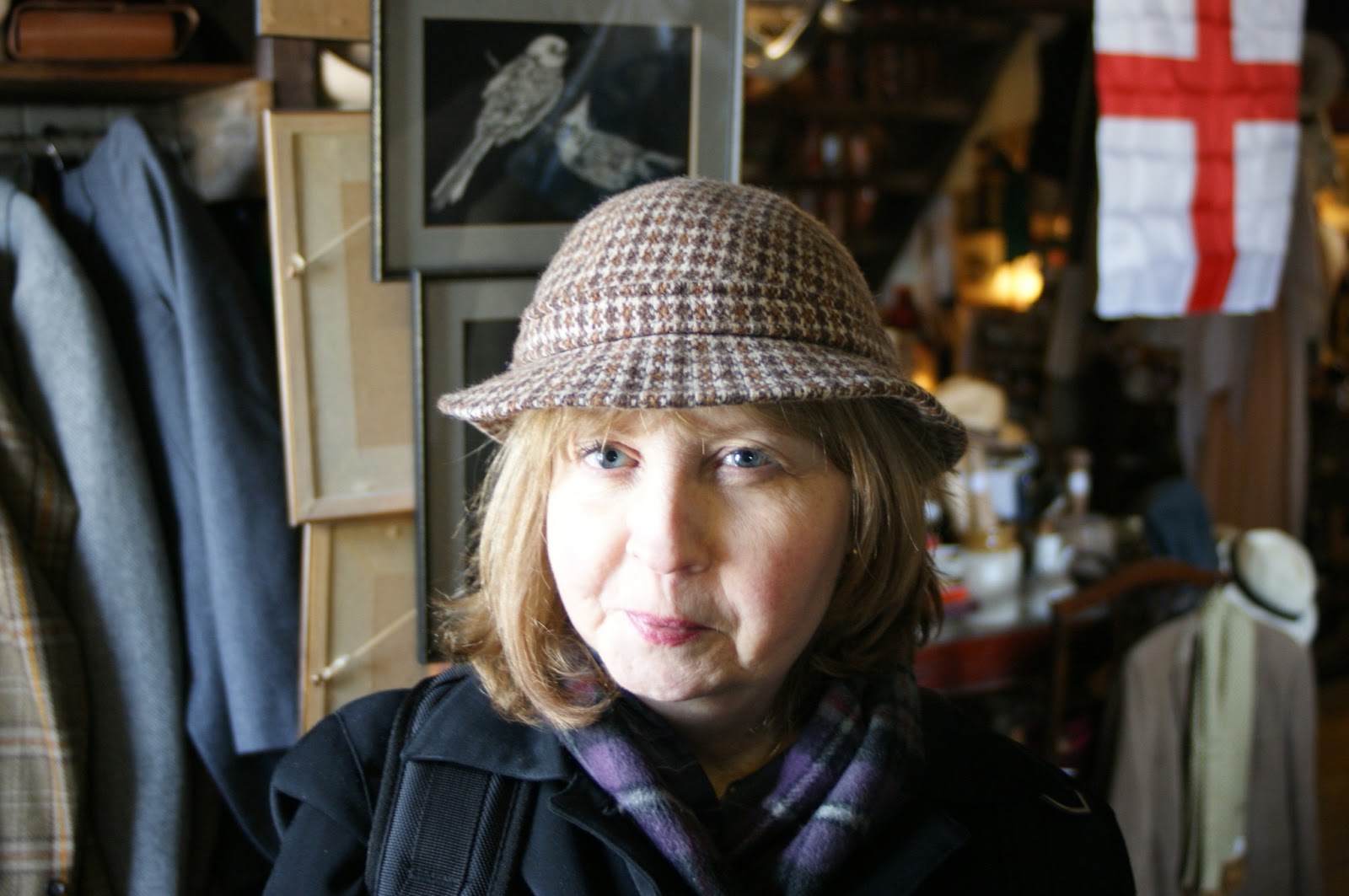
On this journey I found several things I later dragged Bill around to see (he enjoyed it, really). Two things were these hats, which I ended up buying, from an amazing antique warehouse.   I'd no idea Bill was going to snap my photo when I tried them on for him, hence the silly expressions, etc.


That bird is in a picture, not on the hat (see below).


These hats are vintage - even more vintage than I am!


And on the subject of hats (and vintage), did I mention we were celebrating Martin's 40th birthday as well as Bill's 65th?


Bill bought him an 'old man' cap, just like his own.  I wonder if Martin will actually wear it?


When at Jennings, waiting for the tour to proceed, we played around with Bill's hat.


I quite liked it!


[Note to self:  wear eye make-up when on these little jaunts...]

Oh!  And speaking of hats, there is this one that I bought for £3 at a charity shop.  


I spent an afternoon with a glue gun sticking on fabric flowers...but that's another post!

Friday, 5 April 2013

Part XXXIV - The Lower Class and Conservatism

This is a series about a book, Theory of the Leisure Class, by American economist Thorstein Veblen. He titled Chapter Eight Industrial Exemption and Conservatism.


As we saw in earlier posts conservatism is, among other things, about avoiding change, not having to adjust to new ways.  The leisure class is able to be conservative in this regard because they don’t work for their living and are shielded from change by their economic power.  The middle class is more likely to jump on new ideas and to try to direct change to meet their own ends.


Veblen reiterates that adjusting to new habits and outlooks requires mental effort, 
"— a more or less protracted and laborious effort to find and to keep one’s bearings under the altered circumstances."

This takes energy and success in coping with change presumes that there is excess energy to expend, beyond what is needed for the struggle for subsistence.  He points out that doing physical labour and shortage of nourishing food are hardships that limit the energy that is needed to cope with change.  The poor
“are conservative because they cannot afford the effort of taking thought for the day after tomorrow; just as the highly prosperous are conservative because they have small occasion to be discontented with the situation as it stands today.”

Veblen goes on to say that the very existence of a leisure class acts to make the lower classes conservative by keeping them in poverty.
“The accumulation of wealth at the upper end of the pecuniary scale implies privation at the lower end of the scale.”

This enforcement of poverty by the leisure class is not just by wielding their economic power over the poor, but also by ‘fixing the canons of reputability’ and thus fostering the practise of conspicuous consumption as an element in the standard of decency among all classes.  The requirements of decency are considerable and imperative so that after physical needs are met, money is often diverted to satisfy this ‘conspicuous decency’ rather than ‘to added physical comfort and fullness of life.’ 

Veblen reckons that the institution of a leisure class hinders development in several ways:  
"(1) by the inertia proper to the class itself, 
(2) through its prescriptive example of conspicuous waste and of conservatism, and
(3) indirectly through that system of unequal distribution of wealth and sustenance on which the institution itself rests.
To this is to be added that the leisure class has also a material interest in leaving things as they are. Under the circumstances prevailing at any given time this class is in a privileged position, and any departure from the existing order may be expected to work to the detriment of the class rather than the reverse.”

As I have mentioned before, the whole concept of conservatism was a revelation to me later in life than I want to admit.  I can remember a particular conversation with my boss in Utah (also a Mormon bishop) in which he pointed out to me that poor people are also often quite conservative; at which point I threw up my hands and acknowledged ignorance on the topic.  More than a decade later, Veblen provided me with an explanation for this, which I found very satisfying even though I know the world has changed a great deal since 1899 when his book was published. 

Wednesday, 3 April 2013

Jennings Brewery

One of the few things we all did in Cockermouth together was to tour the Jennings brewery.  I wasn't that keen on it but I was pleasantly surprised.


First we got a little history of when John Jennings bought the brewery from a woman, whose history was unknown and I can't even recall her name, which is annoying.  His photo, and those of several of his descendants were on display. I do remember the man saying they brewed 50,000 barrels a year. Each barrel holds 32 gallons and there are 8 pints in a UK gallon.  I could hold the numbers in my head, but not do the math! And Jennings is considered a very small brewery.  They were taken over by Marston's in 2007 and have expected to be closed on any number of occasions, but Marston's have supported them and maintained the Jennings brand.


Then we climbed a bunch of stairs made of metal grating.  I've learned not to look down.  Martin chose to stay behind with Charlotte and her pram, tended by the tour guide's wife who minded the till. She was promising him tea and cake to keep him occupied. Martin seems to have this effect on women, I don't know how he does it. I'm certain he has never gone hungry in his life, not in the presence of any female possessed of any cooking skills.

I don't remember all the details, but will tell you what did stick.  For one, the soaking of barley is called malting.  It smells lovely.  The stainless steel vats are enormous.  A large part of our house would fit in one.  Just looking down into an empty vat made my stomach flip.  The guide said that men have to go down inside to clean the things occasionally and they get terrible claustrophobia. I'm not prone to such a thing, but I fully understood their difficulty.  


Another part I remember was the toasted malt.  He showed us a series of jars labelled 'pale', 'crystal', 'amber' and 'chocolate'.  Then we went up more metal stairs and there was a room full of paper bags full of grain and several open plastic tubs.  I asked about rodent control, a question he didn't seem to like (it's contracted out).  Does anyone remember when The Book of Lists came out in the late 70s?  It brought to light that the governing bodies had a permissible number of rat pellets per unit of cereal...

We nibbled the various grains, only I gave 'chocolate' a miss.  The others all tasted of lovely toasted cereals but everyone agreed that 'chocolate' tasted like burned toast.  I recognise charred food when I see it.  

We also visited a room full of hops.  These are a flowering vine that adds the bitterness to ales and beers.  If you see a dried vine draped around the bar or other feature in a pub, it is usually dried hops.  While we stood there crushing the herb-y leaves in our hands he told us how producing ale was the response to poor water quality in the West and hence our livers developed the capacity to metabolize alcohol.  In the East, however, boiling water for tea was discovered to make the water safe and so many Asians do not have the capacity to deal with alcohol.  This article supposes that the lack of liver capacity drove the need for tea rather than the other way around.  I've no idea which, if either, way around is correct.

Yeast is also important for making ale and beer.  For ale, the yeast floats on top, for beer the yeast is at the bottom.  Yeast can be re-used as long as it's viable.  Each brand has its own type of yeast, never mind its own type of hops and cocktail of malts.  There is a yeast bank for all the brands somewhere, and after the flood of 2009, this bank was called upon when they were able to resume brewing.


At the end of the tour we each got three half pints to try from the half dozen on tap.  The Simon's (what Bill calls Simon & Simone) were methodical and managed to get one of each kind.  Bill and I didn't have that forethought.  In any case I know what some of the ales tasted like and Bill and I don't favour the same kinds; as with many foods he tends towards the sweet, I prefer bitter.  


The guide went on to explain how some of them got their names.  That's one of the best things about visiting a British pub, checking out the funny names on the taps.  For example 'Cocker Hoop':
"The name is derived from 'Cock-a-Hoop', an old custom of removing the cock (or spigot) from a barrel and resting it on the hoop of the cask before commencing a drinking bout, but was changed to reflect the brewery's location on the banks of the River Cocker."

or 'Sneck Lifter':
"In northern dialect sneck means door latch and a sneck lifter was a man's last sixpence which enabled him to lift the latch of a pub door and buy himself a pint, hoping to meet friends there who might treat him to one or two more."


I enjoyed this tour more than I thought I would.  I was vaguely aware about malt, hops and yeast, but I didn't know anything about 'fish finings', or fish 'swim bladders'.  Apparently these are added to beers and wine and then removed ... or not.  First I heard of this!

Martin finished off his (second or third) pie and joined us for a round of photos.  Apparently the youngest always gets posed pulling a pint.


Monday, 1 April 2013

Old Grey Goat

(Sorry, Bill, it's your own fault for choosing that lodging and I just can't resist.)

It's amazing how quickly five years has passed.  Five years ago, Bill turned 60 and the family gathered at Kettlewell.  This blog was there to report on it.  Later that year eleven of us went touring Route 66 (with a few additions) in an RV.   This year there are no grand tours planned, though we do have more trips planned in our motor home.  

This year, for Bill's 65th birthday, the immediate family  - that's Bill's three children and their partners:  Helen (Martin), Simon (Simone), Sarah; and Helen and Martin's six-month old daughter, Princess Charlotte) - all gathered in Cockermouth at The Grey Goat Inn.   

Helen and Martin came from Manchester, Simon from France, Simone from Germany, Sarah from Edinburgh and us from Newcastle, so it was no mean feat to gather.  


The Grey Goat Inn was, until about a year ago, a pub; now it is a 'holiday let'. Bill and I were the first to arrive and when we walked in we saw the owner. We were all quite shocked, as we recognised one another.  Hugh owns and runs a pub near us.  I've written about that, too.  I should go visit one afternoon (when it's quiet) and take some photos to share.  It's a pretty amazing place.  We knew Hugh had a place in Cockermouth, we just didn't know it was this one, it being let by an agent.  And while it's been a long time since we were at the Tynemouth Lodge, he recognised our faces from back when we went more often.

I was going to show you a bunch of photos we took of the Grey Goat, which dates back to 1780, but the website does that just fine.  Just click on that first photo and take the tour!

Easter approaching, I made everyone an Easter chick, using a pattern I've only ever seen the ladies at the sewing group use.


Amazingly, on our first jaunt around the town, Simon spotted a bunch of these in the window and said I'd just come early for some shopping!


Friday, 29 March 2013

Part XXXIII - The Vulgarity of Innovation

This is a series about a book, Theory of the Leisure Class, by American economist Thorstein Veblen. He titled Chapter Eight Industrial Exemption and Conservatism.


In the last post we started talking about societies' development from pressure to change.  In modern society this pressure is economic. The leisure class is 'exempt from industry', ie their income is not earned, and so this class is largely sheltered from economic pressures.  This allows them not to change, making this class largely conservative.

Veblen goes on to say that altered conditions brought about by social changes may benefit the group as a whole, but generally will result in a decrease 'of facility or fullness of life for some members of the group'.  Those at risk of losing from the change have the most incentive to accept new standards and in doing so to hopefully shape the new customs to their own advantage.  Veblen refers to the lower classes, but he means the middle class when he talks about people who try to create and direct change to their own advantage.  I don't recall that Veblen ever uses the term 'middle class' but he does talk about the 'business class'.

At first when Veblen is describing why the leisure class is resistant to change one things he's almost defending them, saying this is not due to any 'unworthy motive' such as protecting their own interests by maintaining present conditions.  He says that revulsion to change is instinctive in all men and only overcome by stress of circumstances. 
“All change in habits of life and of thought is irksome.”

If we weren’t all subject to the forces of economic urgency none of us would choose to change our ways.

Conservatism is an obvious feature of the wealthy class.  The wealthy class set the standard for what is respectable and desirable and therefore it is more respectable to be conservative
“… it is imperatively incumbent on all who would lead a blameless life in point of social repute. Conservatism, being an upper-class characteristic, is decorous; and conversely, innovation, being a lower class phenomenon, is vulgar.”

Even in cases where there is substantial merit in the case for innovation, particularly when 
“…the evils which he seeks to remedy are sufficiently remote in point of time or space or personal contact — still one cannot but be sensible of the fact that the innovator is a person with whom it is at least distasteful to be associated, and from whose social contact one must shrink. Innovation is bad form.”

I love that last sentence!

“The fact that the usages, actions, and views of the well-to do leisure class acquire the character of a prescriptive canon of conduct for the rest of society, gives added weight and reach to the conservative influence of that class. It makes it incumbent upon all reputable people to follow their lead. So that, by virtue of its high position as the avatar of good form, the wealthier class comes to exert a retarding influence upon social development far in excess of that which the simple numerical strength of the class would assign it.”

Some of the proposed changes that Veblen mentions that would (do any of these phrases seem familiar?) “… shake the social structure to its base … reduce society to chaos … subvert the foundations of morality … make life intolerable … confound the order of nature…” in 1899 were an interesting list:

the disestablishment of the Anglican Church
an increased facility of divorce
adoption of female suffrage
prohibition of the manufacture & sale of intoxicating beverages
abolition or restriction of inheritances

Any of this sound familiar?

Wednesday, 27 March 2013

Book about Doing Stuff

I see I never did quote the list of books I took with me to France and at this point I probably can't name them all.  I took copious notes from two of them, both about getting things done, but neither to do with David Allen.  I'm a real sucker for personal development books but, much like my watching an exercise video sitting in my house robe, I won't claim that I put a great deal of the theory into practice.

Much of Richard Templar's How to Get Stuff Done without Trying Too Hard is the common place stuff we all know, but I did learn a few new ideas, or at least thought about some things differently.  You might guess it was that last part that attracted me to choose this book...

Have a Routine.  Walk the dog at the same time each day, check emails after lunch, change the bed sheets on Sunday afternoon, etc.  The more routines, the less effort is involved in keeping track.  I know I have a small routine for housework which involves tidying the bedroom, bathroom and kitchen, mainly about clearing surfaces.  When I'm 'in the zone' doing this, it is practically effortless because it's a habit.  I know how I want those rooms to look and so it's not hard to make them so.  (The rooms I've not figured how I want them to look, well, they don't fare so well).

Do Little and Often.  He talks about putting things away and doing filing before they build up into big jobs.  I've also found this to be helpful when tackling big jobs.  Lately I've been working in the garden, something I want to like but I'm not sure I do.  I don't seem to mind it once I get started though.  I've been trying to make this a follow up to a short run when I'm warmed up.  I put on wellies and water-proof trousers and gloves and work until I've gathered a set number of bags of debris, then I stop before I'm exhausted and fed up.  

How to Make a To-Do List.  The first three things on your list should be 1.  Something quick, 2. Something you'll enjoy, 3. Something you've already done.  With three things ticked off the list, the rest looks more do-able.  I've tried this once and it was fun.  On the other hand, another idea he has is Do the Worst Thing First.  Not nearly as much fun...

How to Tidy.  If your mother, like mine, had other priorities than housework perhaps his system would be helpful.  a) have a bin bag, b) do related objects first (all books put away, then clothes, toys, trash, etc.), c) do specific areas, ie floors, surfaces, each one at a time, d) make a pile of what you don't know what to do with and leave this to the last and make decisions, e) make a pile of things going to other rooms, one for each room, and tackle this last so as not to be distracted.  Do d and e together.   

Be Decisive about Mess.  He says if we were clear about what we were doing, when we were finished with things, what they were for, where they lived and so on, there'd be no clutter.  That's how all those 'busy but tidy' people do it...  How many times have I picked something up, dithered about where to put it and then put it down again without making any decision.  I'm gradually getting better at making decision.  This bit of Templar's book really hit me between the eyes.

Ditch the Eco-Guilt.  I have wasted a lot of my time trailing to the recycling bin with every tiny scrap of paper to be sure nothing is wasted - except of course for hours of my life.  We are lucky here in that paper, glass, old batteries, textiles, a lot of metals and plastics can go straight into a recycling bin that is collected every two weeks.  I've visited several landfill sites and the surrounding areas through my work and I saw an appalling amount of stuff that was probably still usable, had it not been junk to start with.  I try very hard not to add to Britain's landfill sites unnecessarily.  On the other hand, when I'm done with something and it's not appropriate for a charity shop (they throw away an awful lot of the stuff they are given), it needs to go into the trash and I need to just do that.


Monday, 25 March 2013

Crafty Saturday

I spent this past Saturday, along with friends Vivien and Lucy, at a sewing workshop. I thought it would be a teacher-led class about how to use all the feet that come with your sewing machine.  However, it ended up being a play-around-and-try-out-a-bunch-of-stuff on your own day. 

Re-using tea bags...


I learned a few ideas:

Re-cycling trash bags


Sewing Circles:  Use masking tape to fasten a thumb-tack (Brits call them push-pins) pointy side up a few inches from the presser foot; I did it on the bed to the right of the needle, but I suppose some arrangement could be made to the left if you wanted a bigger circle.  Iron some stabilizer to a bit of fabric, then place under the needle and secure on the thumb-tack. If you don't have stabilizer, you might have some luck with putting a couple of pieces of fabric into a small-ish embroidery hoop to hold it stiff.  Choose a decorative stitch and begin sewing - the fabric pretty much takes care of itself and - all going well - you should have a perfect circle, the size defined by the distance between the thumb-tack and the needle.  It's a decorative thing I haven't thought of a practical use for as yet, but it looks cool.

More trash bags


Multi-threading:  Did you know it's not very hard to get more than one thread through your machine needle? One lady managed three!  It's just another fun variation on decorative stitching.  My machine doesn't have the multiple thread spool holders that some others do, but I managed a second thread on a bobbin on the bobbin thingy (if you sew, you'll know what I mean).

I could make this, but I'd never come up with the idea.


Cording:  You get some pretty cool effects zig-zagging over yarns, ribbons, cords and affixing them to fabrics.  If you are artistic, this can be another tool for you.  Also, just zig-zagging over cord alone with different colours produces some fun effects and makes the ordinary cord quite pliant, almost in a wire sort of way.  A sewing book I have talks about making children's jewelry with this cord, but I don't think Charlotte's old enough to appreciate this yet.

We know Gaynor; she's also on Pinterest


The best tip, though, was rather surprising to me.  I was in a room full of women who have sewn, knitted, embroidered for probably an average of 20-30 years, some are members of the local Embroiderers' Guild.  Almost every one of them - and the three of us - benefited a great deal from just reading the instruction manual that came with our machines from cover to cover.  I found out there were sewing feet in that little box at the back of my machine I'd never noticed.  Some ladies just did samplers of the various stitches their machines did - and there were some impressive machines there.   I did actually read mine when I first got the machine, at least the first few pages, but I'd forgotten a lot of it and never finished reading.  I must admit I only took note of the 'care of your machine page'...  


The photos here are from an exhibit at the Customs House in South Shields that Lucy and I visited in January.  There are a lot more photos, but they will have to wait for another day.

Nice little mice, by friend Lesley!