Friday, 15 March 2013

Part XXXI - Conspicuous Novelty

This is a series discussing Theory of the Leisure Class by Thorstein Veblen, an American economist.  His seventh chapter is titled Dress as an Expression of the Pecuniary Culture.


The third principle that Veblen says applies to the clothing of the leisure class is that it must be fashionable.  In fact, people of all classes strive to be sufficiently in style as to not be embarrassed.  This relates in part to Veblen's earlier chapter in which he comments about the need for novelty.  It is his explanation for why fashion continually changes.  

The fashion industry has changed considerably from the turn of the last century.  The need for novelty seems to have been replaced, or at least abetted, by the need for profit.  The speed with which fast fashion can produce cheap copies of new designs has perhaps been the industry's undoing in some respects.  There is not the definitive, must-have silhouette of costume that once demanded new clothes in order to be up-to-date.  However, even classic clothes eventually date and only the younger generations can get away with wearing 'retro'.   The vintage clothing most likely to survive the decades tends to be evening clothes for which most people don't have a great need.

I've avoided extreme fashions and gone for classic since my early 30s.  In some ways I regret this form of premature aging, though I'm sure it saved me a mint.  I tell my step-daughters to wear all the crazy clothes in fashion while they are young, as when they get older it just won't do, unless of course one has the body and the budget of Daphne Guinness

As mentioned previously, Veblen also explains that the speed of change, eg the rate at which novelty wears off, increases as the financial differences between the classes decreases.   The quicker Primark can knock off the catwalk designs, the quicker new ones are needed.  

Personally, I find all this novelty a bit wearing.  As much as possible I've stepped off that treadmill.  I think of it as yet another benefit of retirement.  Anyhow, next week we'll begin exploring Chapter Eight:  Industrial Exemption and Conservatism.

Wednesday, 13 March 2013

Balloons

We were sitting in our campsite in Meursualt one evening after dinner, enjoying our view over the vineyards, when I noticed a small object in the sky.  We followed its slow progress from left to right and on out of sight with a certain amount of wonder.  


Bill told me that balloons originated here in France.  It turns out that they were first invented in China, but France had the first manned flights. 


I hadn't finished reading Seven Ages of Paris, Portrait of a City, by Alistair Horne before we went to France last summer (but I have since).  Like G. M. Trevalyan's English Social History, Horne's writing style is very readable.  I would highly recommend this book to any Francophile, or history-phile for that matter.  I really like France, but not to the exclusion of everywhere else, so I consider myself more of the latter.

This is an excerpt talking about 1870 when Napoleon III surrendered to the Germans and Bismarck marched towards Paris.  Paris, however, was having none of this surrender and barricaded itself up for a siege.  The year 1870-1871* is referred to as l'annĂ©e terrible [The Terrible Year] in a series of poems by Victor Hugo.  And weirdly coincidental (since I drafted this post months ago), it was about this time that the Barton Arcade was being constructed in Manchester. 
"Resistance.  A possible answer ... was provided by the balloons of Paris - which were to constitute probably the most illustrious, most courageous and most inventive single episode of the the siege.  To most people today, the Siege of Paris prompts two main images:  the eating of cats and rats [horses, dogs and much of the zoo] by starving citizens, and the use of balloons.  If the first epitomizes the depths of a collapsing civilization can reach, the second symbolizes man's capacity for courage and resourcefulness in the face of adversity.  The balloons of Paris would come close to being the nation's 'finest hour' of the whole war."
There is much more detail about how the balloons were sewn, what they carried (tonnes of mail!) and how the lowly homing pigeon was the only means of getting messages back into Paris, so some bright spark had the idea of adding pigeons to the city's coat of arms. 


I hadn't read all this yet on that peaceful summer evening.  I just enjoyed the lovely colours, the graceful float and the incredible courage of the person flying this balloon, which appeared to entertain us several evenings that week.


Monday, 11 March 2013

Barton Arcade

One of our serendipitous finds in Manchester was Barton Arcade, built in 1871.


I associate 'arcade' with pinball or other amusements, but the term had another use before those developed.  


Instead, shopping arcades seem to have been the forerunner of the mall.  And the word 'mall' meant 'sheltered walk or promenade' before it had anything to do with retail therapy.


There is a splendid arcade in Newcastle that I've photographed but neglected to show you.  Shame on me!  But I have shared the Block Arcade in Melbourne.


Anyhow, we happened on this lovely building in the midst of a bunch of ugly and ordinary and were enchanted.


I was astonished that office space on the top floor is relatively inexpensive.  I would think I was going to heaven each day.  Then again, without insulation it might be a bit chilly even with any heat rising.


If you like jazz music, you might find this fashion video from an event at Barton Arcade amusing.


Friday, 8 March 2013

Part XXX - More Conspicuosity of Clothing

This is part of a series about Theory of the Leisure Class by American economist Thorstein Veblen.  He titled his seventh chapter Dress as an Expression of the Pecuniary Culture.


Last week I addressed the first of Veblen's principles about clothing, that it had to demonstrate conspicuous waste and to be expensive in order to be appreciated.  The second principle is that clothing must demonstrate conspicuous leisure either through design or cleanliness.  Veblen says that the lower classes didn't wear corsets except for on holiday; they had to be able to do labour which required full range of motion.  Middle and upper class ladies wore corsets.  The lower classes also didn't have as much spare time or conveniences needed for maintaining a pristine appearance.  I soon learned the practicality of a dark-coloured coat from using public transport in a wet climate.  I can only imagine the difficulties of keeping tidy in a world of coal fires or mud streets.

The fashion of tanned skin seems to be tied to this custom of conspicuous leisure.  When hard work was done outside, fair skin was the demonstration of leisure.  Over time, pallor became associated with being a wage slave chained to a desk and deep tans signaled exotic beach holidays or boating at the weekend and so tans were in.  As concern about skin cancer has risen and tanning beds are the purview of the poor (not to mention streaky orange weirdness), the body spray job is the way to go and a slightly more moderate shade is desired.

Though I'm not au fait with office culture these days, when attached to a university I observed the different dress code.   The far more casual / eccentric dress sported by that cohort seemed to insinuate, "I don't need to dress to impress. I'm wanted for my brains, not for how I look."  I gather that this attitude has taken over much of corporate America as well, and the men's tie industry must be very squeezed these days.  Dress codes seem only to apply to the minions who have to deal with the awful public.

One of the saddest sights I often see is a young couple out in the evening, the girl teetering or limping along in ridiculously high heels.  She's determined to be fashionable but her boyfriend's budget won't stretch for a taxi.  She hasn't caught on that those shoes are really only for ladies of leisure and wealth.  Shuffling along, bored with waiting for her, his attention is glued to his mobile.  

Next week we'll finish Chapter Seven with Veblen's third principle of dress:  novelty.

Wednesday, 6 March 2013

St. Martha (not Stewart)

This is the last of the Hospice de Beaune.  Most of the rest was about the wealth of the two main patrons, their tapestries, statues, paintings, carved wooden chests, etc.  


The kitchen cracked me up because there was a statue of St. Martha, the patron saint of the kitchen.  Actually, when I've looked this up it says housewives, but never mind.


There was also information provided about what sort of food was thought healthy for a person who was ill.  I remember something about chicken and beef broth.  Barley was apparently also considered good.  The rationale about various 'humours' and the 'complexion' of foods was more than I cared to know.


I'm always astounded at how good a job the advertising industry has done of convincing a lot of people that cooking from scratch is laborious. Looking around this kitchen reminded me how good we have it these days.


I love the spouts on those faucets!


Monday, 4 March 2013

Manchester MOSI

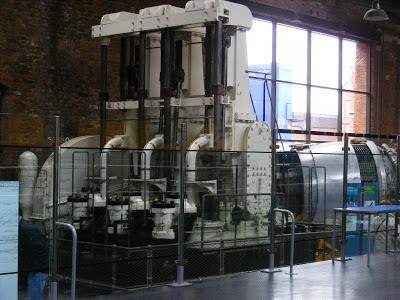
I can't say I loved the Museum of Science and Industry, other than the outside of the building. 


As with most museums in Britain, entrance was free.


The textile part was good, if you wanted to see a thistledown coat, map shoes or fruit clothes. 


It was mainly geared to kids, though I did enjoy watching the old braiding machine. 


There was also a sliding demonstration that showed wool to be smoother than cotton and both smoother than polyester.  Three cheers for wool!  (I know, I'm obsessed).


I think Helen was intrigued by the idea of visiting sewers, which turned out to be a brick tunnel with a lot of posters explaining the history of the water and sewerage systems in England.  It actually is a pretty interesting subject, much related to public health, but I know about it already.  


Bill's favourite part was easily the huge building filled with trains and engines.   Charlotte, Helen and I both wandered around practicing patience. 


 After all, Bill tags along to a lot of things he's not excited about.


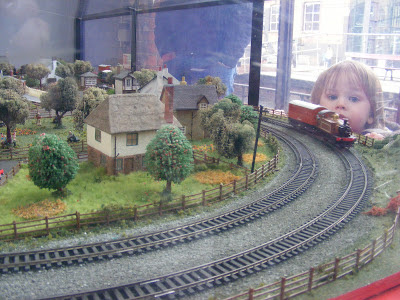
The best thing I saw was this the toy train set up. And even better, watching a child's wonder at it.


Friday, 1 March 2013

Part XXIX - Conspicuosity of Dress


This is a series discussing Theory of the Leisure Class by Thorstein Veblen, an American economist.  His seventh chapter is titled Dress as an Expression of the Pecuniary Culture.


Yes, I know 'conspicuosity' is not a word, but I think it ought to be; the -ness extention is dull.  I was really excited when I first read this Chapter title, but I think that while it is one of the more fun parts it is also this is one of the more boring chapters.  I say this because many of the ideas I found in this book shed a new light on things I’d observed but never understood.  In contrast, this chapter only tells me what I already knew.  Veblen outlines three principles of dress, all of which have to do with 'conspicuosity'.

Clothing is one of the most obvious ways in which we practice conspicuous consumption and from an early age.  One only has to look inside their own closets, at all the charity shops, indeed at the mountains of clothing I saw in a market place in The Gambia, to know that conspicuous waste is a defining feature of the clothing industry and its clients.  
“Other methods of putting one’s pecuniary standing in evidence serve their end effectually, and other methods are in vogue always and everywhere; but expenditure on dress has this advantage over most other methods, that our apparel is always in evidence and affords an indication of our pecuniary standing to all observers at the first glance. It is also true that admitted expenditure for display is more obviously present, and is, perhaps, more universally practiced in the matter of dress than in any other line of consumption.”

I suspect that Veblen defines waste as using clothing for any other purpose than protection of the body.  If I didn’t have to sacrifice pleasing colours, I’d been keen to see what articles might be developed if this were the only criteria.  The clean, simple lines of the 1990s seemed to be the closest we came to that, unless it was the utility designs during WW II.  I can forgive some of the snobbery attached to natural fibres.  Technical fabric does a better job of warmth or wicking in certain situation, but some of those fabrics are horrible against the skin.  I’ll take wool, silk or cotton any day I’m not engaged in strenuous activity.

Anyhow, Veblen asserts that the greater expenditure on clothing is about looking good (respectable).  Furthermore, when we have shabby clothing we feel it more keenly than in our dress.  Acknowledging ripped jeans and all, I’ll put it differently.  Did you ever feel out of place, not quite good enough, because you were not dressed appropriately?  I’m sure it is this sense to which Veblen is referring.  He says we’ll do without a lot in order to afford proper clothing.  In fact, we’ll be ill clad for the sake of appearing well-dressed.  Ripped jeans fit in here, perhaps.  This certainly describes the blue, shivering girls standing at the bus stop in a skimpy dress and heels in January, on their way to go dancing at the clubs in Newcastle.  They’re famous for it.

Again, Veblen says we spend a lot of money just to fit in and not get negative attention.  In addition, we have been conditioned to think that anything not costing a lot cannot be desirable.  He uses the phrase ‘Cheap and nasty.’  I confess to having admired a Viyella coat the other day, but when I learned it wasn’t 100% wool and was lined with polyester, I thought less of it.  I spend less than £500 most years for clothing and buy most of it second-hand.  So, strangely, I feel I can well afford to be a snob about clothing I’m not likely to buy.  I’m sure there is an explanation for this but I’ve not figured it out.

So, the first of Veblen’s three principles about ‘Dress as an Expression of the Pecuniary Culture’ is that it must be expensive in order to be valued.  The lower classes that support fast fashion obviously don't follow this trend.  However, the stories I heard at a high-end consignment shop in Sydney and what I occasionally read at Privilege absolutely support this principle.