Friday, 9 November 2012

Part XIII - Domestic Servants and 'Modern' Life

This is part of a series The Theory of the Leisure Class, Thorstein Veblen.  His third chapter is on Conspicuous Leisure. 


A theme that runs through Veblen’s book is that the code of conduct of the highest class influences the lower classes even into modern times, which for him meant 1899, but perhaps the argument still holds true.

Not that long ago even in only moderately well-to-do households domestic servants were employed.  Bill’s mom had a ‘daily’ and my mother adored her maid, Gussie.  Veblen says servants were ostensibly necessary because the wife (chief servant) had too many social duties or that the work was too difficult or there was too much of it.  He says the real reasons were that under the ‘mandatory code of decency’ the time and effort of the household members must all be spent in a ‘performance of conspicuous leisure’:  making calls; going for drives; attending clubs, sewing circles, sports, charity organisations, and other social functions.   These people will claim that all these required activities along with the proper clothes and other evidences of  (his first usage of the phrase he’s given us) conspicuous consumption are very irksome but unavoidable.

He acknowledges that under the ‘requirement of conspicuous consumption of goods, the apparatus of living has grown so elaborate and cumbrous, in the way of dwellings, furniture, brica- brac, wardrobe and meals, that the consumers of these things cannot make way with them in the required manner without help’.

Modern people don’t general like having servants to “fulfil the routine of decency” but they are “endured and paid for, in order to delegate to them a share in this onerous consumption of household goods.”  Indeed, the presence of domestic and/or body servants “is a concession of physical comfort to the moral need of pecuniary decency.”

Now Veblen, for many reasons, was considered a radical in his time.  He seems to have shared some of the views of Quentin Crisp, who is quoted as saying that after the first four years of not cleaning, his home didn’t get any dirtier.

Veblen had this to say about housework: 


The largest manifestation of vicarious leisure in modern life is made up of what are called domestic duties. These duties are fast becoming a species of services performed, not so much for the individual behoof of the head of the household as for the reputability of the household taken as a corporate unit — a group of which the housewife is a member on a footing of ostensible equality.


So Veblen does note that the woman’s position in the home has improved a bit and that being ‘house proud’ is about maintaining the reputation of the household as a whole, not just of the master.  In this way they fall out the category of vicarious leisure in its original sense of serving as a symbol of status. 

The next post will begin talking about Chapter Four:  Conspicuous Consumption.

Wednesday, 7 November 2012

Pope's Palace

One of our walking tours was of the Pope's Palace. 

We didn't choose to go inside. 


I have mixed feelings about religious places doubling as tourist attractions. 


We agreed that the outside grounds and the views over the river were more than sufficient to satisfy us.
 
 
I've already talked a bit about the history of this place


And many of the photos of Pont d'Avignon were taken from here.


Hmmm. Decorative barbed wire?


Monday, 5 November 2012

Museum Quilts and Patchwork

Last month Vivien and I re-visited the Shipley Art Gallery in Gateshead.   I can't believe it has been over two years since we were there, but apparently so.  This post is the evidence.  The Thursday craft ladies were talking about this textile exhibit so I knew it would be interesting.  That's not even the beginning of it.  There was a sign saying not to touch anything; if one wanted to see the back of a piece, to ask the staff for help.  I practically had to fold my arms to stay out of trouble, these exhibits were so lush.

Quilts

Quilting and patchwork often go together, but in this part of the world, quilting is very much appreciated on its own.  This exhibit honoured a lady named Amy Emms.  This interview about her mother's and her own quilting is brilliant.

Amy Emms made this quilt at the age of 73!


I put up my hand to show the scale of the details...I didn't touch!

Reading Pippa Moss's blog it appears that quilting in the US is now mainly done by machine where as Amy Emm's quilts were done by hand. 

Paddy Killer (interesting name, eh?) on the other hand, does her textile art largely by machine.


"Creation Counterpane" by Paddy Killer


I simply couldn't believe was I was seeing.

Patchwork

There were several lovely patchwork quilts and I gathered they were made by a group of ladies who all learned together and continued to make quilts together, which sounds quite fun.


The patchwork itself is amazing, but with all that quilting in addition, it's just incredible.

My favourite patchwork, though, was the Victorian 9-patch, using all sorts of lush velvets and silks.


And this was just a small part of all the wonders we got to see!

Friday, 2 November 2012

Part XII - Vicarious Leisure

This is part of a series discussing The Theory of the Leisure Class, by Thorstein Veblen.  His third chapter is Conspicuous Leisure.


The forms of work which are without economic merit, performed on behalf of the master in his leisure, are classed by Veblen as vicarious leisure.  Those persons ‘enjoying’ vicarious leisure include wives and the upper ranks of servants, ie valets and butlers.

Where competition for reputability is close and strenuous , ie the race to keep up with the Joneses is fast,  this vicarious leisure may frequently develop into drudgery.  Veblen says in modern life (his book was published in 1899) much of the domestic service provided by women might be called ‘wasted effort’ instead of vicarious leisure (but then he was known to be a slob).

However, wasted effort is not to be despised:  the main point of vicarious leisure is that these occupations ‘shed a glow of pecuniary reputability’ onto the master or even to the household, given that wasted effort costs money.  In this way, Veblen claims, there arises a subsidiary or derivative leisure class, whose job is the performance of vicarious leisure for the ‘behoof’ of the primary or legitimate leisure class.  Of course, the leisure of the servant is not his/her own leisure;  s/he is at the call of the master, his/her “leisure” passes under the guise of “specialised service directed to the furtherance of his/her master’s fullness of life.”

Along with shedding a glow and furthering fullness, those engaged in vicarious leisure must also display conspicuous subservience.  According to Veblen,


“Even today it is this aptitude and acquired skill in the formal manifestation of the servile relation that constitutes the chief element of utility in our highly paid servants, as well as one of the chief ornaments of the well-bred housewife. The first requisite of a good servant is that he should conspicuously know his place.”


A well-trained servant is also evidence of wealth because the training itself is not productive and therefore expensive; also, ‘well-trained’ signals a long history of ‘employment in vicarious leisure’ and suggests a history of the master’s wealth. 


“The possession and maintenance of slaves employed in the production of goods argues wealth and prowess, but the maintenance of servants who produce nothing argues still higher wealth and position.”


Veblen said that the need of vicarious leisure, or conspicuous consumption of service, was a dominant incentive to the keeping of servants.   


“…while one group produces goods for him, another group, usually headed by the wife, or chief, consumes for him in conspicuous leisure; thereby putting in evidence his ability to sustain large pecuniary damage without impairing his superior opulence.”


Veblen says that another term for the quasi-peaceable stage of barbarian life might be the Stage of Status, which best describes the prevailing attitudes of the time.  At that writing, he acknowledges that this economic phase is probably in the past except for a small but ‘very conspicuous fraction of the community’. 

Even so, he says we owe to this class much of our traditions, usages and general views.  

In the next post, I’ll talk about Veblen’s views about domestic servants.

Wednesday, 31 October 2012

Happy Halloween

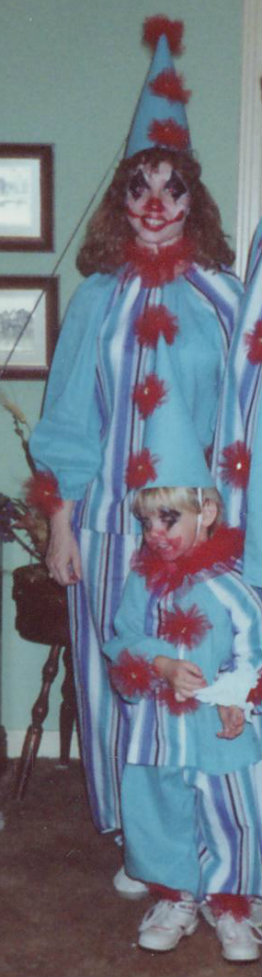
Halloween costumes are so easy when your mom is an avid sewist and loves making costumes. 
 
That face paint never stayed put for long!


The first year she had a step-grandson, she made Three Bears costumes. This year (1981) we were clowns.


Wearing bells is so fun!


Never mind that they were only worn twice, she loved making these outfits.  If I'd been smart, I would have passed them on or sold them the next year, but by then Mom was gone and I wasn't thinking very straight about anything, much less things she'd made.
 
Edited to exclude that other clown...


What are you going to be this year?

Monday, 29 October 2012

Indian Cooking Lesson

I can't believe the Women's Institute meetings only roll around once a month.  Shows how time is rushing past these last few months of 2012.  I'd have sworn we were just there a fortnight ago. 


Our scheduled speaker, from a local restaurant, hadn't been able to make it but he found a brilliant substitute.  Jackie is the head chef of the local posh school, King's.  It's about to change into a completely different animal, amidst loads of uproar and confusion, but in this post we don't care about that.  

She said naan bread is made for special occasions; chapatis are for every day.
She also pointed out that the traditional tear-shape is similar to the shape
of India itself, which I thought was fascinating.


Jackie was brilliant, she made everything look incredibly easy. She had made the naan dough ahead of time.  She started the soup, shaped the bread pieces and put them in the oven, worked a bit more on the soup, pulled out the naan bread and tore it into pieces, finished the soup and poured it into cups for us to taste.  I think they must teach juggling in chef school. 

 
Brits seem to prefer their soup pureed.  At first I thought it resembled baby
food, but I've got used to it.


Recipe for Spicy Lentil and Carrot Soup

2 tsp cumin seeds
2 tsp curry paste or mild curry powder
2 TBSP olive oil
600g carrots, washed and coarsely chopped (no need to peel)
140g split red lentils
1 litre hot vegetable stock (from a cube is fine)
125ml milk
plain yogurt and naan bread, to serve

Heat large saucepan and dry-fry the cumin seeds for 1 minute, or until they start to jump around the pan and release their aromas.  Scoop out about half of the seeds with a spoon and set aside.
Add the oil and carrot and cook gently until the carrots begin to soften (with a lid is good).
Add lentils, stock and milk to the pan and bring to the boil.  Simmer for 15 mins until the lentils have swollen and softened.
Whizz the soup with a stick blender or in a food processor until smooth (or leave it chunky if you prefer).  Season to taste and finish with a dollop of yogurt and a springling of the reserved toasted spices.  Serve with warmed naan breads.

Make it Moroccan:  substitute the curry and cumin seeds for a few teaspoons of harissa paste.  You could add cooked shredded chicken at the end of the cooking, too.
Make it dairy-free:  For a richer but dairy-free alternative, use a can of reduced-fat coconut milk instead of the milk. 

238 calories, protein 11g, carbohydrate 34g, fat 7g, saturated fat 1 g, fibre 5g, salt 0.25g.

Recipe from Good Food magazine, October 2005.

Naan Bread

Ingredients:
60 ml milk
200g strong flour
1 x 5 ml sppon baking powder
1/2 sachet instant yeast (about 3.5 g)
1 x 15 ml sppon plain yoghurt
1 x 15 ml spoon oil

Equipment:
Baking tray, measuring jug, saucepan, mixing bowl, sieve, wooden spoon.

Method:
Preheat the oven to 250C or gas mark 8.  Put the baking tray in the oven
Warm the milk (either in a saucepan or microwave)
Sift the flour and baking powder into a bowl.  Stir in the yeast
Add the yoghurt, oil and warm milk
Mix into a soft dough
Knead for 10 minutes
Leave the dough to prove (rise) for around 30-60 minutes
Kead the dough and divide into 4
Roll out each piece of dough into a 'tear' shape (oval)
Cook the naans ion the heated tray for 3-4 minutes until puffed up and brown

Tips
To make them extra special, brush thenaans with melted butter and sprinkle with poppy or sesame seeds before baking.  Flaked almonds, dried fruit, coconut and spices could be added to the naan mix before baking.  Make a meal out of your naan.  Once baked, stuff with your favourite curry.


Friday, 26 October 2012

Part XI – On Wives and Servants

This is part of a series  The Theory of the Leisure Class, Thorstein Veblen.  His third chapter is on Conspicuous Leisure. 


In an earlier post I explained Veblen’s belief that the development of a leisure class and of individual ownership of property went hand in hand; also the capture of women from an enemy tribe was the beginnings of acquiring trophies for man’s exploit.   Thus, the institution of ownership began with the ownership of persons, primarily of women. 

The incentives for acquiring women as property were several: a) a natural propensity for dominance; b) evidence of prowess in war; and c) perhaps most importantly, the personal services they provided.  Veblen makes no particular reference to sexual services, he’s just talking about servants generally providing service.  Like cattle, slaves are an investment and in spite of moving into the quasi-peaceable stage (still within the barbarian culture) women still serve as a unit of value.  Accepted evidence of wealth is the possession of many women and other slaves engaged in attendance on their master’s person and in producing goods for him.

A division of labor develops where personal service and attendance on the master becomes a more prestigious level of service than those who are engaged in industrial occupations and distanced from him.  At some point those servants involved in personal service come to be increasingly exempt from productive industry carried out for gain.  This exemption generally begins with the wife, or the chief wife.

Once the habit of capturing a wife from an enemy tribe is no longer the done thing, the chief wife is usually ‘of gentle blood’:  ‘ennobled by protracted contact with accumulated wealth or unbroken prerogative’.  This further promotes her exemption from vulgar employment.  The wife, chosen to gain alliance with her powerful relatives,  is her husband’s property as she was her father’s.  Although her gentle birth removes her from the ‘debasing employments of her fellow-servants’, she is still inferior to the male members of the social stratum of her birth.  Veblen says as a wife, the scope of her leisure is limited only by her owner’s wealth, though her leisure is not the same as that of her master. 

As the social development continues and property becomes massed in relatively fewer hands, the standard of wealth of the upper class rises. The same exemption from menial employments granted the chief wife will follow on to other wives and servants in the immediate attendance upon the master.   Thus we see the development of a special class of personal or body servants at the master’s call.  Their attention cannot be diverted by any other regular occupation and so their usefulness is actually more for show than for service performed.  The duties of a footman (in extravagant uniform called livery), a butler or a valet would fall into this category.

Male servants come to be preferred over females for roles in the public view.  Male servants are ‘obviously’ more expensive than women.  Another book I read on holiday said taller men were paid better.  In a recent TV programme about the lives of servants, it was said that a special license was required to employ a male servant.  This license served as a sort of luxury tax.  No such license was required for female servants.   According to Veblen, men are also “better fitted for showing a larger waste of time and of human energy”.  See why I enjoyed this book so?

 
Should one ever envy the ‘trophy wife’ Veblen points out that
“In all … walks of life [or] stage of economic development, the leisure of the lady and of the lackey differs from the leisure of the gentleman in his own right…[theirs] is an occupation of an ostensibly laborious kind. It takes the form…of a painstaking attention to the service of the master, or to the maintenance … of the household paraphernalia…[their efforts are] … frequently directed to ends … necessary to household comfort … [and thus] they are to be accounted productive work. Only the residue of employment left after deduction of this effective work is to be classed as a performance of leisure.”

However, it's not leisure as I would call it, wherein I can do as I wish when and where I wish.  Veblen goes on to say that
“The labor spent in these services is to be classed as leisure; and when performed by others than the economically free and self-directed head of the establishment, they are to be classed as vicarious leisure.” 

I'm thinking that except for 'trophy wives', the concept of vicarious leisure is increasingly remote and I didn't initially grasp the idea.  It seems to come down to the idea of having people at your 'beck and call'.  Those holding themselves at the ready to serve have a waiting function that could look to some as a form of leisure.  However, theirs is not true leisure.  There is also the matter of status attached to serving positions; the butler stands around a lot more than say the laundry maid.  A butler to a duke would likely feel he could look down his nose at his counterpart serving only a viscount.  One can imagine that the upper levels of servants did take some satisfaction in their status and did live a bit vicariously through the lives of their masters. 


In the next post on this topic, we’ll explore more about vicarious leisure and the importance of training.