Thursday, 24 June 2010

Venice


Our next destination -- our real destination as far as I was concerned -- was Venice.  I've taken a number of vacations just to get away from cold weather, to distract myself from the pressures of work, but Venice is a place I've always wanted to see and I've no idea why we haven't been before.  It looks just like the pictures but of course the pictures are more fun when you get to take them yourself.  I've always heard that Venice smelled bad, but unless we were passing a sewer maintenance project, I can report that it smells fine. 
Upon leaving the train we found a queue outside a booth with signs about tourism and accommodation.  This was the first time we've been approached by touts, men who want you to skip the queue and come to their hotel.  We resisted on the basis of resisting anyone who approaches us first to sell something; "Don't call us, we'll call you" has worked well for us.  Turned out we were standing in the wrong queue (it was for event tickets) and we could have just walked into the accommodations booth, but never mind.  

We got a room about 5 minutes away, in a one-star hotel.  The first night was 120 Euros, the second 95 and the third 75.  I wondered if we stayed long enough if it would be free.   Our criteria were a) city centre and b) has a bathroom.  The room was lovely:  


velvet headboard, Venetian glass chandelier, modern shower, marble floors, 


enormous shuttered windows with (Venetian) blinds.  We were happy.  


No TV - even better.  It had a phone, but who cares?  No room service, no on-site restaurant (bar a minimal bread and coffee breakfast), the desk is not manned at night.  -They give you a key to let yourself in the front door; what more do you need?  We later put our hands on a hotel guide with all the details and I plan to study it, but I doubt we'll ever work out the hotel rating system.  I wasn't worried though.  If we'd hated the room we would have left and returned to the tourist information office.  We've done it before in Amsterdam.

Anyhow, you come into Venice via the sea.


You step out of the (very elegant) train station and there it is right there:  


The Grand Canal.  Amazing.  Venice is all about bridges, balconies and boats.  


I'm sure there were at least as many tourists there as in Verona, but they seemed to move along in groups, like shoals of fish washing in and out on a tourist tide.  You get a bit of respite here and there.  Or maybe I was just learning to swim.
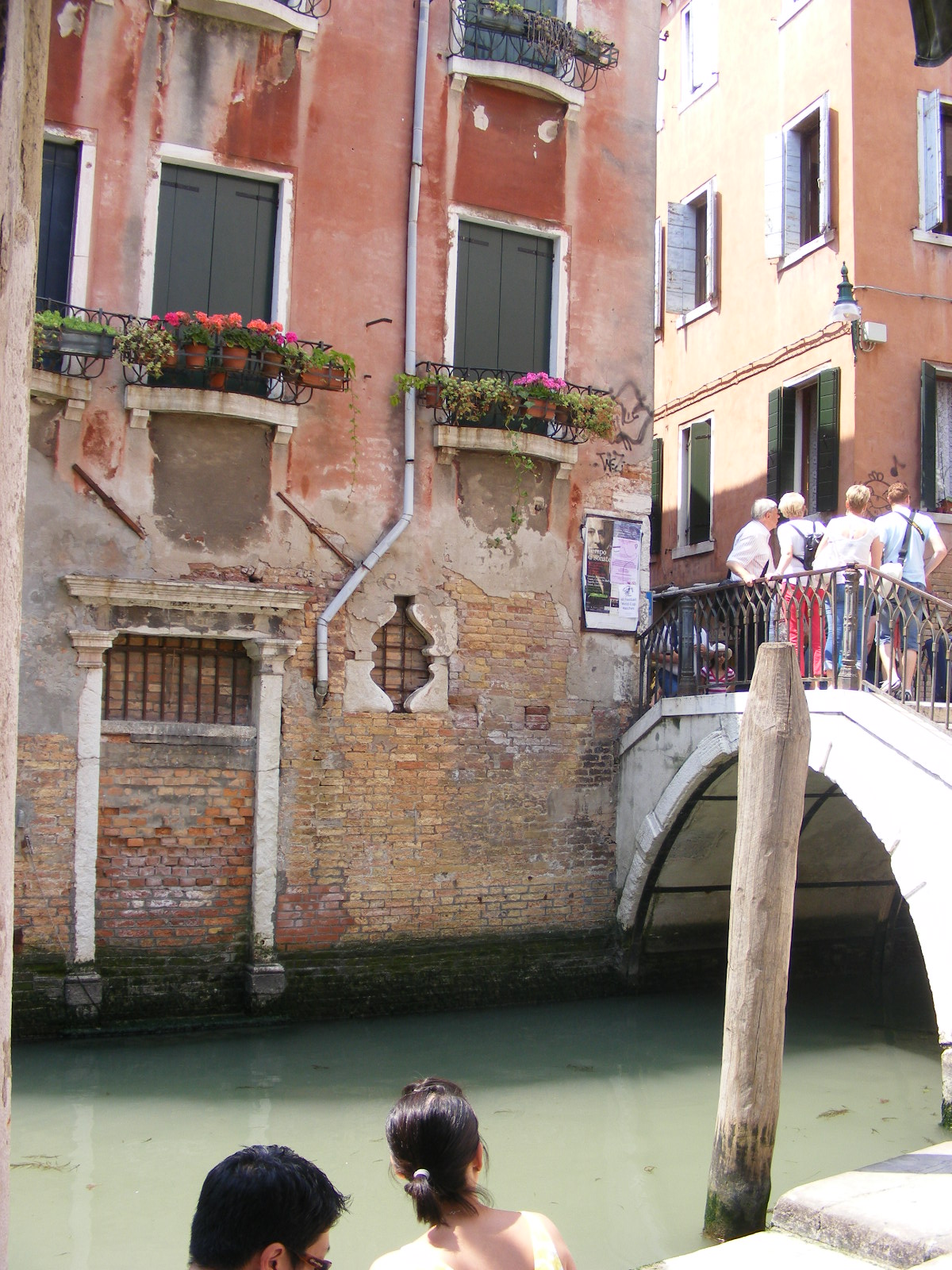


Imagine having a boat instead of a car, a boat instead of a commuter train (vaporetto), canals instead of roads, bridges instead of overpasses,

a pier instead of a driveway, a back door that steps out into the sea, a gondola instead of a taxi, a balcony instead of a picture window, a roof garden instead of a back yard.   One of the things I loved best about Venice was the absence of cars. 

Imagine being wealthy enough to live in a house with a huge walled garden shielding the house from the main road, and that backs onto the Grand Canal.  


Everything looks pretty tatty, if sometimes colourful, 

from the outside, but Europeans don't usually bother much with the appearance of the outside of their houses.  They save their efforts for the inside and it can often be unspeakably grand behind the half rotten front door.  Besides, for a woman who falls in love with houses for their potential (not to mention men, on occasion), Venice is a dream come true.  We soon found ourselves laughing about 'Vende' signs: "There's a fixer-upper!"

Of course, Bill spotted the waste bins with the naked ladies on.  How artsy can you get? 


Bill was thinking that the place was built on limestone piers, but turns out it was actually wood, which doesn't decay in seawater.  I know there are places along the River Tyne where wood imported from Scandinavian forests was dumped into the seawater to harden for a few years before being used as building material.  There seems to be some doubt about whether Venice is still sinking, but it does suffer from spring and autumn floods and the ground floor of many of the old buildings is no longer usable.  Global warming can't be good news either.
However, Venice does obviously have a roaring tourist trade and in the past its great wealth came from trading with the East.  Marco Polo is quoted as having said that all the gold in Christendom flows through Venice.   So, there is lots of wonderful history to learn about here but for us the best part, beyond what you could see just walking around, was that it was 21:15 and 25 degrees (that's 9:15 pm and 77 in American).   

Sheer bliss...

Wednesday, 23 June 2010

Casa di Giulietta

This is not the first famous fictitious house I've visited.  221b Baker Street in London was good fun and made one nearly forget that Sherlock Holmes never actually existed.  There weren't a huge number of other people there either; no doubt they were all in the queue for Madame Tussaud's.  The other most memorable house I've visited was Anne Frank's in Amsterdam, but of course she was very real.  The queue to get in wrapped around the block, but everyone was orderly and quiet throughout.  You may remember our visit to the Jane Austen Centre (Heavens, was that only 6 months ago?), where they collected nearly everything associated with Jane and her time.  Juliet's house reminded me a bit of this. 


The outside of Juliet's house in Verona, on the other hand, is practically a mob scene.  I saw a plaque in the courtyard stating their wish to get rid of the trash and graffiti, to raise the tone a bit.  They have their work cut out for them.  As we entered a young man was actually writing his and his girlfriend's name on the gate.  She was looking on with a smitten expression.  His father was taking a video.  I was horrified.  It gets worse. The archway just beyond the gate is plastered with paper notes, not all of which stay stuck to the wall.  


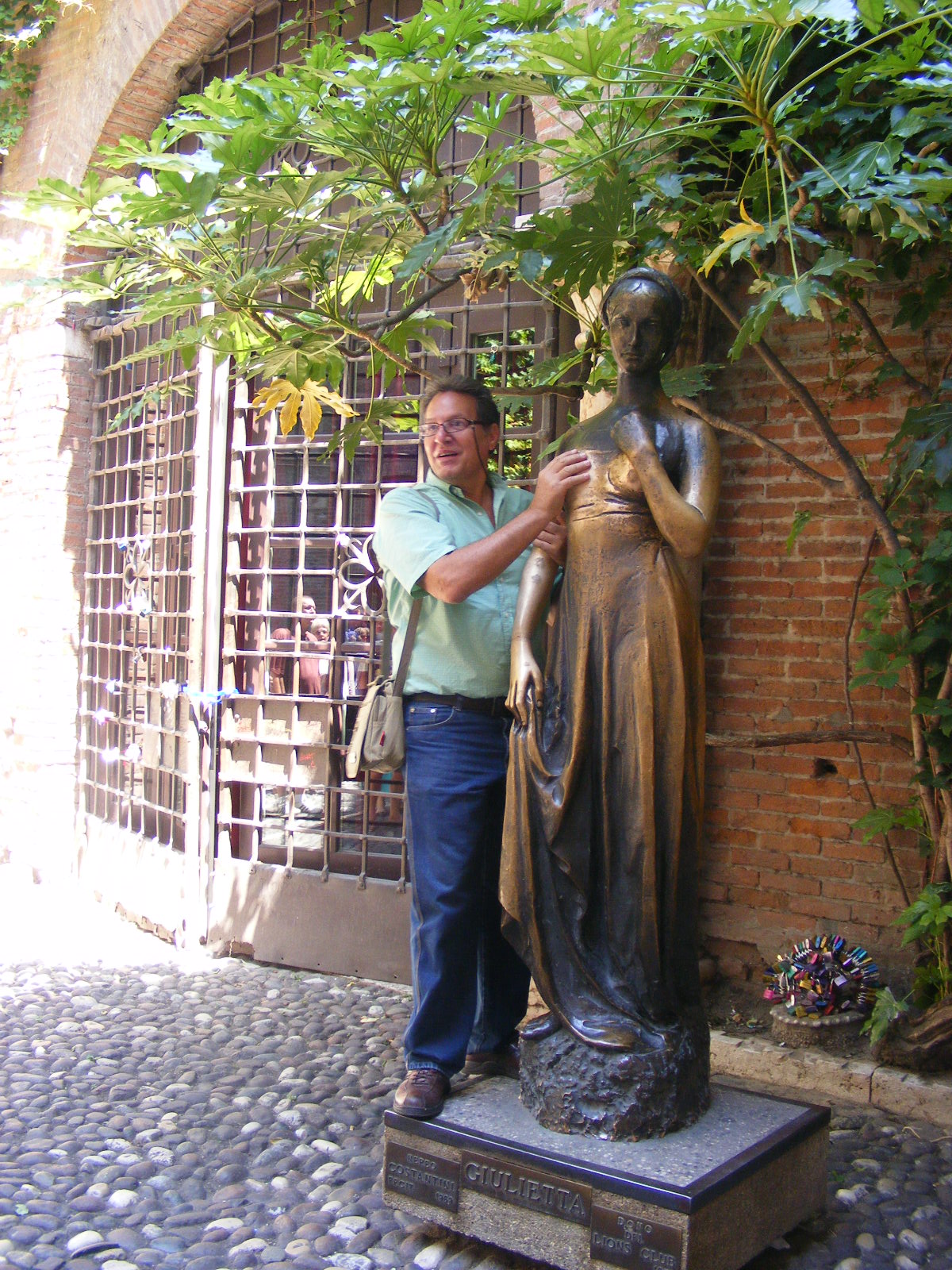
Then there is the queue, not waiting to get in but waiting to be photographed with the bronze statue of Juliet.  It is apparently good luck to rub her right breast and so of course it is a much shinier hue than the rest of her.  I was amazed to see apparently sane, middle-aged men -- lots of them -- doing this.  


I'd seen all I cared to, but Bill convinced me to return the next day and tour the house, as it is a real 15th century house if nothing else.  So we did.  There were no mobs in there and photographs being allowed, I enjoyed the visit immensely.


The house was sparsely furnished with pieces from that time, all dark heavy wood.  The floors were large marble tiles.  


Each room had a smallish fireplace and the shape of the windows looked quite Moorish to me.  

There was a short hallway built onto the outside wall, half wood and half windows like a gallery.  


It reminded me of the kind of sitting 'porches', sort of box windows built extending out from the upstairs floor of houses.  They are very prevalent in Malta, where women used to sit to see the world, but not be seen. 


In one room the ceiling tiles were lovely.  In another, the ceiling fell in a series of graceful arches from the center arch.  

There were any number of paintings about Romeo and Juliet.  (I'm guessing there is a 'Romeo's House' somewhere but we didn't track it down.)


Also a bed that featured in Zeffirelli's movie from 1968.  


I remember that I saw it (aged 13) and was swept away by the sadness and the romance, but 40 years later I could only come up with 'Olivia' so it couldn't have been that that wonderful to someone who remembers so many actors from the 1940's films. 

The costumes were OK, 


but mainly I liked the house.  I photographed an exhibit that I thought suggested the story had its roots in fact, but upon re-reading it only says that the story line was not original to Shakespeare. 
 
"Although immortalized in Shakespeare's tragedy, the story of Romeo and Juliet has its true literary roots in early 16th century Italy.  Already around 1526, Luigi Da Porto of Vincenza wrote a novella with an exact description of the events, according to a tale heard from the archer Pellegrino of Verona.  From this story came the version by Matteo Bandellow (1554) and that of Gherardo Beldier (1553) in the form of a short poem, "Adriana" by Luigi Groto (1578) represents a variant with the important detail of the nightingale taken up later by Shakespeare.  In Spain, Felix Lope de Vega inserted a unique happy ending (1959), while the translations of the Italian texts by Pierre Boiteau in France and by Arthur Brooke and William Painter in England were the direct sources for Shakespeare."

What have I forgotten?  Oh yeah, The Balcony.  Can't leave that out.  


Now I have an admission to make:  I don't like Shakespeare.  I remember having to study his writing in school and being completely mystified by the language.  It stops me from enjoying the plays as well, though I did once muddle through "Twelfth Night" at Newcastle's Theatre Royal (great costumes).  I greatly enjoyed Bill Bryson's book, Shakespeare, however, and can appreciate that the he was a genius.  He also lived in the time of my favourite British monarch, Elizabeth I.  

I re-watched the film Shakespeare in Love the other day and quite enjoyed it, mainly because of Gwyneth Paltrow. 

Clearly, I got no kulchure.

Verona was pretty and we enjoyed looking around, but as a World Heritage Site, I found myself slightly under-whelmed.  If you've been to Verona, what did you see that we overlooked? 

Sunday, 20 June 2010

Verona

Verona is a World Heritage Site and it is a beautiful place.  Not surprisingly, it is also awash with tourists.  I have shown you another World Heritage site we visited in Scotland.


I thought a lot about my Uncle Pat's comment that because of this blog he got to see the world from the comfort of his computer chair; particularly whilst carrying my 22 pound backpack the half mile from the train station to the tourist information on the Piazza Bra only to be told their accommodations desk was closed that day and we should consult the information office back at the train station, which we'd looked for but couldn't find.  Upon returning, it was easy to find entering the station, but completely obscured when coming the other way.  We doubled (trebled?) back yet again to end up at the Hotel SanMicheli, which I mainly liked because it was named after me ;-)

Though we were located nearer the Piazza Bra, with the Roman amphitheatre that Napoleon re-built he felt so bad about knocking it down, I didn't see anyone but tourists there, and heard nothing but American English spoken.  So we went the other direction and tended to hang out in Piazza Erbe. 


Mind it was also chock full of tourists but at least I couldn't understand much of what they were saying, so that was OK.  


I don't quite feel as though I'm on holiday if I'm still hearing English.


We went to Piazza Erbe to eat, drink and buy food at the market,


but mainly we went to watch people.  


We didn't do much research in advance of this trip.  The book from the library on Italy was far too heavy to carry and frankly between tax preparation, changing property managers in Oklahoma City, writing blog posts for two weeks in advance and planning out the packing strategy, I didn't have much energy left for research.  So, we just showed up, looked around and investigated what interested us from amongst the tourist office recommendations.

One day for lunch we bought fruit and took it (along with the tea-towel and water bottle I'd packed) to Garibaldi Park for lunch.  There was a nice statue of Guiseppe on horseback.  


Bill kept referring to Garibaldi as 'that bloke from down the street' as there is a plaque on one of the buildings in a village near us commemorating his stay there.  Garibaldi is credited with making possible the unification of Italy.  I was pleased to see public drinking fountains all over Italy, starting with this park; unfortunately, the design was such that one needed to have a vessel to capture the water, else get soaked.

We walked around the grounds of Castelvecchio, with its strange almost 


floral style of crenellation on bridge and tower.  This structure dates back to the 14th Century.   


We walked for hours up and down the riverside, photographing the river, the bridges, 


the apartments overlooking the river...everything. 


We went up Lamberti Tower (in the elevator/lift) and took pictures, of the roof tops, the roof gardens, the colourful buildings, the piazza with ant-sized people scurrying around.  


Then back to join the ants, get a drink and sit for a while.  Behind us, Bill noticed a customer entering a jewelery store; the jeweler closed and locked the door, which we found interesting and could place all sorts of connotations on that practice.  "You are such an important customer, we want no other distractions while we serve you." or "We are going to look at jewels of such great value, we need added security." or 


"We're ensuring you'll not be getting out of this store with the jewels until you've paid." or "You'll not be leaving without making a purchase".  


We didn't try to test any of our theories, mind...

Saturday, 19 June 2010

Milano Centrale

Whoops, I want to back up a moment and show you the most gorgeous 


train station I've ever seen.  Bill recognised that it had been built in the


1930s by Mussolini to show off, basically.  According to Wikipedia, it 


includes the 'Liberty' (which turns out to be Art Nouveau) and Art Deco styles, 


amongst others, so it is no suprise that we both were bowled over.  We had  


about an hour to kill between trains, and so had a wander around, found the loo


and had a cold drink before starting the next leg of the journey.

Friday, 18 June 2010

Brescia

The next morning all we had to do was pack up and walk 2 blocks to the train station.  It took a while to figure things out; Bill finally, against what must constitute his strongest instinct, caved in and asked for help.  The ticket seller listened to Bill explain our wishes in his best French.  He then replied in French, English and, Bill told me later, Italian.  Looking back, it almost seemed to me he spoke French up to a point then, when describing our connections over the border, he seemed to think Italian was more appropriate.  Fortunately, Bill was able to pretty much follow it all.  Turned out that trains couldn't travel directly between Nice and Italy.  One had to go to Monaco (mostly through a tunnel), change trains and travel to Ventimiglia, then change again to go north to Milan.  


There we would catch yet another train west to Brescia.  We were ultimately headed for Venice, but Brescia was as far as we would get by early evening.  In fact, we got there just before 5pm and I was a little panicked that tourist information, on whom we were relying to find us a place to sleep, might have closed by the time we found it, which didn't prove very easy.  Bill could walk faster without me, so I parked myself with a coke at a sidewalk cafe and left him to it. 

He came back with a reservation at some sort of religious institution; see what happens when I let him out on his own?  Actually, he did rather well.  While we were there we figured it was either a former convent or monastery, or perhaps was now a retirment home; we saw a couple of nuns and priests as we went to breakfast.  However, in looking it up now, the website only refers to it as an 'accomodation facility'.  


Our room was plain but pleasant.  The bathroom had the quaintest triangular shower in the corner; adequate, but just.  

 
I thought the moveable spokes that held the shower curtain were ingenious.  


Our shuttered windows opened onto some of the most beautiful evergreen trees I've seen since I left Salt Lake city.  


Everywhere we looked were grand arches, huge wooden doors, marble floors and only two other 'civilian' guests, so it was really quiet.  Not too bad for 60 Euros a night.  The man at the front desk had an old world kind of courtesy that was lovely to receive. 


Again, we ditched the bags and went in search of food.  It was early, we learned, by Italian standards and so this wasn't as simple as it sounds.  Eventually we landed in a place with bustling waiters wearing English styled suit vests over their long sleeved white shirts, which Bill found amazing considering the heat.  Not realising we each ordered main course salads, the two pizzas and the two salads that arrived were a massive amount of food, but we managed to put away most of it.  Thirty-two Euros for what amounted to food for 4 wasn't a bad price either. 

Brescia turned out to be a pleasant, rather sleepy little town, at least the portion that we saw of it.  If we ever go back, I'd volunteer to stay in the 'convent' again.  Not only was it an amazing place, they served an excellent Continental breakfast.