I'm really excited. I found a yoga class -- in the same place that I attend the sewing circle; none of the sewing ladies were there last night, though, so it's unlikely we'll be doing sewing and yoga at the same time.
Actually, it's not proper yoga, more a pilates-yoga-stretch-we can show you all the things your body can't do anymore sort of class. Not that I was going to be great at regular yoga, either.
Two things were particularly difficult for me. One was standing on one foot and waving my arms like an Indian Goddess. The other was bending over with my legs straight and my hands on the mat, making a triangle with the floor. The instructor wanted us to HOP to bring our feet up closer to our hands. Actually, I would call it a JUMP, as it used both feet, but I found it rather scary. Not only were my weak arms going to have to take even more weight, but my HOP muscles seem to have retired to Florida or somewhere.
I can't remember the last time I needed to HOP. I do jump off the occasional chair, true, but only after a slight hesitation to gauge the likely level of pain involved. I had to consider just how I was going to accomplish this HOP, and meanwhile ever more blood was rushing to my brain. I did eventually manage it, after a fashion (think deconstructed, asymmetric fashion). She had us do it 3 times; I had to think about how to do it each time.
So, we have some work to do to catch up with Madonna. But don't worry, I have no intention of making a video, I promise.
Friday, 2 May 2008

Thursday, 1 May 2008
Start at the Bottom
Since I’m an admitted tightwad and I write for my own amusement, you will be subjected to the more than occasional post about frugality; (and here I get to use my new phrase, acquired from studying the highly erudite writings of numerous blogs) “suck it up”.
One of the main tenets of tightwaddery I learned from the Tightwad Gazette, and several other books, was not doing without, but spending consciously, making informed decisions. I see lots of people sniff at the store brands, snobbily choosing the ‘premium’ brand, having never tried anything ‘less’. In fact, I’ve heard from several sources on both sides of the pond that in the canning factories the exact same product may often be found behind different labels. The price difference is likely a combination of the advertising costs to stamp their brand on your brain and of how gullible they think consumers are.
If you are one of those sad people who worries what your fellow shoppers think about the contents of your trolley, or you shop only at Sainsbury’s or Marks and Spencer’s because it’s what people ‘like you’ do, or you carry a bag from Harrods so that people will know you shop there, stop here. In fact, just get off my weblog, OK?
I’ve learned to start at the bottom and try the cheapest item on offer. Then, if I don’t like the quality I can chose the next one up and so on until I get what I want for the least amount of money. These are a few of the things I’ve discovered.
- I think the best hair conditioner comes with in the boxes with the hair colouring. Clairol now sells a 57 ml tube of the stuff separately for 99 pence. My grocery store brand is 39 pence for 500 ml. It doesn’t have the nice scent and is slightly less creamy, but the outcome is the same if not better. Hairdressers often comment on the good condition of my hair; the trick is just to leave it on for a couple of minutes before rinsing. This is one of my excuses for taking long showers.
- Tinned products such as beans or tomatoes come in a wide range of prices. I can’t say I know much about the quality of the name brands; the store brand suits us just fine, for 19 pence a can. When comparing prices of tinned or bottled foods consider how you use the product and decide whether the full tin or the drained weight is more appropriate.
- I’ve no idea how much fresh milk costs here in the UK now, but my experience is that it sours in a few days; I know this from keeping milk at work for my coffee. In the US I bought milk by the gallon and rarely had it go off before it was finished. I gave up on fresh milk in the UK as soon as I discovered UHT (ultra-high temperature) milk in litre boxes. It keeps for months on the shelf and an opened box lasts at least a week or more in the fridge. The price jumped up this past fall from 35 to 38 to 44 pence a litre, which is still the best deal I’ve found and we go through at least a litre of skimmed UHT milk a day, so we save a lot by buying the cheaper product.
- I can choose a brand name of dish soap and get 500 ml for 68 pence or I can get 1000 ml (a litre) for 19 pence; I decant it into the smaller bottle for easier handling. The latter is sometimes – but not always – a tad more watery. I’ve found the best way to make dish soap last and have satisfying suds is to squirt it on my sponge, not in the water. I know I’m one of the last people on the planet to still do dishes by hand. Even though I’m the laziest person I know, I can’t get excited about owning and using a dishwashing machine; I can’t explain it.
- On the down side, I discovered that 20p per litre shampoo is harsh and unpleasant to my hair, so I buy the next brand up and pay 69p for 500 ml and get my choice of peach, apple or suntan lotion scents.
- Shredded tuna is cheaper than tuna chunks, but Bill doesn’t care for the texture: it’s almost non-existent the pieces are so fine. There might be recipes in which you can’t tell the difference, but we buy the store brand of tuna chunks for 29p.
If all this sounds very picky and describes your vision of a down at the heels lifestyle, consider the fact that when the shampoo is used up and the food is eaten, you have nothing to show for what you spent at the grocery. I wouldn’t waste my time trying to convert anyone who doesn’t want to be, but I know I’d rather choose cheaper products such as these and have spare cash to pay off my mortgage, buy something I’ll enjoy that will keep it’s value, like antique furniture, or have a great holiday and make happy memories.
End of lecture. I really enjoyed that, didn’t you?
Wednesday, 30 April 2008
Imperial Gardening and Metric Costing
When doing by-the-book Square Foot Gardening, one makes up 4x4’ boxes (6” deep) and fills them with a mixture of composts, peat and vermiculite. The boxes are set on weed cloth and a precise number of seeds or plants are placed in a particular arrangement in each square. The soil mixture (plus water) is all that is healthy plants need, and – a big plus for me, the person who once mistakenly pulled up all of Bill’s parsnips -- the plots are almost entirely weed free and so it’s not a problem distinguishing between plant and weed. I thought it looked interesting enough that I bought the book and was going to follow his plan.

There were some obstacles, however. The author seems to envision (the pictures show) great fields of sunny green lawn on which he has plunked down these lovely white boxes overflowing with plants. Our back garden is about 20’ x 7’, enclosed by a brick wall, and here by the North Sea we’re as liable to have sea frets as sunshine; the temperature rarely hits 80. It is nearly always windy here, even within our little enclosed area and the warm growing season is short. Still, that’s not a major issue with the right crops, a bit of pre-planning and the use of cold frames (don’t I sound confident, never having done it!)

Also, Bill pointed out that the soil was in excellent condition, thank you very much. He’d been working with it for several years and all our composted kitchen waste has gone in. He objected to my ignoring all that work by covering it with weed cloth and so the soil in the raised garden area is just that: soil.

There were some obstacles, however. The author seems to envision (the pictures show) great fields of sunny green lawn on which he has plunked down these lovely white boxes overflowing with plants. Our back garden is about 20’ x 7’, enclosed by a brick wall, and here by the North Sea we’re as liable to have sea frets as sunshine; the temperature rarely hits 80. It is nearly always windy here, even within our little enclosed area and the warm growing season is short. Still, that’s not a major issue with the right crops, a bit of pre-planning and the use of cold frames (don’t I sound confident, never having done it!)

Also, Bill pointed out that the soil was in excellent condition, thank you very much. He’d been working with it for several years and all our composted kitchen waste has gone in. He objected to my ignoring all that work by covering it with weed cloth and so the soil in the raised garden area is just that: soil.
When I did the calculations converting litre bags of peat and vermiculite to the cubic area of our garden (after subtracting the area used for paths and the compost bin), it appeared that even using our own compost, it would cost £121 for the peat and vermiculite, before any wood for the frames or plant seeds were obtained. That was more initial outlay than I was prepared to make as that represents about 5½ months worth of vegetables bought at green markets. We don’t have any problem with water shortages up here, so the water holding qualities of vermiculite aren’t critical, though I did buy a couple of small bags.
I did think there were too many rocks in the soil to imitate the very light consistency of the soil the book proposed, so I spent a few hours sifting it (Bill provided a mesh-bottomed pan and said it was called ‘riddling’). I finally found a method that didn’t kill my back – sort of a let’s-do-the-twist move (with less soil) instead of the hula-ing motion that deposited as much on my feet as back on the garden. The sieved soil looked very nice, though I was disconcerted when I discovered earthworm parts at the bottom of the pan, which is nothing compared to what they probably thought about it.
Whilst he did think removing rocks wasn’t a bad idea, I think Bill was relieved to hear me remark something to the effect that control over nature was largely an illusion. I think he was a beginning to worry that I would try to get the earthworms signed up to tenancy agreements on their assigned square foot -- or, as it turned out, more like 710 sq. cm. Since Bill was doing the muscle work with a fair amount of skepticism, I didn’t feel I could be too exacting about the dimensions. I’m trying not to be too compulsive about the whole thing. (It’s a great way to procrastinate, being compulsive, you know.)

 It’s definitely going to be a work-in-progress, as I suppose all gardening is. I think I have the sowing in recycled boxes down pretty good, though, so at least I have some little plants looking for a good home. Bill tells me it’s good practice drawing plans and considering the height and spacing of plants, etc, so that part is good fun (an activity I can do propped up with pillows and coffee, but I recognize eventually I do have to get out of one bed and get to work on the other.)

Tuesday, 29 April 2008
The Weekend: Here and Gone
Steve & Vickie came over for dinner Saturday night, which was lovely; we haven’t seen them since Christmas. They are expecting their first child (on 4 July!!) and we laughed about the medical staff referring to her as a ‘geriatric’ mom. We had lots to catch up on: news about our other friends, names for the baby, maternity leave plans, how their dogs are doing, the latest reorg at work, Bill’s new job. Bill’s cooking was superb as usual: crackers with smoked salmon and boursin cheese to start; chicken and chorizo with mushrooms in a tomato sauce; roasted potatoes, parsnips and red peppers, steamed broccoli; sweet potato pie with whipped cream. I intended to take pictures, but forgot all about it. Vickie looks really great; I think pregnancy agrees with her, even at her greatly advanced age …
They brought Series 6 and 7 of West Wing for me to watch. I think Vickie is trying to wake up my political conscience, even though we sit on opposite sides of the fence. That doesn’t matter – we both think it’s a great show. Unfortunately this means my productivity is likely to drop even further, which one wouldn’t have thought possible.
Sunday morning Bill and I met John from the running club to recce a possible course for a road (or multi-terrain) race.

It was raining when we set off from home, but we had fairly dry skies for our recce.
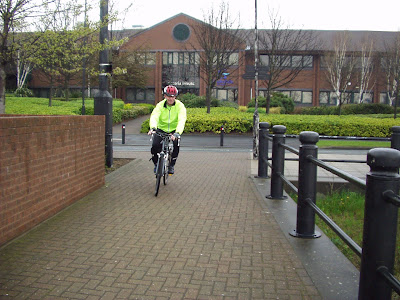
We met a few obstacles but came up with a tentative plan A. We thoroughly enjoyed our leisurely ride along the riverside.

I tried to take a few fun pictures in addition to documenting possible problems on the route. (Pictures which have gone into hiding somewhere; will add them to this post when I have tracked them down. Found them: Bill had downloaded them in a new folder...)

Monday night at the club we had a short (3 mile) handicap race; I generally get to start first, being by far the most handicapped runner, and the fast guys have to wait a l-o-n-g time to start. After that, free food and a drink at the pub.
They brought Series 6 and 7 of West Wing for me to watch. I think Vickie is trying to wake up my political conscience, even though we sit on opposite sides of the fence. That doesn’t matter – we both think it’s a great show. Unfortunately this means my productivity is likely to drop even further, which one wouldn’t have thought possible.
Sunday morning Bill and I met John from the running club to recce a possible course for a road (or multi-terrain) race.

It was raining when we set off from home, but we had fairly dry skies for our recce.

We met a few obstacles but came up with a tentative plan A. We thoroughly enjoyed our leisurely ride along the riverside.

I tried to take a few fun pictures in addition to documenting possible problems on the route. (Pictures which have gone into hiding somewhere; will add them to this post when I have tracked them down. Found them: Bill had downloaded them in a new folder...)

Monday night at the club we had a short (3 mile) handicap race; I generally get to start first, being by far the most handicapped runner, and the fast guys have to wait a l-o-n-g time to start. After that, free food and a drink at the pub.
Friday, 25 April 2008
British Bureaucracy at Its Best
Just got off the phone with the UK Border Agency, part of the Home Office. Found their website yesterday, but didn't call as they were having a 'reduced service' (AKA being on strike, I think to support the teachers' strike). After about a 7 minute wait and listening to 7 or 8 recordings nothing to do with me, thank goodness, I got a real person to ask my question.
I have a sticker in my old passport that gives me 'leave to remain' (love that phrase) for an indefinite period. Having just renewed my passport, how do I get that sticker in the new passport. Turns out there are two ways.
One - Post both passports to them, it will cost £160 and take between 4 and 14 weeks
or
Two - (silly me thought this would be the economy version) Book an appointment, show up in person in Croydon (near London) and it will be done on the same day; this costs £500 (+ the train fare, etc)
The third option is to carry both passports, but she didn't recommend this if I travelled very much, ie for business.
Guess which option I'm going to choose?
I have a sticker in my old passport that gives me 'leave to remain' (love that phrase) for an indefinite period. Having just renewed my passport, how do I get that sticker in the new passport. Turns out there are two ways.
One - Post both passports to them, it will cost £160 and take between 4 and 14 weeks
or
Two - (silly me thought this would be the economy version) Book an appointment, show up in person in Croydon (near London) and it will be done on the same day; this costs £500 (+ the train fare, etc)
The third option is to carry both passports, but she didn't recommend this if I travelled very much, ie for business.
Guess which option I'm going to choose?
Thursday, 24 April 2008
But First, a Little Carpentry

I’ve been playing around with the idea of Square Foot Gardening. I looked into this because a couple of my tightwad references mentioned it and because Bill said the gardens were going to be my job now that he was working a 9-5 M-F job. I thought this was fair enough, except that I don’t know much at all about gardening. My experience with taming the great outdoors is mostly about cutting grass. I did once have great success with growing beautiful, giant tomatoes when I lived in Salt Lake City, but the climate here will not support tomatoes without a greenhouse. My very slight foray into this area in Oklahoma City was curtailed when I encountered several species of creepy-crawlies in one afternoon. The worst I’ve seen here are snails and slugs and I can cope with those; just give me some gloves and a box of salt.
Back around 2000-2001, Bill and I had an allotment garden for a year or two; but we couldn’t keep up with it properly. That was at the height of our marathon fever and training for a spring marathon like London or Barcelona is a major conflict with maintaining an allotment at the weekends and working full time. Bill was the mastermind behind the allotment maintenance and we had fabulous crops of runner beans and spinach, but we’ve also had those from our back garden, a plot of about 20 x 7’. We’ve put our name on the 2-year waiting list for another allotment, but in the meantime I figure I need to find out (a) how to do this thing and (b) if I even like it well enough to take on in a big way. I do find it frustrating to pay the asking price for strawberries and raspberries, though, knowing that they aren’t that difficult to grow and it is very satisfying to plan a meal that includes fresh courgettes (AKA zucchini) or leeks straight out of the garden.
The attractions of the SFG method for me are that it (a) breaks down a big job into small parts, ie 1 SF at a time; (b) removes the need for long handled tools, with which I’m unbearably clumsy; (c) eliminates this business of sowing and then thinning, which I’ve always thought wasteful; (d) seems to make gardening more like a handicraft, ie everything is in reach. I see me down on my hands and knees, tending to plants at eye level. This may not sound great to everyone, but I think I’ll be more comfortable with it.
We have to make some compromises with the original method, but I’ve enjoyed sketching plans to incorporate the concept of every thing being within reach, ie within 2 feet. Bill moved the location of the path and showed me how to use his jigsaw (!!!).

Back around 2000-2001, Bill and I had an allotment garden for a year or two; but we couldn’t keep up with it properly. That was at the height of our marathon fever and training for a spring marathon like London or Barcelona is a major conflict with maintaining an allotment at the weekends and working full time. Bill was the mastermind behind the allotment maintenance and we had fabulous crops of runner beans and spinach, but we’ve also had those from our back garden, a plot of about 20 x 7’. We’ve put our name on the 2-year waiting list for another allotment, but in the meantime I figure I need to find out (a) how to do this thing and (b) if I even like it well enough to take on in a big way. I do find it frustrating to pay the asking price for strawberries and raspberries, though, knowing that they aren’t that difficult to grow and it is very satisfying to plan a meal that includes fresh courgettes (AKA zucchini) or leeks straight out of the garden.
The attractions of the SFG method for me are that it (a) breaks down a big job into small parts, ie 1 SF at a time; (b) removes the need for long handled tools, with which I’m unbearably clumsy; (c) eliminates this business of sowing and then thinning, which I’ve always thought wasteful; (d) seems to make gardening more like a handicraft, ie everything is in reach. I see me down on my hands and knees, tending to plants at eye level. This may not sound great to everyone, but I think I’ll be more comfortable with it.
We have to make some compromises with the original method, but I’ve enjoyed sketching plans to incorporate the concept of every thing being within reach, ie within 2 feet. Bill moved the location of the path and showed me how to use his jigsaw (!!!).

Wednesday, 23 April 2008
Happy Saint George's Day!
St. Patrick's Day gets a lot of notice in the US, but the many descendents of English settlers ought to pay some attention to St. George. That said, in my experience the English themselves don't do a great deal about celebrating this day, but it may be because I'm not a school child. Last night, on our walk after dinner, Bill and I observed the English flag flying outside the posh prep school nearby.
I don't recall seeing the English flag much until a couple of years ago when the England football (soccer) club made it to the World Cup. I'm afraid I tend to associate the flag with football and with the British National Party, a far right political party that I know little about other than our Neighbourhood Watch guy (George) is a member and doesn't like having an Asian family down the street. You always know when George is working his allotment, as his flag is flying.
Putting aside English politics, St. George is also the patron saint of a number of other countries, of people with a variety of onerous occupations, of Scouts and of persons suffering from any of several loathesome diseases, including syphillis. (Crosses my mind to wonder what Scouts get up to these days.)
I visited Google.com to see if they had it (of course not), so I'm sharing the UK's logo for today (http://www.google.co.uk/), because the little dragon is just too cute to miss.
Subscribe to:
Posts (Atom)


