Wednesday, 3 March 2021

A Life on Our Planet

I finished reading this book by Sir David Attenborough a week or so ago and it still resonates with me. I read it as a library book but decided to buy it because I wanted to re-read and study it. I want it to inform a lot of my purchasing decisions. I actually think it should be required reading for everyone on the planet - or at least for everyone with young children. 


Although this book is packed with scientific information, it's an easy read - except perhaps for the Glossary which I found I had to concentrate to get through. All those terms placed in context with his straightforward style of writing were easy to take on board when introduced in the text. 

It isn't a terribly depressing book either. I had watched his television programme of the same title and found that though the information presented was alarming, the gorgeous photography and the history of his career (in black and white) was fascinating. This book does present much of the same information but it also presents some of the possible solutions being developed. He sets the stage for us all to make some adjustments as well. 

One of the things I love about A Life on Our Planet is that is explains why some things are important, eg 'diversity'. I've recently come to associate this term more with racial and other minority people being more included in society, but of course diversity of species is one of the necessary criteria for health of the planet. Or, let's be right about it, health of the human race. The planet will be just fine, thank you very much, without humans. The plant life we work so hard to beat back will re-grow, various inconvenient species will thrive and the ecosystem will set about re-creating itself. The species we've killed off may never return, but other species will develop to take their place, in time.

For example, Attenborough explains why we needed to stop killing off whales: 

A key problem restricting life in the open ocean is the availability of nutrients. When conditions are right, plants and animals live in the surface waters and, when they die, drift continuously downwards as 'marine snow'. Where nutrients are not freely available, the surface waters of the oceans can be almost sterile. Just as land plants need fertiliser as well as sun and water, so phytoplankton, the photosynthesising foundation of the food web, need nitrogenous compounds in the sunlit surface waters if they are to thrive. There are places in the ocean where the decomposed marine snow is stirred and carried upwards by the currents flowing over submarine mountains and ridges, and here the phytoplankton - and hence fish populations - can flourish. But the rest of the open ocean would remain a vast, blue desert were it not for the whales. They are so big that when they dive to feed in the depths or rise to the surface to breathe, they can create a great stirring of the water around them. That helps keep nutrients near the surface. And when they defecate, the waters around them are also greatly enriched. This 'whale pump' as it is often termed, is now recognised as a significant process in maintaining the fertility of the open ocean. Indeed, whales are now thought to be responsible for bringing more important nutrients to surface waters in some parts of the ocean than the outflows of local revers. The ocean of the Holocene needed its whales to remain productive. In the twentieth century, men killed close to 3 million of them.

He also includes the idea of a 'Donut Economy' as part of his vision for the future. Population growth is a large contributor to the difficulties we are facing. He quotes a report I hope to read soon: The Economics of Biodiversity, which states that 50% of the impact we humans have on the living world is attributable to the richest 16% of the human population. I am curious to learn whether I am part of that 16%. Don't laugh - there are an incredible number of very poor people in the world and it is remarkably easy to be 'rich' by comparison if one lives in a developed country. The donut economy should be our compass for the future: the inside ring is a minimum standard of living to be enjoyed by all humans: clean water, health care, food, housing, gender equality and other basics for a decent life, called the 'social foundation'. The outer ring is is called the 'ecological ceiling' which is the limit of our human activities that the natural world can tolerate and still be in balance, still provide us a place to live. Some of these boundaries include climate change, air pollution, biodiversity loss, fresh water withdrawals, among others. Not all of these boundaries have been quantified, but several have already been breached and need to be brought back into line. Using the Donut Economy is seen as the best way to bring all nations into a state of population stability, to help them transition past the high death rates and resulting high birth rates.

One of my favourite parts of this book is about empowerment of women. It seems that 

Among all these social improvements, one in particular is found to significantly reduce family size - the empowerment of women. Wherever women have the vote, wherever girls stay in school longer, wherever women are in charge of their own lives and not dictated to by men, wherever they have access to health care and contraception, wherever they are free to take any job and their aspirations for life are raised, the birth rate falls. The  reason for this is straightforward - empowerment brings freedom of choice and when life offers more options for women, they choice is to have fewer children. The faster and more fully women are empowered, the quicker a nation will move through State 3 and on to state 4. 

I may have fallen in love with David Attenborough when I read those words. He goes on to describe various examples of empowerment. As it happens I am also in the midst of reading The Moment of Lift: how empowering women changes the world, by Melinda Gates. It hasn't thus far told me a great deal I didn't already know or suspect, but it's an interesting read all the same. At this point I might venture the opinion that it is more about social psychology than philanthropy.

So, I hope I've convinced you to read A Life on Our Planet. Do you think you might?


Wednesday, 24 February 2021

Learning New Tricks

One thing that has seemed to fill a lot of people's time during this pandemic has been cooking. I think that's brilliant as people can only control what they y eat by cooking their own meals. I've often seen a sign on local restaurants 'Don't Cook Just Eat', which infuriates me. Turns out this is a delivery service that restaurants can contract with to do deliveries. I gather it isn't cheap and they collect their money whether or not the restaurant is selling delivered food, though I could be wrong about this. 


In any case, Bill and I have been out of the habit of eating out much for years now. Once I retired, cooking dinner didn't seem particularly onerous, particularly since I had any number of 'recipes' memorised. My favourite involved starting with sauteed onions and then adding whatever vegetables and possibly meats were on hand. Stir fries cook up quickly and you don't have to use a lot of oil. 

However, I must admit it started to get a bit boring and, far worse, I started gaining weight. So I got out my Betty Crocker's Cook Book from 1987, which has calorie counts for each of its recipes. I had at some point circled the calorie count of any recipe under 300 calories and those are the ones I focussed on. Besides calories, I've been trying to cook less and less red meat and more whole grains and vegetables. I frequently substitute yoghurt for sour cream or oil for bacon fat (it is an American cookbook after all). 


Some of Bill's favourite recipes of late have been cream of mushroom soup and Pennsylvania red cabbage (cooked with brown sugar and apples). I've never, in the 30+ years I've owned this book, looked at the vegetable recipes. We've also discovered that bulgar wheat cooks up as easily as rice and tastes something between white and brown rice. 

So, amazingly, some bulgar wheat cooked up with a vegetable stock cube and some red cabbage and some Brussel's sprouts (shredded and stir fried with a diced onion) is a pretty satisfying meal. Who would have thought?

Thursday, 18 February 2021

Threads of Life

 I've just finished a book that I found very moving. Threads of Life by Clare Hunter speaks about not just historical sewing but about the experience of women. It's difficult to describe further without quoting long parts. 

I did fold down one page to return to. It lists the textiles Mary Queen of Scots brought with her on her return to Scotland from France:

For her voyage to Scotland Mary had packed ten cloths of estate (the ceremonial cloths which hung above monarchs' thrones emblazoned with their coat of arms), forty-five bed sets, thirty-six Turkish carpets, twenty-three suits of tapestry, eighty-one cushions, twenty-four tablecloths and a variety of embroidered wall hangings. There was her own wardrobe of fifty-eight dresses, thirty-five farthingales (hooped or padded underskirts), several cloaks and shifts, petticoats, stomachers, drawers and coifs. They encompassed thousands of metres of luxurious fabric: embroidered, appliqued, braided, beriribboned, fringed, tessellated and studded with jewels.

Never mind cloths of estate, she had me at fifty-eight dresses. I wonder how many pairs of shoes she brought?

At the end of the book the author lists websites that hold images of some of the things about which she wrote:


Bayeux Museum: https://www.bayeuxmuseum.com/

Conflict Textile Collection: https://cain.ulster.ac.uk/

(https://cain.ulster.ac.uk/conflicttextiles/)

Craftivist Collective:  https://craftivist-collective.com

Embroiderers' Guild: https://embroiderersguild.com

Foundling Museum: https://foundlingmuseum.org.uk

Hunterian Museum: https://gla.ac.uk ( https://www.gla.ac.uk/hunterian/about/video/)

Judy Chicago:  https://www.judychicago.com/

Peace Museum: https://www.peacemuseum.org.uk/ 

(search for textiles)

Peoples' History Museum:  https://phm.org.uk

(banner-display)

Quilt Museum: https://quiltm.org.uk

AKA The Quilters' Guild Museum

(oh, the shop! - and the close ups of items in their collection!)

Sewing Matters: https://sewingmatters.co.uk

(sadly, this is not a secure site?)

Smithsonian Institution: https://si.edu

(search textiles)

National Museum of African American History and Culture:  https://nmaahc.si.edu

Textile Society: https://textilesocoety.org.uk

Victoria and Albert Museum: https://vam.ac.uk

Visual Arts Data Service: https://vads.ac.uk

(search for textiles and enjoy the amazing close up views)

Wednesday, 17 February 2021

Sewing a Bit

 My WI Craft group has motivated me to sew where little else has. In the good old days we met each month and I would have a teacher lined up to show people embroidery, needle-felting, patchwork, making wax wraps, all sorts of things. We each would take a turn demonstrating something we knew how to do. I think those are the best groups - where everyone participates, giving and taking in turn.


We still meet each month, but on Zoom. Since the technicalities of demonstrating a craft on Zoom are beyond what most of us have the patience for, we've each been released to do our own thing. Eventually we decided to have a theme for each month, with each of us making an interpretation of that - or not. It has yielded some fascinating results. 


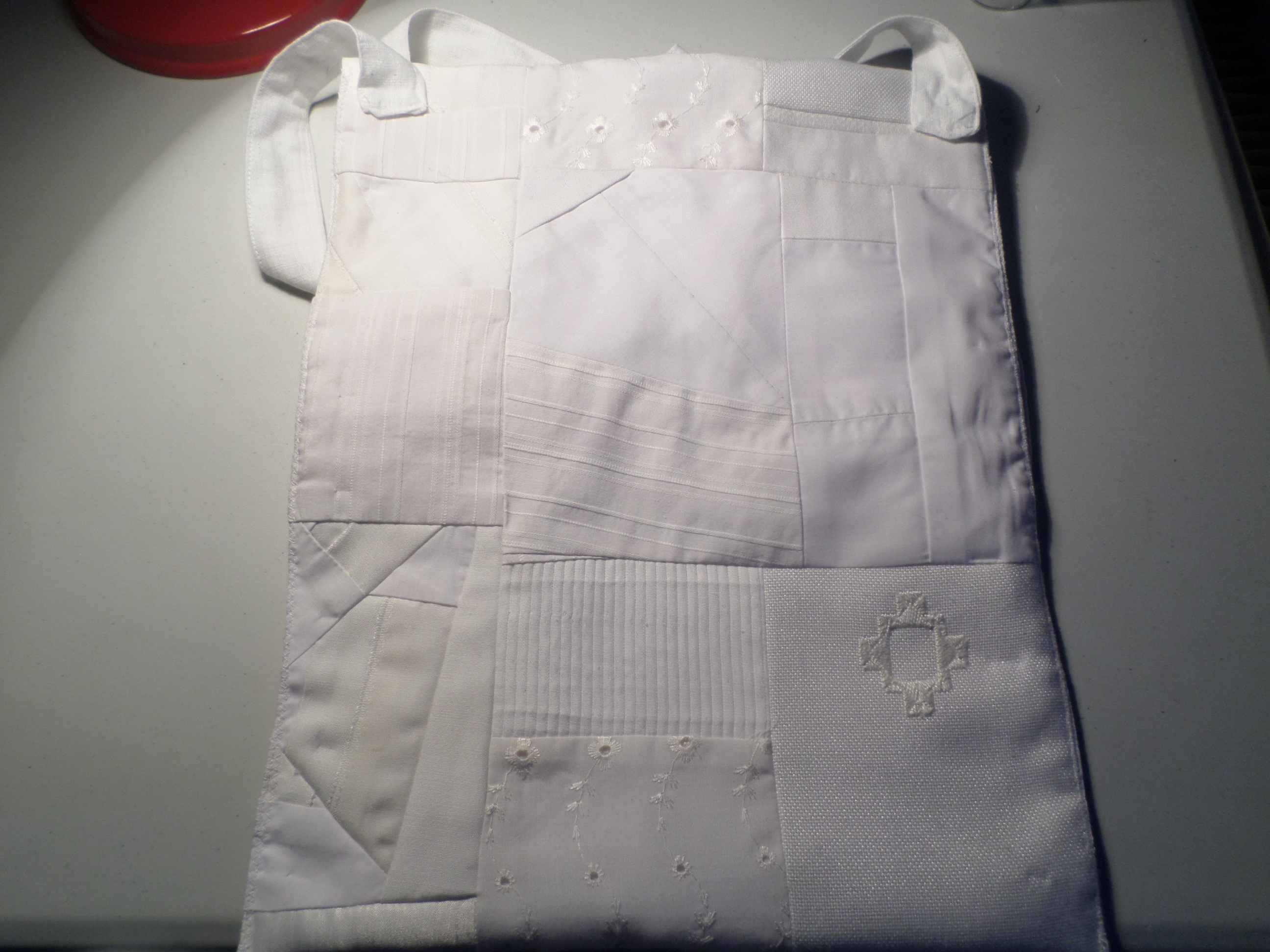
Our theme for January was 'snow'. I couldn't come up with anything but 'make something white' which turned out to be a cross body bag from white scraps. I'm not happy with the finished product: it's too wide and the strap is too narrow. So it's likely not finished but just at a resting point.


Our theme for February was 'red', for George Washington's birthday (cherries), the Chinese New Year (red is an auspicious colour in that culture) and of course Valentine's Day. So I made yet another tote bag. 


I can remember where quite of bit of these fabrics originated. Some belonged to Rita. I have a photo of her wearing a red dress made of the taffeta-like fabric of the front pocket. Others were from upholstery fabric samples. The French toile picture is from having my kitchen curtains made at an outlet in Blaydon. I asked for the scraps left over - I'd paid for the fabric after all. 


The inner pocket has some cross-stitching on it. I lined that pocket to protect the back of the stitches. Both the cross-stitch and the lining fabric came from Jan, a lady formerly in my Thursday night craft group. Jan is terminally ill and no longer crafts so she handed over her enormous stash, some of which came my way. I will share photos of this bag with that group and perhaps it will get back to her. Leslie, another lady from that group, gave me quite a bit of the patchwork cottons. She is a crafter who buys the materials for a project, finishes the project and discards any leftovers. About as opposite to me in every way!


The theme for March is 'Easter'. I've no interest in eggs or rabbits, so will likely make another tote bag...perhaps in green.

Wednesday, 10 February 2021

Strange Lights

Somewhere around Christmas I read that it was OK to leave the tree and decorations up longer this year as they lifted peoples' spirits. I had a think about this but still opted to take it all down in the first week of January as per usual.

I did suggest to Bill we try putting some lights up, though. We have red lights in the dining room (red is supposed to stimulate appetite, not that ours generally is in need of help) and white lights along the stairs. I had it in mind they would be on the bannister, but Bill put them on the ground.


These have turned out to be rather practical, lighting our way without having to turn on either the downstairs lights (even if I did feel that turning on the upstairs lights produced a slightly better photo).


We may need to keep those even after the pandemic (if such a thing happens). I see the neighbours across the street left some lights up in the doorway between kitchen and dining room, also some on one of the trees in their back yard. Another neighbour has lights up in their conservatory. 


Have you done anything to keep a festive/light-hearted spirit in this dark time?


Wednesday, 3 February 2021

Cajun Gumbo?

Morphy drank a bottle of Breux Bridge and I had a soda. Angie sipped a glass of white wine as she cooked. She cut four chicken breasts into about sixteen piece and set them to one side as she set about preparing the roux. Cajun gumbo is made with roux, a glutinous thickener, as a base. Angie poured peanut oil into an iron-based pan over a hot flame, added in an equal amount of flour, and beat it with a whisk continuously so it wouldn't burn, gradually turning the roux form blond to beige and through mahogany until it reached a dark chocolate colour. Then she took it off the heat and allowed it to cool, still stirring. While Morphy looked on, I helped her chop the trinity of onion, green pepper and celery and watched as she sweated them in oil. She added a seasoning of thyme and oregano, paprika and cayenne peppers, onion and garlic salt, then dropped in thick pieces of chorizo sausage. She added the chicken and more spices, until their scent filled the room. After about half an hour, she spooned white rice on to plates and poured the thick rich gumbo over it. After that, we ate in silence, savouring the flavours in our mouths.

From Every Dead Thing by John Connolly

No idea if this is a good recipe for gumbo (I thought there was okra in there somewhere) and I'm not sure about cooking roux until it is dark brown, but this sure made me want to give this a go. May do a bit more research first.

Thursday, 10 September 2020

Grandpa's Birthday

They say women marry men who are like their father. I can't say this has been obvious to me in the past but it might be possible; I need to consider this a bit more. The thought crossed my mind the other day that Bill was a lot like Grandpa: kind, patient, a tinkerer, someone who loves good, well made clothes for a very long time, sociable, a do-er more than a thinker.


Grandpa's father was a blacksmith. I remember reading or hearing somewhere that blacksmiths had an important position in their community, in part because they tended to be quite strong men who mastered fire and metal, but mainly because they were the makers of the tools that all the other craftspeople relied upon having. They were also frequently the repair shop for many household goods.  Not to mention that horses were the made mode of transport of their day and they were the source of horseshoes. The 1880 census says that Grandpa's father was a plough smith, so he was supporting the source of food. The 1900 census tells us he was now called a blacksmith, also that he immigrated from Germany in 1868, at the age of 27. He was 53 and his wife, Catherine 40, when Grandpa was born.

Grandpa's mother died when he was 11, in 1905, and his father when he was 17, in 1911 (and I thought I was young when mine died: 32 and 34). He was the youngest of eight children.  Three of Grandpa's siblings died before he was born: a girl aged one, another girl aged 16 (along with her twin babies) and a boy aged three. The rest of the family reached maturity. The last to die was Grandpa's eldest brother, John, who predeceased Grandpa by 10 years. I was seven years old when John died and I remember Grandpa being very sad. He said the John had largely raised him. 

I always count myself very lucky to have had Grandpa in my life. He is still one of the best men I've ever known.