Showing posts with label Sydney. Show all posts

Sunday, 18 May 2014

Manhunt

I love to play with my post titles. They are often silly private jokes. I chose this one mainly because how often will I get to talk about a 'manhunt'? No, it doesn't refer to a police chase. Nor is it about that song from the movie Flashdance. Is that telling my age? Well, no matter.


Somewhere I have a photo of people running up and down Cheviot, but for now,
Wallington Hall will have to suffice as illustraion.


I believe this is related to a 'hash'. (No, it's not food either, but does involve drink). The first time Bill and I encountered a 'hash' was on our first visit to Sydney. Jane knew we were into running and so she looked for an event we could join in. The Sydney Hash House Harriers was celebrating St. Patrick's Day with a hash involving Baileys and Guinness, if I remember right.  It sounded really daft but we went along for the fun.

As they did it, a course was planned in advance and marked with symbols indicating which way to turn. The hash course has loads of false trails which you don't know are false until you find the symbol telling you to turn around. The faster runners of course found and deduced the false trails first, often catching the slower runners about to enter and able to warn them off taking that turn. The result is that slower runners should follow more or less the true course, letting faster runners do the work of travelling the extra distance of the false trail. It is a way of letting runners of all abilities run together, after a fashion. People shouted 'on-on' a lot and I think there was some guy running around tooting a bugle (an allusion to a Fox Hunt - the kind done on horseback - no doubt). Halfway through the run there was a bandstand with tots of alcohol on offer. Can't say I've ever run under the influence before then or since. It doesn't help much.

When we finished running there was a 'barbie' (cook out) and a meeting in a pub where new people were required to 'down-down' as in chug a half pint of beer. Other people seemed to get beer poured on their (new) trainers. It was all a bit mad. Bill says it's all very 'public school' (upper class), ex-pat stuff. Which according to the HHH history, is true.  Jane & Chris joined for a while, though they were more of the walking persuasion and Jane was 'Hon Sec' (honourable secretary) for a while. She sent us HHH t-shirts for Christmas that year. 

Wikipedia dates Hash runs back to 1938 in Malaysia, but they apparently based their runs on what Brits called a 'paper chase' that dates back to 1880s, which is in turn based on the Elizabethan game of 'Hunt the Hare' or 'Hunt the Fox'. The Paper Chase involves a lead runner dropping bits of paper for his chasers to find.  The 'hare' or the 'fox' are usually the faster runners in a group. 

What has all this to do with Wallington Hall? Well, it seems that George M. Trevelyan, whilst in his undergraduate days at Trinity College, Cambridge, was a co-founder of a race in the Lake District, sometimes called the Lake Hunt and sometimes referred to as the 'Trevelyan Manhunt', beginning in 1898. G.M.'s (disinherited) nephew was involved in this race for forty-two years and so far as I can tell, it is still run, but by two separate groups.  There is the Trevelyan Manhunt and there is possibly a manhunt run by Trinity College, Cambridge.

Though, given the 'health and safety' considerations raised by this author, it may have fallen by the wayside for Cambridge students. In any case it is clearly considered an historical and hallowed tradition by some, even important enough to mention in their obituary.

Monday, 2 July 2012

Nelson

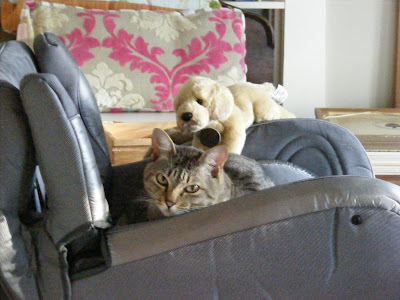
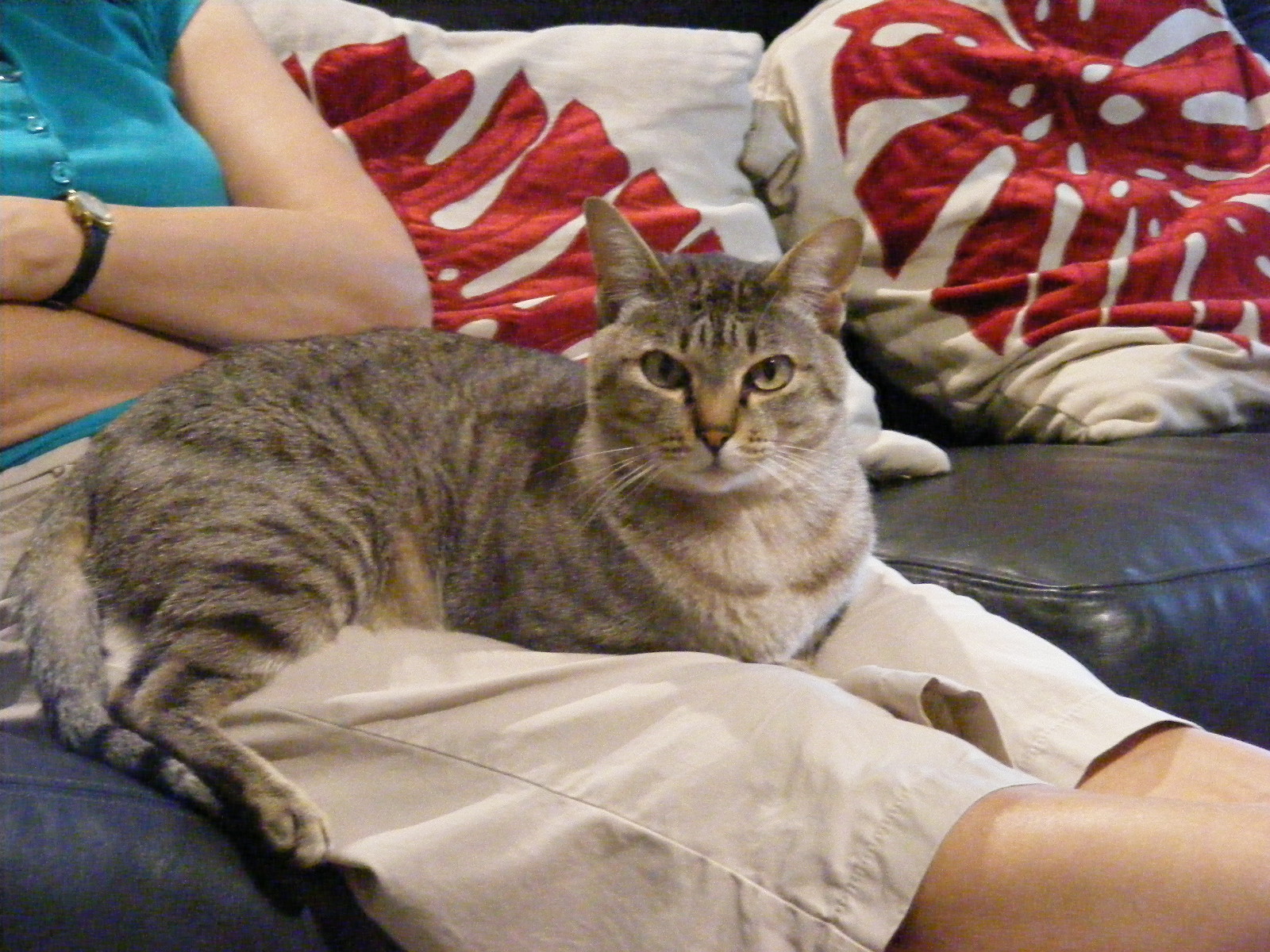
Jane's daughter, Jenni, and her husband Cedric have a cat named Nelson.   I can't find my notes - and I did make some - but I believe he is an Australian Mist;  They are bred from Burmese, Abyssinian and Australian Domestic Short-haired cats and are particularly suited to indoor life.  Being a house-only cat and thus virtually, if kindly, imprisoned, he is named after Nelson Mandela.


Jane came back early from Avoca do take up cat-sitting while Jenni and Cedric were away.    Also, to get some quiet time for herself after the stretch of busy-ness and stress of those weeks.

When Bill and I returned to Sydney a few days later, Nelson was still pining for mommy and daddy, though he did pose for photos and allow petting at times.


This will be the last post about Australia for a while. I think it's time to go home, don't you? But before we do, let me tell you about some new words I learned.

You didn't really want to do any ironing, did you?


Stickybeak: An inquisitive person; a Nosey Parker; The act or an instance of looking at or watching something, especially something which does not directly concern the one looking; to pry or to snoop. As in "Let's take a stickybeak at that house that's for sale."
Can't you see I'm busy topping up my stripes?


 Bagsy: declaring a first claim to something to which no individual has any clearly recognized right. As in, "I call bagsies." In American, one might say "I've got dibs." In fact there is a whole Wikipedia entry about the origin of the term 'dibs'. 


When is my Mommy coming to get me?


Bogan: Usually pejorative or self-deprecating, for an individual who is recognised to be from a lower-middle class background or someone whose limited education, speech, clothing, attitude and behaviour exemplifies such a background. I picked this up from Corinne Grant's book and she seemed to mainly refer to people's nerdy clothing style, basically meaning anyone British or Dutch. (She's a comedian). The Geordie word would be 'charver'. I've lost my American term.


Someone get this idiot dog off my back!


 Daggy / daggies: Uncool, unfashionable, but comfortably so. This is the term used to refer to shabby underwear in an advert for a feminine hygiene product. I remember the term from The Thornbirds, it being the result of diarrhea in sheep. Apparently short for daglock (I'm never going to look at dreadlocks the same again) and not to be confused with bogan.


Daddy plays rough, but I love it.
Budgie-smugglers: Bill dropped this one on me one day at the beach when he was making observations about age and choice of swimwear. He concluded that the youngsters preferred board shorts and the oldies liked budgie-smugglers. He tends to wear the loosed, lined swimming shorts.

 
You're not really taking a photo of my rabbit feet are you?
Isn't English an amazing language?


Friday, 29 June 2012

Race Day

So now we come to the whole purpose of why we came to Australia when we did this year:  so Bill could do a 10K race.  Crazy, eh?  


This is the Rotary sponsored race that Chris had worked to organise before he became ill.  Jane and Jenny and others staffed the water table. 


No one looks good at the end of a hard race.


Several thousand runners turned out, plus family members.


Some people got more fun jobs than just handing out cups.


There were loads of prizes given out.  Bill didn't get a prize, but he was reasonably content with his race time nevertheless.


When the main business of the race was done, a group of us ladies met up at the cafe near the park, Sous le Soleil.  I was taken with these lovely little bottles grouped in their own little wooden crate and filled with flowers.  Turns out that Belvoir drinks are from the UK; in spite of the fact that these bottles' labels were in French.


This shop had been on Jane's list of things we might do and so I was keen to see the shop inside; she did warn me that the prices were breath-taking and she wasn't wrong.  They wouldn't allow photographs, but you can take a walk around the shop yourself if you like, here and here.

Whether or not I approve of their prices - or their policy about photography - they certain have a way of presenting things beautifully.

Monday, 25 June 2012

Crafting with Jane and Jenny


In addition to loving books, my sister-in-law Jane sews wonderfully.  She and Jenny (of The Quilt) are involved with their husbands in Rotary, which of course has many different fund-raising activites.  One of these is a bridge day.  Neither Jane nor Jenny are interested in bridge, but they do like to put on a craft stall and try to sell hand made items to the bridge-players. 


Great apron; shame about the light fixture.
V. bad photography, that!


Jenny came over one day to show us what she was making and to consult about other plans.  Jane modelled her fabulous striped aprons.   She'd also made some really smart looking place mats from lush fabrics and was going to add some braid or other trim to some small square tablecloths.


Jenny showed us her incredible covered hangers. 


She starts with inexpensive store-bought covered hangers, already padded, and then adds her own style of covering with over-the-top embellishments that make the hangers very unique. 

Obviously a work in progress...
I think Jenny has a really good eye for what works.


Wouldn't you find these hangers irresistable?

Jenny also showed us the crochet throw she's making for one of her and Jane's grand-daughters.  All the grand-kids are getting one!


I found this get-together quite inspiring...not that I've had much time since our return to do any crafting, but I'll get there eventually.


Friday, 22 June 2012

Beauchamp Park, Sydney

I never stop being astonished when I trip over something I wasn't seeking, something that ties into one of my obsessions.  The world really does feel like a small place occasionally.


Bill and I walked to the shops one day to pick up a few food items.  We happened onto this lovely little park. 


The names Beauchamp, Lygon or Madresfield probably don't mean much to most folks and I'm sure that a good percent of the world doesn't remember Evelyn Waugh. However, the name Brideshead sort of sticks in the brain I think.  


For those not familiar with these names, a short explanation is: a man named Evelyn Waugh (1903-1966) wrote a novel called Brideshead Revisited: The Sacred and Profane Memories of Captain Charles Ryder which drew heavily on the real lives of the Lygon family, whom he met when he was attending Oxford University. The book is renowned for evoking the nostalgia of the interwar period in Oxford, before social changes chipped away at the privileged lifestyle of Britain's nobility. The head of that family, William Lygon (pronounced Liggon), was the 7th Earl Beauchamp (pronounced Beecham)and the ancestral family home was not called Brideshead as in the book, but was Madresfield.   Before being exiled from England for his homosexuality, which was then illegal here, Lord Beauchamp had also been Governor of New South Wales, the Australia state in which Sydney is located.


Sadly, I read that Lygon wasn't a big hit with Australians, owing to a reference he made to the 'birthstain' of their convict heritage.  So, I guess diplomacy wasn't his strong point. 


There was also a Lygon Street in Melbourne. We took a walk out there one of our last mornings and wished we'd done so sooner. Just out of the CBD, it was an oasis of calm. Street cafes lined one side and residents sipped coffee and read the papers under the shade of awnings. A nearby park and flats surrounding all made it look quite appealing. It is apparently a largely Italian sector and I'm sure there would have been some delicious meals to have been enjoyed had we discovered the area sooner.

Friday, 15 June 2012

Jane's 80th Birthday Lesson

Jane will love this title when she reads it!  No, she isn't anywhere near 80 years old.  However, on the day The Quilt was presented, I stayed to watch as she gave her ESL (English as a Second Language) lesson.   I thought it was a clever lesson in that it discussed a current event and also told her students something about herself and her homeland.


She asked if they knew what 80th 'birthday' was approaching.  Several of them knew that the 80th anniversary of the completion of the Sydney Harbour Bridge was around the corner.  Jane showed them a photo from the local newpaper.


Sydney Harbour Bridge (1932)
Then she showed a photo from the internet and asked them what it was - they all answered, 'Sydney Harbour Bridge'.  However, it was not.  It was the Tyne Bridge, located in her home town, built around the same time as the Sydney Harbour Bridge, but completed a few years earlier.  She went on to explain that Newcastle-upon-Tyne in England was where she grew up.

Tyne Bridge, Newcastle (1928)
Now I always believed that the Tyne Bridge was sort of a trial run for the much larger Sydney bridge, but it turns out that they were both designed based on the even earlier Hell Gate Bridge in New York.

Hell Gate Bridge, New York (1916)


If one starts reading about 'through arch bridges' it turns out there is an even older one in Vermont, simply called Arch Bridge.  However, while this was quite an innovation in the US at the time, the through arch is an improvement on a Roman design.  The Romans built Newcastle's first bridge, called Pons Aelius, near the site of the present Tyne Bridge in about 122.

Getting completely carried away with through arch bridges, it turns out that Sydney Harbour is not the largest either.  That distinction is currently held by the Lupu Bridge in Shanghai.

I'm pretty sure Jane didn't get quite this carried away in her lesson, but I must admit that I slipped out before I had to talk English with her students as I figured my American accent would just confuse them.


Arch Bridge, between Vermont and New Hampshire (1905)

Monday, 7 May 2012

Darling Harbour

One of the things that did go to plan on this holiday was our week in Melbourne. 


We had booked non-refundable tickets on the train and fortunately by this time we knew that Chris was out of danger. 


The rains had stopped, or at least slowed, and so the basement was also out of danger.   


The first step was to spend the night in Sydney town centre. 


 This had always been the plan because Jane and Chris were supposed to be on Kangaroo Island.


We wandered around Darling Harbour (love that name) to find some dinner.

  
I'm always shocked at how expensive everything is in Sydney, but I did want to eat outdoors for a change (it's just not feasible where we live). 


Eventually we found a pizza place whose prices were almost palatable. 


It was great sitting next door the the Brazilian buffet place, watching a family consume more meat than we've eaten in a year. 

I also spotted my first ever real life Hermes scarf.  A tiny Asian girl waltzed past wearing crisp orange linen shorts, a white t-shirt and an amazingly brilliant orange print scarf.  Bill and I agreed it must have been an Hermes, but she was too fast for my poor old camera to catch.


Bill had booked us into a really fun place for the night:  The Great Southern Hotel.  Having an obsession with art deco does give a focus for making choices. 


Also, and probably more importantly, it was just across the road from the train station and we had an early start the next morning.

Wednesday, 2 May 2012

Experimental Farm at Parramatta

One of the days out that Jane suggested to us was to visit Parramatta.  This involved a bus ride to the Circular Quay and a ferry ride to Neutral Bay.  I had given up on extra anti-histamine tablets and gone to decongestion tablets, thus I missed the sights on the way there and back, falling asleep almost the instant I sat.  After that day I broke the tablets in half so I could remain conscious.  Owing to my state of health, I took no photos of our trip to Parramatta, but Bill took a few. 


We were both amazed at the evidence of the impressive flooding everywhere around the dock.  Whilst I wasn't feeling particularly creative and enthusiastic, I did still enjoy the lovely warm weather and I remembered a great deal of our two tours. 


On the way to Parramatta we passed through Harris Park, where we ate the most amazing Middle Eastern fast food:  chicken and sausage kebabs, hoummus and tabbuleh salad.  I wished they'd open up something like that in the North East of England.

The oars are just decoration, but I wondered if they might be
 useful if the flooding had continued...


So what is Experimental Farm?  The First Fleet of convicts arrived in Sydney in 1788, one of whom was a man named James Ruse, from Cornwall, who has convicted of larceny (some silver and two watches valued at £5).  Ruse had served most of his sentence on a convict hulk on the River Thames, but was then transported to finish his sentence.  I learned a new vocabulary word:  'emancipist', referring to convicts who had finished serving their time and were free.  Prior to his crime and conviction, Ruse had been a farm labourer in Cornwall and the Governor of the colony, Governor Phillip had concerns about the burden of provisioning all the convicts and their keepers in this new land. 

As an experiment, in 1789, the Governor gave newly emancipated James Ruse 1 1/2 acres of land to farm, to see if it were possible for emancipists to become self-sufficient and if so how long it would take.  If Ruse was successful in this endeavor he would be given 30 acres to own and farm for himself and his family.  Ruse married Elizabeth Parry who came over on the Second Fleet and was the first woman emancipist there.  Within 18 months they were able to feed themselves from this plot of land and they were given their 30 acres.  It was only 'middling' quality soil according to Ruse.  He sold this 30 acres in 1793 to a Naval surgeon who arrived with the Second Fleet, named John Harris, and got more fertile land elsewhere, near the Hawkesbury River. 

Before we leave Ruse there was a story our tour guide told that I'm not finding elsewhere.  Apparently there was a Naval officer on the First Fleet who claimed to be the first footer on the shore from that journey.  However, in fact, he was carried ashore on the back of a convict - James Ruse.  This made Ruse in fact the first to step ashore and he was apparently proud of that.

Experimental Farm Cottage, built by John Harris


John Harris built the present building which we toured, in the Indian bungalow style.  Harris had his fingers in a lot of pies during his time in this area:  in addition to continuing to practice medicine, in 1800 he was made a magistrate and was in charge of the local police.  The following year he was appointed Naval Officer, putting him in charge of the Port of Sydney.  He later helped to found the Bank of New South Wales.  Through grants or purchase he amassed thousands of acres of land. 

In 1803 Harris was charged with 'disclosing to others the opinions of members of the court while acting as prosecutor' at a trial.  He escaped any penalties because the wording of the charge was in error, claiming his indiscretion had occurred on '19 ultimo' instead of '19 instant' - meaning the 19th of the previous month instead of the 19th of the current month.  This lucky escape amused him and he later named his home in Sydney 'Ultimo House' and the area around it came to be known by the same name.   I'm sure he was a very intelligent and industrious person and that the world was a much simpler place that might actually allow a single person to claim expertise in the fields of medicine, law and finance.  However, his amused use of the name Ultimo suggests to me he was a bit of a scamp. 

Harris died in 1839 without issue, leaving property valued at about £150,000.  His will left his property to be divided between his brothers for their lifetimes and then to any of their legitimate sons named John Harris.  Our tour guide indicated that when the heirs named John Harris ran out, the court allowed the terms of the will to be change, something I'd not realised could happen.  We were later to hear of another example of such activity around a will.

Never mind the people, what about the house?  I could happily live there; I think I could live anywhere with a veranda and warm weather...


The wood floors had gaps where the original oakum had dried out and fallen through.  There were French doors leading to the veranda from several of the rooms.  As with many early pioneer homes it was furnished simply and I noticed a lot of items hand made by volunteers.  I'd never before seen knitted 'penny jugs'.  The guide said that spare change was kept in such a little container for paying for deliveries and such.   He pointed out a trunk with a domed lid.  These were called 'first class' trunks because the arched lid prevented them from being at the bottom of a stack; they had to go on top.  There was a large knitted and stuffed ottoman next to a rocking chair.  Door stops were bricks covered with brocade.   There was a lovely hexagonal patchwork quilt on one of the beds. 

After the tour we were given directions to the next venue, having bought a double ticket.  We were told it was a 25 minute walk to Old Government House, but don't you believe it; it's closer to 45 minutes.  We were nearly turned away by the woman at the front desk as she thought the last guide had gone home.  Bless him, our guide at Experimental Farm (first name, Harley) happened to arrive by car just as we were leaving and he insisted that we either be refunded or that he would do the tour, but then the usual guide turned up having not left after all.  I'm glad it worked out that way, as I also enjoyed that second tour.

Of course, you don't have to make that 45 minute walk, you just have to wait for my next post...

Monday, 30 April 2012

Woollahra

After leaving Double Bay, Bill proposed that we walk along to Rose Bay where we could catch the ferry back to Circular Quay.  I agreed, even though we didn't know how far it was and it was slow going in my flip flop sandals.  It turned out to only to a couple of miles but with all the photography we were inspired to undertake we ended up running to catch the last ferry; between my sandals and my dodgy lungs it felt like a potentially fatal activity, that sprint. 


In looking back through my photos, I wonder if it was just our appreciation of a beautiful sunny day that made us take so many pictures. 


I was till in awe about the grey and yellow tones of Australian greenery, the different styles of housing and the views of warm, blue Pacific.


Australia has always seemed to me a funny mixture of slightly American:  all the balconies, BBQs, surfing, wide streets, poisonous creatures and a gold rush in their history.  But they are also British: tea, rugby, cricket and of course they are part of the British Commonwealth.  


'Flats' on stilts!


Australia seems quite European as well:  soccer - I gather they call rugby football - nice apartments in suburban and urban areas, good public transport systems.

I took five snaps of traffic to get this cute little bus stop / shelter.
Then again, Australia is uniquely Australian:  gum trees, really poisonous creatures, marsupials, school uniforms that include broad brimmed hats...uhm...Crocodile Dundee?). 


I'm sure that Australians could come up with a far more sophisticated list! 


We could see a lot of history here as well, not to mention that we were still walking through a prosperous area.  


And I'm sure that a lot of what pushed our buttons would seem nonsense to plenty of folks, eg how many people do you know who get really excited at spotting an art deco font?  (Or for that matter, art nouveau fonts?)


We found this building called Redleaf pretty amazing, particularly as it houses the Woollahra Municipal Council


This reminded me of  when I worked up in Morpeth and my colleagues at the local authority had their District Council offices in Longhurst Hall.   


Redleaf is apparently 'Victorian Italianate', built in the 1860s. 


The council originally acquired this property because it included a popular public beach which was in danger of private development and enclosure. 


I was also enthralled by the Woollahra Municipal Library,

One can just see the bookshelves in that back room;
doesn't it look like just the best ever reading nook?


which I have since learned was a home built for a son of a Redleaf proprietor in the late 1800's. 


I spoke to a woman standing outside and it turned out she, too, was visiting from Britain. 

Entrance to the magical library.


Surely such a gorgeous building would inspire even the slowest and least enthusiastic of readers.  Sadly we had a ferry to catch and so didn't have time to explore further inside.


One of the things that tickled Bill was seeing the sign in the car park at the Rose Bay Police station.   


I wonder how many people parking there would refer to themselves as a 'customer'?