Wednesday, 9 October 2013

Queen Katherine

Queen Katherine by Linda Porter.  This is about Katherine Parr, the sixth and last wife of Henry VIII. The one who lived.  This book banishes some of the commonly held beliefs, for example that she was a dowdy old thing that nursed Henry in his old age. She was anything but, in fact she was being courted by the best catch of her day, Thomas Seymour, when Henry stepped in.  She married Seymour in secret soon after Henry died. 


I was astonished to learn that she had been married and widowed twice before she married the King.  Particularly as she never had any children by her first two husbands in spite of being married something like a total of 14 years. Her second husband got dragged into something called the Pilgrimage of Grace, a popular uprising protesting the dissolution of the monasteries.  I'd never heard of this uprising either.  She had no children other than a daughter by Seymour; Katherine died within a week of giving birth.  She only outlived Henry by just over a year. Her fourth husband was beheaded six months later for treason.  I found myself counting on my fingers a lot while reading this book: people died quite young back then, for all sorts of natural and political reasons. 

There was one part that made me laugh and I re-checked the book so that I could share it with you.  It was the marriage vows of Henry VIII and Katherine:


Henry:  I, Henry, take thee Katherine, to my wedded wife, to have and to hold from this day forward, for better for worse, for richer for poorer, in sickness and in health, till death us do part, and thereto I plight thee my troth. 


Katherine:  I, Katherine, take thee Henry to my wedded husband, to have and to hold from this day forward for better or worse, for richer for poorer, in sickness and in health, to be bonaire and buxom in bed and at board, till death us do part, and thereto I plight unto thee my troth.

And some of us women worry about having to promise to 'obey'!

As usual, I'm fascinated by strange words and had to look some of these up:

plight:  pledge or promise

troth: fidelity, allegiance (variant of truth)

bonaire: cheerful and pleasant

buxom:  obedient, lively, yielding 

board:  dinner table

See other Tudor terms at: http://www.thetudorswiki.com/page/Tudor+Words+Glossary  

Tuesday, 8 October 2013

Books I Took to the Loire Valley

Here are the eight books I took in the motor home segment of our French summer, in order of preference, least to most preferred.

Knits to Give by Debbie Bliss -  Useless. I don't know why I bothered, as I'm never willing to go out and buy the recommended yarn and I can only follow the simplest of patterns. Fortunately, Vivien's husband gave her an excellent book and she shared a simple pattern for a baby's cardigan, one even I can knit.

Someone Like You by Roald Dahl - Has everyone but me heard of Roald Dahl?  I only learned his name when Bill mentioned he was the very successful author of children's books. It came up when his daughter (Sophie) was posing nude on enormous billboards advertising Opium perfume. This is collection of short stories he wrote for adults. I read a few and then left it alone. They were creepy stories with gruesome plots and twisted endings. They seemed very much of my parents' time when everything seemed a bit hardboiled. Can't say I cared for it.  At all.

Alexander McQueen, Genius of a Generation by Kristin Knox - This was a so-so book, a bit of light reading with loads of pretty pictures. I didn't expect it to be anything else. I didn't know that McQueen had been a tailor on Saville Row before breaking into women's fashion, but there you go. His suicide - like many others - is such a terrible waste. Seems ironic to me that as fascinated as people are about fashion, fame and wealth, his death demonstrates that even being at the height of a glamorous career doesn't always make a person happy.

My Life with Martin Luther King, Jr., by Coretta Scott King. I generally avoid autobiographies but I was intrigued to read what his wife had to say about him. This was another part of my catching up on the history during my lifetime. I'd not ever appreciated some of the things he accomplished, the beauty of his writing or his ideas. I was amused to read that he encouraged Coretta to wear make up and to dress nicer than she would have otherwise done. It also occurred to me that it was a tad selfish to have four children when one led the dangerous sort of life he did. It was fascinating to read about MLK Jr's and Coretta's family backgrounds. This is no doubt a biased account of his life - how could it not be - but I definitely felt it was worth reading.


Photo by Cecil Beaton. Why does she look annoyed?
He made her stand in the loo for this picture,
because the light was best there.


Princess Margaret:  a Life Unravelled  byTim Heald. Of course this is about the Queen's sister. She's another of those people I've always heard about, but didn't know much beyond the catty rumours. It must be difficult to be the second born when being first gets the Grand Prize. Being royal back in the 50s and 60s had quite a bit against it as well as things going for it; for one, you have to marry appropriately. Then there are royal duties, exciting things like visiting paper manufacturers and opening old folks' homes. Everyone is thrilled to meet you and to tell you what they do {yawn}. Then when the heir to the throne starts having children you get pushed further away down the line of inheritance and, in that distinctly British way of assigning people to their place, ones importance diminishes measurably. Mind, don't cry too hard, she lived a marvellous life in beautiful places, she made the best of the choices allowed her and those broadened over time. In some ways I found the book more interesting because of the other people it mentioned, including Deborah, Jessica and Nancy Mitford. In all I think the book concluded that members of the royal family who are not the sovereign tend to lead trivial lives, which is pretty sad. That said, her son David Linley (David Armstrong-Jones, Viscount Linley) seems to do well for himself:  he manufactures luxurious furniture (I gather his father tinkered around with furniture in the basement) and earlier this year became Chairman of Christies. Not sad at all.

The Casual Vacancy by J.K. Rowling. Do you remember hearing about how Harry Potter - I mean Daniel Radcliffe - got a part in the play Equus?  It was mainly notable because he had to get naked, and naked he got. It always struck me that it was almost a ritual washing after so much clean living on screen; like he had to prove he could get down and dirty, though if I recall his character was a victim rather than a villian. Well, this book struck me as being Rowling's ritual roll in the mud. It's a good book, don't get me wrong. Interesting plot, believable characters, etc., but gritty and sordid.

I've saved my two favourite books for another post two posts.

Monday, 7 October 2013

Reading Ben's Books

So, visiting the Villa on Cap Ferrat was how we spent out last day in Nice.  The next day we said good bye to the kitty cats and Ben kindly drove us to the airport.  We landed in Newcastle, grabbed the car and headed home to do laundry. The next day we spent four hours loading up the motor home and headed down to Calais.  Before we left town, though, Bill had a couple other errands to run and I took the opportunity to go to the library.


Hotels along the Promenade des Anglais.

We love art nouveau and art deco!
Looked for and found Hotel Negresco, as my
friend Shiela recommended; sadly, a sign
said we couldn't enter unless we were guests...


While I was at Ben's flat on my own, I watched some videos (the first time I've seen Pirates of the Caribbean...I'm always late to the party...).  I also read two of the books written by Barack Obama. I enjoyed both a great deal. 

Whether or not you agree with his politics, I would recommend these books. I think he write in both a very logical way but he also expresses a lot of emotion.  I came away understanding a little better how challenging it must be to be of mixed race and yet I think this experience must be one of Obama's personal strengths.  I also appreciated how he seemed to be able to appreciate the character, the skills or the outlook of people who have taken the opposite side of the political table from him.  The cynic in me suggests this could be a good 'tactic' but it read as pretty genuine to me.

In reading Dreams from My Father I got a lot of my own questions answered, about his family background and life experience.  I've always been a bit vague about Hawaii, Kenya and Kansas and now I know to add Indonesia to that mix.  I loved reading about the strong women in his family.  I think I'm having an interesting life, but of course his and his mother's lives go far beyond mine.

I actually read Audacity of Hope first, which is a bit backward of me since it was written second; I just happened upon it first and was hooked from the very beginning.  I remember the first time I saw paper dolls, my childhood toys, in a museum as historical items.  I was pretty irate about it and not a little concerned.  I must have got past this kind of thinking because I felt this book told the history of American politics during my lifetime.  I was fascinated to have things explained to me, things I remember vaguely when they happened, but I wasn't particularly interested.  I felt a bit uneasy at times, but didn't feel it had much to do with me. But of course what went before explains a lot about how things are today.  Just after I finished the book I felt as though I'd found the CliffNotes I was supposed to have studied all those years.  Of course, I've already forgotten a lot of it, but still, it was brilliant.

I recently told someone I didn't get interested in politics until about the last decade, but actually I think this is wrong.  I'm still not particularly interested in current events, only in how things work out.  I expect that's odd of me, but there it is.

Before I continue with the rest of our adventures in France, I thought I'd take a break so you don't OD - like I almost did.

Sunday, 6 October 2013

Bea's Gardens

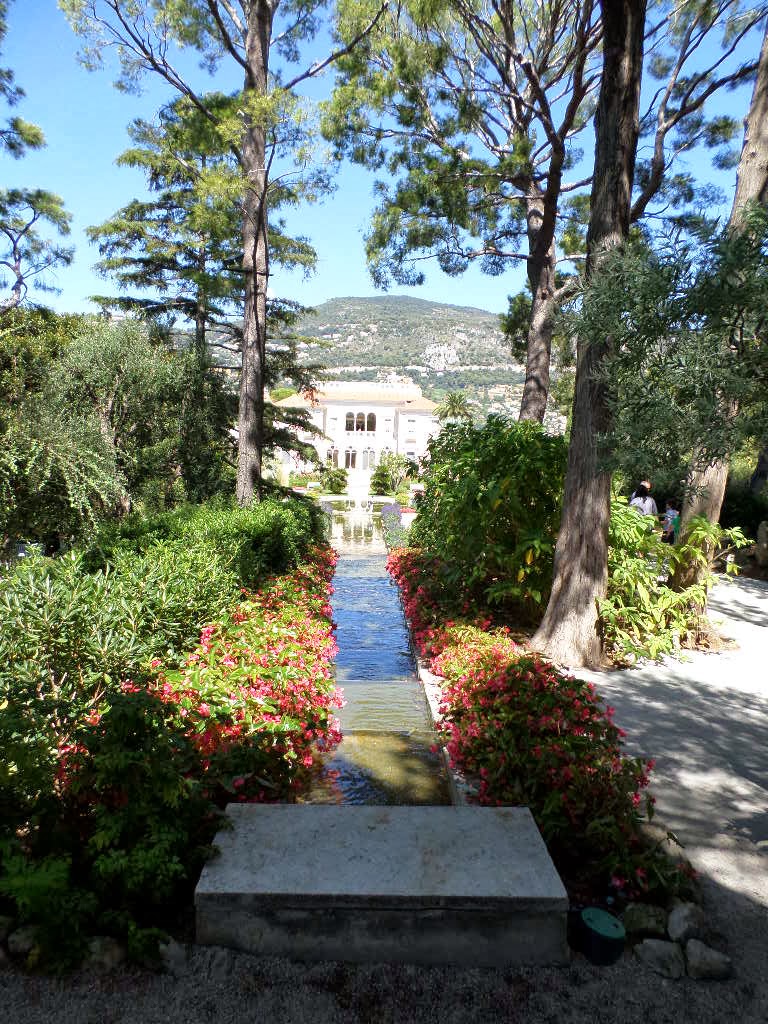
Yes, there is an 's' on that word, gardens.  I came away from the Villa Ephrussi de Rothschild thinking there were seven gardens, but I can't name them all.  The website seems to list far more than seven, so perhaps it took seven years to landscape the place.  It wouldn't be hard to believe.

I do remember that there was a Rose Garden, mostly with pink roses.  I can tell you that there was an exquisite smelling rose called Rosa Fragonard, Hybride de thé Delbard.  I'm not alone in thinking it was heaven.  According to the World Rose Society, this rose was voted by the public as the most fragrant.  As Heather recently said...The Things You Learn Here...

There was also a Japanese Garden, with lines traced in the pebbles surround the rocks and a veritable forest of bamboo.

One of my favourites was the Stone Garden.  I seem to remember a bit of wrought iron there, too.  Just as the furniture inside the villa was all seemingly of historic significance, I'm sure that the stone monuments were hijacked from various priories or cathedrals.  

My hat is off to the garden landscapers, though.  Excepting the Cactus Garden, it was all completely delightful; neither of us is keen on plants that stab and rarely flower.  The layout was very much like walking from room to room, with no boring bits in between.  There were no angles that weren't camera-worthy.  It was actually a garden that lived up to the house.

The best bit was at the end, though, when we came back towards the villa to find the fountains were tied in with a selection of classical music.  It was all very restful and a much needed rest, too, after all that walking around.


That screen-like structure originally had glass panels to shield
the garden from the winds. The glass had to come out as too many birds were being
killed, flying into the wall they couldn't see.
When the symphony finished I sat looking around, thinking how lucky we were to have seen this wonderful place.

Saturday, 5 October 2013

Bea's House - Part II

Sorry, yes, this is more of that extravagant woman's house.  I don't know that we saw all of the upstairs and I believe there are other areas of the villa still being worked on.  

One of the most memorable things about this place is that the architecture of the house seemed really simple.  It looked like just a big central square with rooms off the sides and a staircase stuck off of one corner.  Upstairs looked liked just a gallery around the top with rooms off of it.  It's not quite that straight forward, but compared with many stately homes and castles it is beautifully uncomplicated.

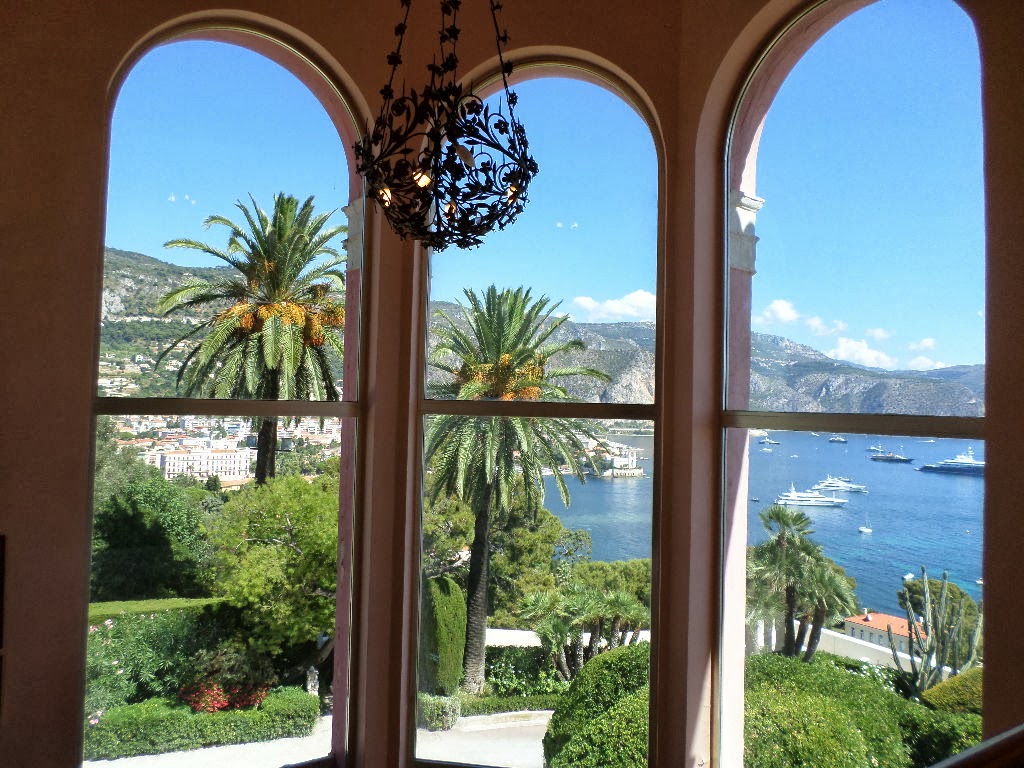
At the back you step out onto a loggia - a balcony with columns - overlooking the gardens and the sea. It is simply stunning.

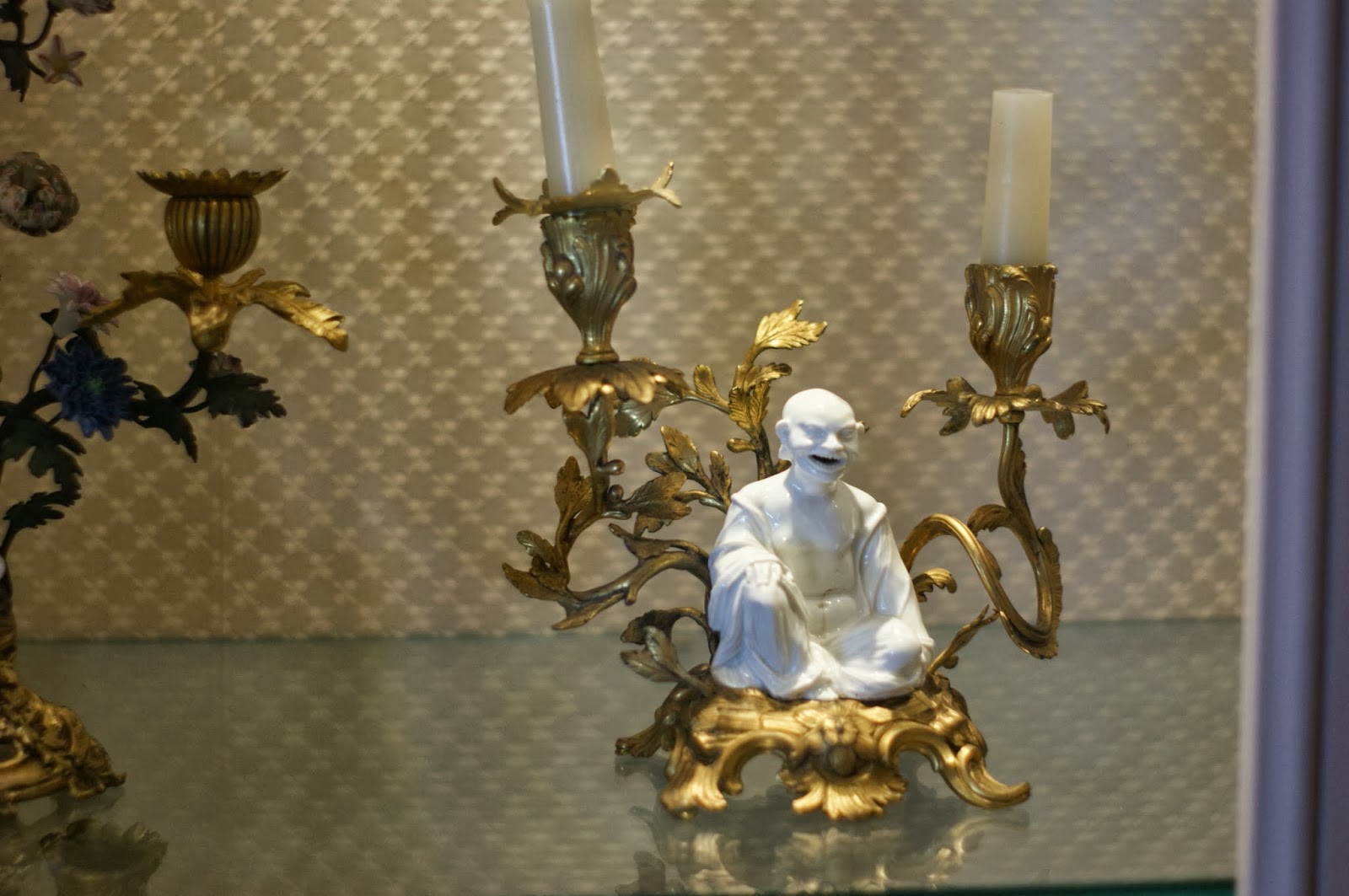
There were beautiful things in each room, as well as the building itself and the views outside.  No doubt all priceless. She had a thing for monkeys and there was a room full of them pictured with silks on the walls.  She liked the work of artist Fragonard, but collected his sketches more than his paintings.  

It dawned on me that such a pink house wasn't overwhelming because there was so much blue and green outside.  Somehow it all balanced out.


Bill and i are both a bit mental about stairwells.


No idea who these two delightfully colourful ladies are, but Bill snapped their photo.