Monday, 14 May 2012

St. Kilda and Toorak

Have I mentioned before that this was a Phryne Fisher trip?  You'll have to accept that we dip in and out of reality pretty regularly at our house and Phryne's world is a popular escape.  I believe I made introductions here.


St. Kilda and Toorak are two Melbourne suburbs often mentioned in Greenwood's books. 


Bill had made a list of places to visit, and left it at home of course, but fortunately he could remember quite a bit as he reviewed maps of Melbourne and the free tram circled the city.


Lest you make the same error I did and say TOO-rack, I can tell you since Chris told me that it's actually something like 'Track'.  Given my struggles to pronounce 'chook' (chicken) properly - or perhaps Chris was playing with me, he does that sometimes - it's probably somewhere between Toorak and Track; Teh-RACK.   Whatever.


I noticed in hearing the place names on the train journey that Australian's muffle their vowels more than I do, but almost anyone swallows their vowels more than those of us with a Southern drawl.


I loved St. Kilda:  gorgeous houses with verandas, flats with balconies, all trimmed with lacy ironwork that reminds me so of New Orleans.  


Bill was continually astonished at the use of corrugated tin for roofing, even on quite substantial structures. 


St. Kilda was a Victoria seaside playground, perhaps similar to Whitley Bay near us.  If I were to live in Melbourne, I think I'd want to be located in St. Kilda, not necessarily overlooking the sea, but within a few blocks. 


As if.  The median house price there is $940K and $823K for a 'unit' (flat).

One thing that struck me was that on our way down to the seaside from the tram, we passed a man wearing a t-shirt with the slogan 'Eat the Rich'.  I was thinking this was a more violent take on Occupy Wall Street, but it turns out this is the name of a band, also of an Aerosmith album.  Who knew?


Toorak was another story.  The houses looked more like museums or office buildings than homes. 


I kept looking for the brass plaque identifying which country's embassy I was seeing, all surrounded by six to eight foot walls.  The houses were completely out of scale, being built to within a few feet of the lot boundary.  They made me imagine a life lived in air conditioned rooms, mincing across miles of marble.  Not my cup of tea. 


Wikepedia says that the name Toorak is synonymous with wealth and privilege, one of Australia's most expensive and prestigious suburbs.   If one walks through Nichols Hills in Oklahoma City the police come along and inquire about your business (I had a girlfriend who lived there); I kept waiting for the cops to come talk to us!   The internet gives a median house price of $2.6 million, but in the recent recession housing prices were tumbling.  Not at all surprising; one pays dearly for prestige.

However, there was one house in that area that we paid to enter, because we'd had a glimpse of it on TV the previous Friday night.  More about that next time...

Friday, 11 May 2012

Gosh, Melbourne!

Where to start?  Melbourne is an amazing mix of old and new architecture.  It's frantically busy with people and there seems to always be something to do.  We stayed pretty close to the CBD (Central Business District) and the toughest thing was to figure out how to prioritise to get the most of our days. 


Tram passing Federation Square


I must admit I was pretty tuckered out by about 4pm, walking and standing most of the day.  It's not a matter of just striding out to get to a destination, but of dodging people and prams, waiting for lights to change, watching for the very high curbs, for cars, trams and buses, keeping one eye on Bill while trying to stop and snap a photo. 


St Paul's Cathedral


The hotel was a slight disappointment.  The rooftop pool was out of order and I could have shown the cleaning person a thing or two, which is worrying. 


The Forum Theatre


The first thing I did was to trip over the tiles that raised the threshold of the bathroom, bruising the ball of my foot.  This meant wearing my trainers for added cushioning, not very stylish with my skirts, but there was nothing for it but to get on and see the sights.  Each night I pulled the bathmat over that threshold to remind me to lift my feet during any night time excursions.


Three Melbourne businessmen


It rained a bit while we were there, but mostly it was sunny and in the 80s or lower 90s, so I generally happy with the weather.  We went to a proper restaurant in Chinatown one evening, but the rest of the time we had room picnics with grocery bought foods.  Not very low calorie food, sadly, but the walking took care of most of it.


Public Art; public purse?


Melbourne has had to battle to save her older buildings from the wrecking ball (or is it all just dynamite these days?).  In one exhibit relating the rescue stories of various buildings, it was interesting to note that even the demolition workers had a view about some of them and went on strike rather than to participate in their 'downfall'.   We saw one instance where a facade was being supported while a modern building was being constructed behind and observed a few examples where this had been done elsewhere.  Not ideal if the interior is still original, but many buildings not historically protected have been trashed anyhow and the facade is perhaps better than nothing.


Mitchell House, at Elizabeth St and Lonsdale, built 1936


There was a surprising amount of things to do for free:  a tram that circled the city centre, the galleries at Federation Square, an exhibit at the library, the Victorian Women's Centre.  We chased down all things Phryne Fisher and pretty much walked all the cross streets of central Melbourne, laid out on a lovely grid.  The street names echoed out of Kerry Greenwood's books and Bill was in seventh heaven. 


The Flinders Street Station


has to be seen to be believed.  It's so....yellow.


I would happily go back to Melbourne, to spend more time exploring the coast and further afield. 


I'm certain we've only scratched the surface, as has this post...more to come!

Wednesday, 9 May 2012

Why I Prefer Trains

When I was growing up in Oklahoma City there weren't a lot of passenger trains around.  We lived about half a mile from a railway line where it crossed a main road, so one of the sounds of my childhood is the wail of the train horn at night.  It was of course a big deal to wave to the train conductor and one of life's excitements was to be at the front of the queue of cars when the train first approached, in order to have the best vantage point for counting cars.  To this day when I see a freight train in the US, I'm in awe of how long the things are.


When I first visited Britain, a journey on a train was a major experience for me.  I remember taking a small tape recorder to capture sounds (a suggestion from Europe Through the Back Door, by Rick Steves):  the girl playing a flute in Cambridge, the chatter of an Italian family on the London underground, the bagpipes playing outside Waverly Station at Edinburgh, the rhythmic clatter of the train.  So what is so great about a train journey?


One can get up and go to the loo anytime they like; this requires no permission from a member of staff or from the driver.

There are generally as many toilets as there are train cars provided, not a measly three or four for a full double decker plane.

One can wander the length of the train if they wish.

No seatbelts required - or even provided. 

The chances of surviving a crash are considerably better.

No navigation required, no map reading, no disagreements about which route to take.

No immigration portals, as a rule, though we have been awakened at 3am with a bang on the door followed by a machine gun, between the Czech Republic and Slovakia.  We trust since joining the EU they have a more civilised understanding of how things work.

In many cases, a ticket may be purchased along the journey.

Full sized servings of junk food available in the catering car, along with hot and cold drinks, alcoholic beverages and often books and magazines.

The timing  of one's meals is largely one's own choice.


The staff pass infrequently, to check tickets or to gather rubbish, and otherwise leave folks alone.

The windows are enormous and one can see the world pass; no one orders one to shut them so
others can watch their telly or sleep.

No sausage socks required to prevent deep vein thrombosis.

There is often a 'quiet car' in which use of noise making gadgets, including mobile phones is prohibited (in my ideal world, use of mobile phones would go the way of smoking).

Roomier seats, often with footrest; no piggy-in-the-middle three-across seating arrangements; sometimes very interesting compartments as in Harry Potter films.

No junk mail (or little white bags) in the seat pockets; to date, no duty-free sales announcement, beg-a-thons  for your spare change or sales of Lottery tickets.

Newer trains provide electrical outlets and Wifi, not to mention nifty little hooks for a person's jacket.

Rarely any ashtrays in the arm of the chair to remind one that the vehicle is actually antique.   Or, if the train is elderly, the implications seem less dire, nothing much worse than a slower journey.

No baggage check and no waiting for unloading; it's DIY and one may choose from ground level at one end of the train car, over head and sometimes behind your seat.

Passengers are allowed whatever amounts of creams, liquids and gels they wish to carry for their beauty and refreshment; this includes picnic food  and drink to save on the cost of meals.


More flexibility in the use of tickets:  one can often just take the next train available going to one's destination (though one is not guaranteed a seat).

Very annoying passengers may simply be put off at the next station, causing no disruption to anyone else's time table.

No one worries if their electronic device will cause malfunctioning of critical control systems.

Some trains (ie Eurostar and Inter-City Express) are fast (sometimes faster than on a plane, what with all the security, not to mention cheaper); but I like slow trains just as well.

On sleeper trains, one may have a private compartment with two beds and a sink for less than the cost of a lung transplant.  As a rule these compartments are ingeniously designed to make full of limited space.


All this said, a twelve-hour train journey is a bit tedious.  Of course Bill booked this during the day so he could see all the sights out the window.  Jane said it would be boring, though the recent floods might be interesting.  We did remark on the irony of irrigation equipment in the midst of a flooded field, and there were patches where flood damage to the tracks caused the train to slow down or stop to let other trains pass, but on the whole the trip was fascinating.  I think Australian countryside is beautiful.  It reminded me much of eastern Oklahoma, with the wide open fields and bunches of trees, only the tree trunks were white instead of brown.


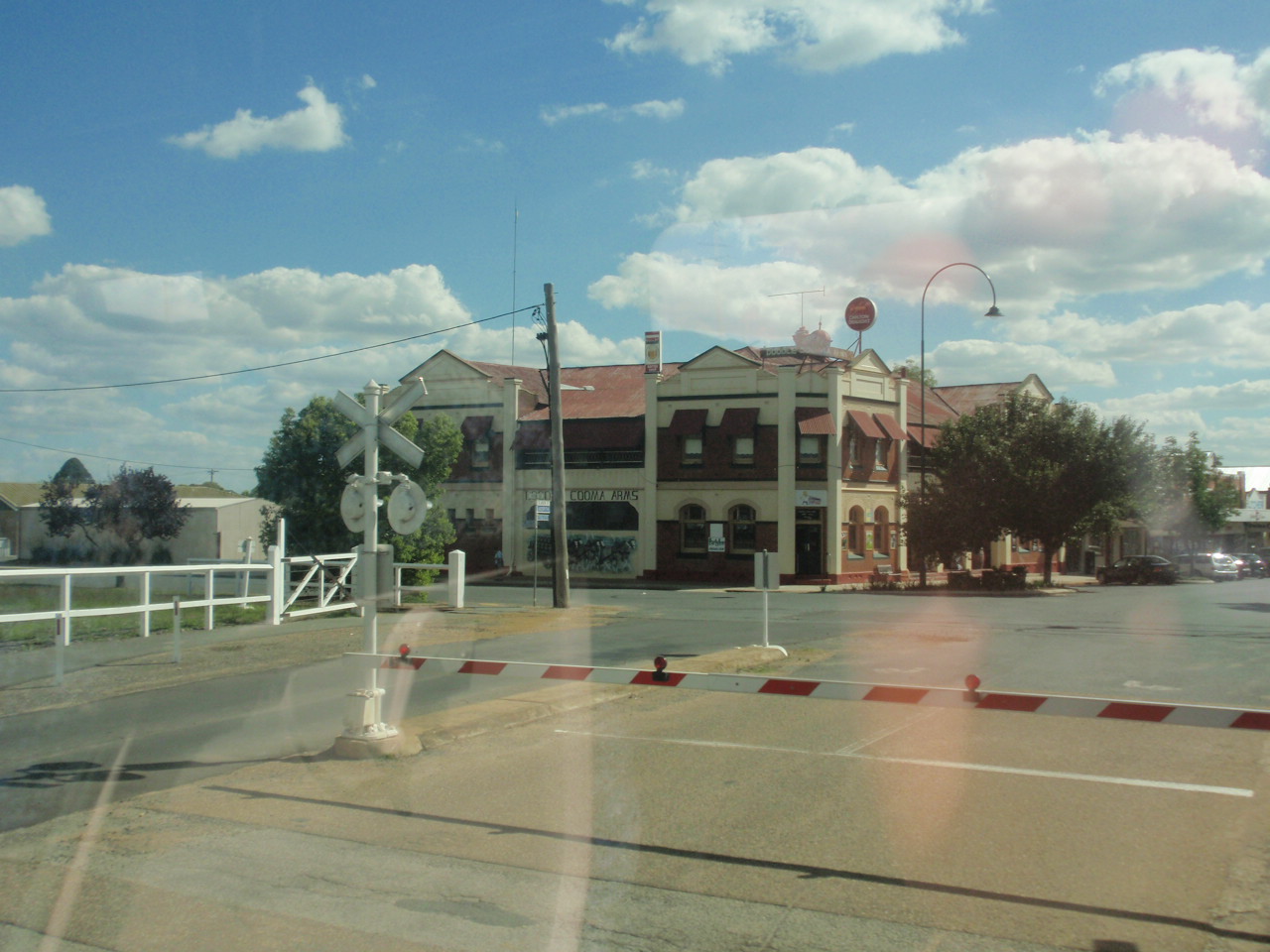
In a couple of stations (I should specify train station; in Australia, what we would call a cattle ranch is called a station), the delays were such that we were invited to step off onto the platform and stretch our legs.  The station buildings were lovely Victorian styled.  A lot of people lit up a cigarette, though later in the journey we were warned that there was a $300 fine for smoking on the train or in the train station (but perhaps it was different in Victoria than in New South Wales).  Apparently someone actually tried to smoke in one of the toilets, causing the air con system to shut down for a short while.  I'm so glad not to have that addiction anymore (not since 1980).  The place names were also quite fun:  Moss Vale, Goulburn, Yass Junction, Harden, Cootamundra, Junee, Wagga Wagga, The Rock, Henty, Culcairn, Wangaretta, Benalla.


Announcements about food were a close second to those about arrivals and destinations:  breakfast, morning tea (scones with jam and cream), lunch (including hot lunches one could order in advance, to give time for heating), afternoon tea (see morning), and hot dinners (as above) were all on offer.  Not a lettuce leaf or a tomato slice to be found, but pleasant enough food and it filled the time as well as bellies.  Prices seemed comparable with food on British trains, about the only prices we observed that didn't seem inflated.


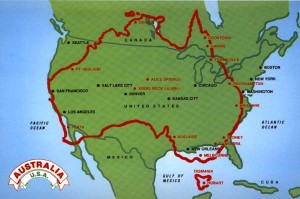
When I look at a map of Australia I cannot believe it takes a whole 12 hours to get from Sydney to Melbourne, then again I hadn't realised it was a whole 612 miles.


Of course, one needs to mentally flip Australia upside down, to remember that the warmer part is North.  Very confusing, that. 

http://petergrantfineart.wordpress.com/2010/06/21/the-size-of-australia-vs-usa


I sat across the aisle from an older Gary Cooper look-a-like, reading his Bible; it was truly an amazing sight when he stood up (and up and up) and put on his long coat and his wide brimmed hat.  I listened to the chatter of Australian voices.  I looked over the shoulder of a woman doing a word search puzzled titled 'Workers Rights', loaned my tiny retractable tape measure from Louisiana (from Great Aunt Peggy to Aunt Rita to me) to a woman who was knitting and forgot hers.  I sewed patchwork squares the entire journey, flashing my weapons of mass destruction with great pleasure.

And...eventually...we arrived.

Monday, 7 May 2012

Darling Harbour

One of the things that did go to plan on this holiday was our week in Melbourne. 


We had booked non-refundable tickets on the train and fortunately by this time we knew that Chris was out of danger. 


The rains had stopped, or at least slowed, and so the basement was also out of danger.   


The first step was to spend the night in Sydney town centre. 


 This had always been the plan because Jane and Chris were supposed to be on Kangaroo Island.


We wandered around Darling Harbour (love that name) to find some dinner.

  
I'm always shocked at how expensive everything is in Sydney, but I did want to eat outdoors for a change (it's just not feasible where we live). 


Eventually we found a pizza place whose prices were almost palatable. 


It was great sitting next door the the Brazilian buffet place, watching a family consume more meat than we've eaten in a year. 

I also spotted my first ever real life Hermes scarf.  A tiny Asian girl waltzed past wearing crisp orange linen shorts, a white t-shirt and an amazingly brilliant orange print scarf.  Bill and I agreed it must have been an Hermes, but she was too fast for my poor old camera to catch.


Bill had booked us into a really fun place for the night:  The Great Southern Hotel.  Having an obsession with art deco does give a focus for making choices. 


Also, and probably more importantly, it was just across the road from the train station and we had an early start the next morning.

Saturday, 5 May 2012

Lentils for Terri

In one of Terri's comments on a post I'd published while in Australia she asked what I did with lentils as she was running out of ideas.  I had to admit I didn't have a particularly large repertoire myself.  We have two recipes we like a lot.

One is from Food for Sport, by Judy Ridgway.  I'm a major fan of this book, full of inexpensive and healthy recipes.

Spiced Lentils
Ingredients
Serves 6; 205 calories per serving; suitable for vegetarians; freezes well
2 large onions, peeled and finely chopped
2 cloves garlic, peeled and crushed
1 tsp chilli powder
1 tsp dried thyme
1/2 tsp ground cumin seeds
1/2 tsp ground allspice
salt and freshly ground black pepper
2 TBS vegetable oil
225g/8oz red or yellow split lentils
2 TBS tomato puree
2 tsp yeast extract
1.75 litres/ 2 1/2 pints water

1.  Fry onions, garlic & spices in the oil for 3-4 minutes to soften the vegetables. 
2.  Add remaining ingredients.  Stir and bring to the boil.
3.  Reduce heat and simmer for about 40-45 minutes until the lentils are well cooked and the mixture is fairly thick.
4.  Serve with boiled rice.

I've no idea what 'yeast extract' refers to.  I never have freshly ground anything around and can't remember the last time I had allspice on hand, but we like the lesser version just fine - with mashed potatoes as well as with rice.

I don't remember the source for the next recipe.  Excuse my lazy shorthand method for writing on index cards:

Lentil Burgers
Makes 8-10 patties
Ingredients
(a) 1 cup rinsed lentils, 2 1/2 cups water, 1/2 tsp salt
(b) 1 TBS olive oil, 1/2 medium onion minced, 1 medium carrot diced, 1/2 tsp pepper, 1 tsp soy sauce (optional)
(c) 3/4 cup each bread crumbs and finely ground oatmeal

1.  Simmer (a) 45 minutes until almost dry
2.  Saute (b) and mix all but, then add (c)
3.  Make patties and either keep in fridge, freeze or cook
4.  May be fried for 1-2 minutes or baked on greased cookie sheet at 400 F. for about 15 minutes.

I use whatever oatmeal I have on hand and sometimes add a bit more if the mix seems wet.  Sometimes adding an egg or two helps things stick together.  We plan to play with spices included in this to see if we can make Indian burgers, Italian burgers, etc.

I have also been too lazy to mess with burgers and have just patted the mixture into a greased square pan to bake.  That worked fine as well, though if I recall it didn't come out quite as crunchy and Bill likes the burgers crunchy.

Nothing to do with lentils, I know, but I did snap the photo in Sydney...


Since I was sitting around in Sydney when I got Terri's comment, I looked through Jane's cookbooks and found:

The Vegetarian Book, by Charmaine Solomon

Puree of Red Lentils
Serves 6; 261 calories per serving
Ingredients
300g (11 oz) red lentils
3 TBS ghee or oil
2 large onions, finely sliced
2 cloves garlic, crushed
2 tsp finely grated fresh ginger
1 tsp ground tumeric
2 tsp salt or to taste
1 tsp Garam Masala

Pick over lentils to remove grit.  Wash in bowl of cold water and drain well in colander.  Heat ghee and fry onions over moderate heat until golden brown.  Stir in garlic, ginger and tumeric, fry until garlic and ginger are golden.  Add lentils and fry for 2 minutes, stirring.  Add 1.5 litres (60 fl oz) hot water, bring to boil, reduce heat and simmer covered for 15 minutes.  Stir in salt and Garam Masala and continue cooking until lentils are soft and liquid absorbed.  Serve with rice or Indian bread (naan).

We tried this when we got home and it was very nice, but I think it makes more than 6 servings. 


Then, by one of those strokes of luck, Wise Bread published this article on something like 25 ways to fix lentils.  The list includes recipes from Russia, France, Equador....  I can't wait to try some of them!

-------------

As an aside, I've recently had a couple of comments left by Anonymous expressing appreciation for some of my older posts on frugality.  I'm thrilled to bits to have a 'frugal fan'.  Sharing those ideas was one of my main motivations for starting this blog, so I'm really pleased that you like them.  Thanks for your lovely comments.


Friday, 4 May 2012

Old Government House, Parramatta

As I said in my last post, we nearly didn't get the tour at Old Government House, but we won in the end.   One of the things I didn't mention about the name Parramatta is that it comes from an Aboriginal word, Burramatta, which refers to the multitude of eels to be found in the Yarra River there.  Of course in times past, eels were a mainstay of the British diet and one can still find eels at the fishmongers.  It's not a dish I'm likely to try, however, and I recently read that European and American eels are on the endangered species list.  If that doesn't serve as sufficient excuse, one can always remark on the extraordinarily high fat content of eels and express concern about potential dioxin contaminants.  That should get you out of eating eels.  Aren't you glad I let you in on these tips?

Source:  Wikipedia


Anyhow, Old Government House was home to the first ten Governors of New South Wales.  The first lath and plaster house was built by (1st) Governor Phillip but it didn't last long at all, due to termite infestation (Australian termites are pretty awesome).   The next Governor built a brick house on the same site and the present house with additional wings and the front portico is the result of work of (5th) Governor Macquarie...and his (2nd) wife. 

The tour guide began by explaining that the house is Georgian in style but that substitutions had to be made because of lacking the proper materials.  The columns out front are not marble but concrete painted to look like marble, as are the interior 'marble' fireplace mantles painted wood.    The front door is not oak, but local wood painted; the house is not built of stone, but is brick, disguised to look like stone; the front hall tiles are not tile but painted wood, and so on.  I suppose one does what one must. 

Mrs. Macquarie had interior doors added to some rooms to bring about the symmetry required by the Georgian style of architecture.   The decor of the house is in the style brought about by the efforts of Governor and Mrs. Macquarie who lived there from 1810 to 1821.  Naturally, photos were not allowed inside, but this page gives you a glimpse of what we saw.

Our guide made two statements which I thought were incorrect, though I said nothing at the time.   He referred to 'consumption' as being heart disease; consumption is what they used to call tuberculosis.  He mentioned that Britain had for a time sent convicts to the American colonies, a practice that was halted by the Revolutionary War.  I didn't believe that convicts had been sent to America, but I was wrong.   Initial Transportation Acts in Britain were for sending convicts to North America, a practice that may have started as early as 1620.  Funny how in Australia people are generally pleased to identify a convict (early 'settler') in their family tree, but I've never heard this claim made in the US.  It may just be that records don't allow identification, but it does seem strange to me.  So I learned something about American history on this trip to Australia. 

The tour guide also made reference to a 'slave' whom Macquarie had named Jarvis, his first wife's maiden name and indicated that Macquarie had made generous provision for Jarvis in his will.  I wondered about the race of this man Jarvis and how slavery fit in with the early history of Australia.  In writing this post was pleased to find out more about George Jarvis, who indeed was held in high esteem by the Governor.


Source


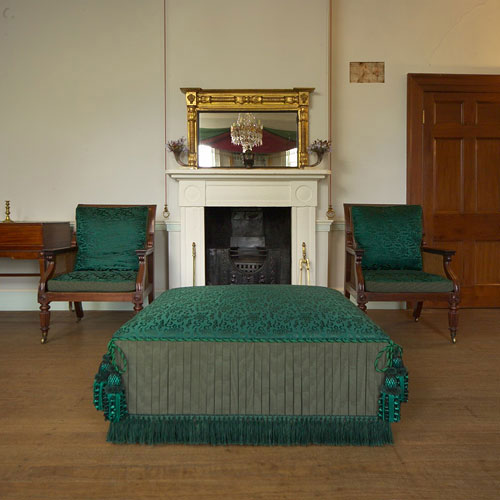
As to the house, my notes remind me that I was taken with a great square ottoman in the centre of one of the parlours.  It will have been comfortable seating and - if they were smart - fantastic storage.  I was also taken with the shutters in that same room (since the opening credits of Downton Abbey I always notice shutters).  Our guide showed us a hidden surface that indicated the former paint colour of the room.  Also, he pointed out that in summer the upper shutters were closed and the lower ones opened; it was the reverse in the winter.  I also took note of the ladies' sewing table with a central hole and a pouch hanging down.   The table in that personal sitting room - where Mrs. M would invite her close friends - had a pouch of bright red silk.


Source


Another item of note was a grandfather clock in the hall that chimed four o'clock as we passed.  Our guide paused, saying that in the four years he'd worked there he'd never before heard the clock chime.  I can't remember who made the clock but it was purchased new in the early 1800's for a huge price of £40; the same price for which James Ruse sold a house and 30 acres to John Harris about the same time. 

Meat safe (L) and ice box (R) at Como House


I may or may not have seen a 'meat safe' before (makes me think of a chicken coop), but I know I never before seen a 'sugar loaf'.  The one sitting in the kitchen was about a foot tall and the guide explained that smaller sugar loaves were involved in making a traditional German Christmas drink.

Source


I'm quite taken with these 'pouch tables'... They are 'only' about £2,250 on eBay....

Wednesday, 2 May 2012

Experimental Farm at Parramatta

One of the days out that Jane suggested to us was to visit Parramatta.  This involved a bus ride to the Circular Quay and a ferry ride to Neutral Bay.  I had given up on extra anti-histamine tablets and gone to decongestion tablets, thus I missed the sights on the way there and back, falling asleep almost the instant I sat.  After that day I broke the tablets in half so I could remain conscious.  Owing to my state of health, I took no photos of our trip to Parramatta, but Bill took a few. 


We were both amazed at the evidence of the impressive flooding everywhere around the dock.  Whilst I wasn't feeling particularly creative and enthusiastic, I did still enjoy the lovely warm weather and I remembered a great deal of our two tours. 


On the way to Parramatta we passed through Harris Park, where we ate the most amazing Middle Eastern fast food:  chicken and sausage kebabs, hoummus and tabbuleh salad.  I wished they'd open up something like that in the North East of England.

The oars are just decoration, but I wondered if they might be
 useful if the flooding had continued...


So what is Experimental Farm?  The First Fleet of convicts arrived in Sydney in 1788, one of whom was a man named James Ruse, from Cornwall, who has convicted of larceny (some silver and two watches valued at £5).  Ruse had served most of his sentence on a convict hulk on the River Thames, but was then transported to finish his sentence.  I learned a new vocabulary word:  'emancipist', referring to convicts who had finished serving their time and were free.  Prior to his crime and conviction, Ruse had been a farm labourer in Cornwall and the Governor of the colony, Governor Phillip had concerns about the burden of provisioning all the convicts and their keepers in this new land. 

As an experiment, in 1789, the Governor gave newly emancipated James Ruse 1 1/2 acres of land to farm, to see if it were possible for emancipists to become self-sufficient and if so how long it would take.  If Ruse was successful in this endeavor he would be given 30 acres to own and farm for himself and his family.  Ruse married Elizabeth Parry who came over on the Second Fleet and was the first woman emancipist there.  Within 18 months they were able to feed themselves from this plot of land and they were given their 30 acres.  It was only 'middling' quality soil according to Ruse.  He sold this 30 acres in 1793 to a Naval surgeon who arrived with the Second Fleet, named John Harris, and got more fertile land elsewhere, near the Hawkesbury River. 

Before we leave Ruse there was a story our tour guide told that I'm not finding elsewhere.  Apparently there was a Naval officer on the First Fleet who claimed to be the first footer on the shore from that journey.  However, in fact, he was carried ashore on the back of a convict - James Ruse.  This made Ruse in fact the first to step ashore and he was apparently proud of that.

Experimental Farm Cottage, built by John Harris


John Harris built the present building which we toured, in the Indian bungalow style.  Harris had his fingers in a lot of pies during his time in this area:  in addition to continuing to practice medicine, in 1800 he was made a magistrate and was in charge of the local police.  The following year he was appointed Naval Officer, putting him in charge of the Port of Sydney.  He later helped to found the Bank of New South Wales.  Through grants or purchase he amassed thousands of acres of land. 

In 1803 Harris was charged with 'disclosing to others the opinions of members of the court while acting as prosecutor' at a trial.  He escaped any penalties because the wording of the charge was in error, claiming his indiscretion had occurred on '19 ultimo' instead of '19 instant' - meaning the 19th of the previous month instead of the 19th of the current month.  This lucky escape amused him and he later named his home in Sydney 'Ultimo House' and the area around it came to be known by the same name.   I'm sure he was a very intelligent and industrious person and that the world was a much simpler place that might actually allow a single person to claim expertise in the fields of medicine, law and finance.  However, his amused use of the name Ultimo suggests to me he was a bit of a scamp. 

Harris died in 1839 without issue, leaving property valued at about £150,000.  His will left his property to be divided between his brothers for their lifetimes and then to any of their legitimate sons named John Harris.  Our tour guide indicated that when the heirs named John Harris ran out, the court allowed the terms of the will to be change, something I'd not realised could happen.  We were later to hear of another example of such activity around a will.

Never mind the people, what about the house?  I could happily live there; I think I could live anywhere with a veranda and warm weather...


The wood floors had gaps where the original oakum had dried out and fallen through.  There were French doors leading to the veranda from several of the rooms.  As with many early pioneer homes it was furnished simply and I noticed a lot of items hand made by volunteers.  I'd never before seen knitted 'penny jugs'.  The guide said that spare change was kept in such a little container for paying for deliveries and such.   He pointed out a trunk with a domed lid.  These were called 'first class' trunks because the arched lid prevented them from being at the bottom of a stack; they had to go on top.  There was a large knitted and stuffed ottoman next to a rocking chair.  Door stops were bricks covered with brocade.   There was a lovely hexagonal patchwork quilt on one of the beds. 

After the tour we were given directions to the next venue, having bought a double ticket.  We were told it was a 25 minute walk to Old Government House, but don't you believe it; it's closer to 45 minutes.  We were nearly turned away by the woman at the front desk as she thought the last guide had gone home.  Bless him, our guide at Experimental Farm (first name, Harley) happened to arrive by car just as we were leaving and he insisted that we either be refunded or that he would do the tour, but then the usual guide turned up having not left after all.  I'm glad it worked out that way, as I also enjoyed that second tour.

Of course, you don't have to make that 45 minute walk, you just have to wait for my next post...